

What Is a Helical Pile? How Helical Piers Work, Where They're Used and What They Cost
A plain-English guide to helical piles and screw piles: parts, how torque gives capacity, where they're used, pros and cons, code approvals and 2026 cost ranges.
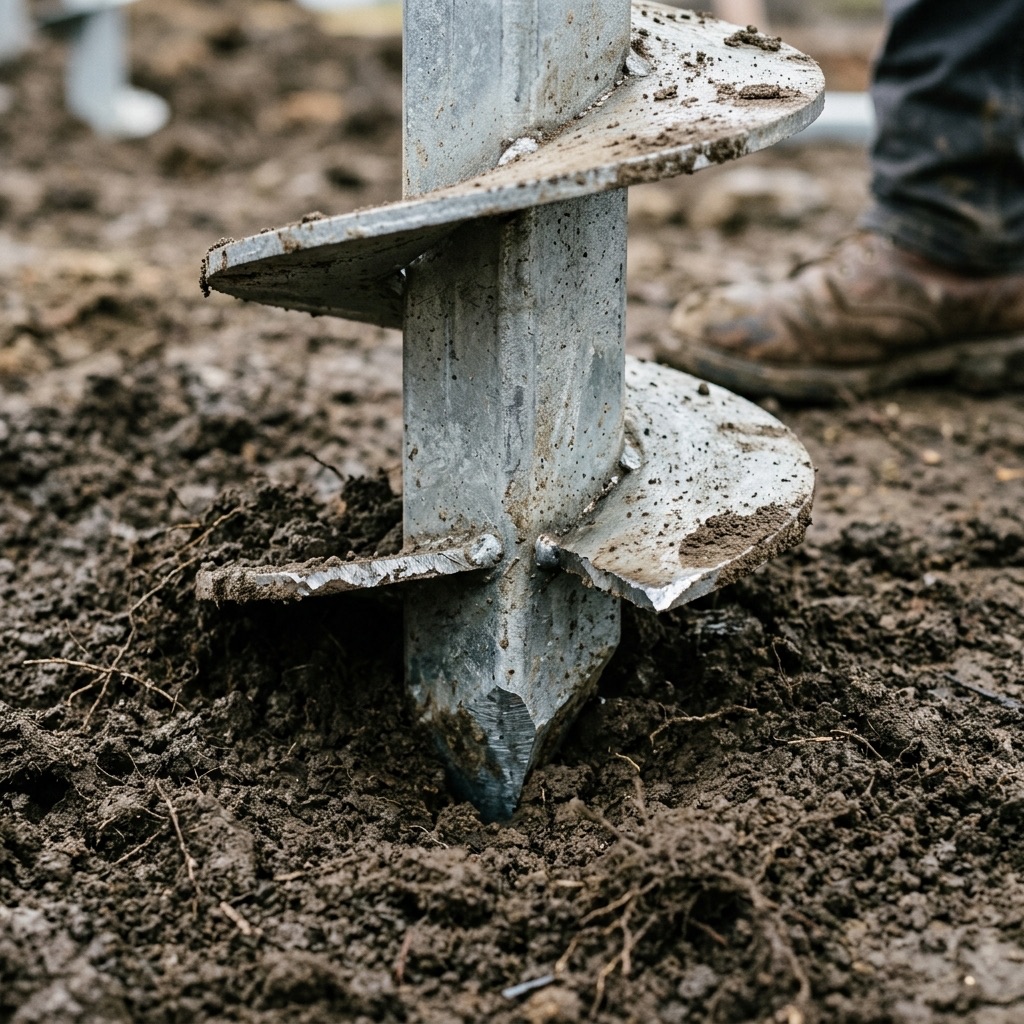

A helical pile is a steel foundation shaft with one or more spiral plates welded near the tip. It is screwed into the ground with a hydraulic motor until it reaches soil strong enough to carry the load. The torque needed to turn it at the final depth tells the installer how much the pile can hold. Helical piles (also called helical piers, helical anchors or, in Canada, screw piles) support decks, additions, homes, solar arrays and commercial buildings. They are also used to repair settling foundations. New-construction piles typically cost a few hundred dollars each installed, while foundation repair piers run $2,000 to $4,000 each.
Key takeaways
- What it is: a steel shaft, helix plates and a bracket or cap that connects the pile to the structure.
- How capacity is proven: installation torque is converted to capacity with the formula Qult = Kt × T, a method recognized by the International Building Code (IBC) and by the ICC-ES acceptance criteria AC358.
- Where it's used: decks, porches, additions, new homes, light commercial buildings, solar, towers, boardwalks and foundation underpinning.
- Main advantages: fast installation, small equipment, no concrete curing, immediate loading and little site disturbance.
- Main limits: cobbles, boulders and shallow rock can stop a pile, and heavy loads need larger, more expensive sizes.
- Cost: about $350 to $900 per pile for typical new construction and $2,000 to $4,000 per repair pier, based on published guides cited below.
What is a helical pile?
A helical pile is a manufactured deep foundation. Instead of digging a hole and filling it with concrete, the installer screws a steel shaft into the ground like a large wood screw. The helix plates pull the shaft downward as it turns. They also give it a wide bearing surface once it is in place. Loads from the structure travel down the shaft and into firmer soil below the weak, wet or frost-prone surface layers.
The idea is older than most people think. The Irish engineer Alexander Mitchell described screw piles in an 1848 paper, about a decade after he first used them, and screw-pile lighthouses were built along the U.S. east coast in the second half of the 1800s (Wikipedia). Modern helical piles grew out of the utility industry. The A.B. Chance Company began torque-correlation research in the late 1950s and early 1960s, and Hoyt and Clemence published the formal torque-to-capacity relationship in 1989 after studying load tests from 24 sites (Hubbell).
Helical pile, helical pier, screw pile: what's the difference?
Mostly regional habit. “Helical pier” is common in U.S. foundation repair. “Helical pile” is the engineering term used in the IBC and in evaluation reports. “Screw pile” is the everyday word in Canada, used by manufacturers such as Postech, GoliathTech and Almita. “Helical anchor” usually means an element designed to resist tension or uplift. Our guide to helical anchors vs. helical piles explains that difference in detail.
The parts of a helical pile
| Part | What it does | Typical specs |
|---|---|---|
| Lead section | The first section into the ground. It carries the helix plates and has a cut or pointed tip. | Lengths of about 3 to 10 feet, depending on the manufacturer |
| Shaft | Carries load from the structure down to the helix plates. | Solid square bar (about 1.5 to 2.25 in.) or hollow round pipe (about 1.875 to 12.75 in. or larger) |
| Helix plates | Pull the pile into the soil during installation and bear on the soil afterward. | Commonly 8 to 14 in. diameter, 3/8 to 1/2 in. thick, with a 3 in. pitch |
| Extensions | Bolted on to reach deeper bearing soil. They may be plain or carry extra helix plates. | Added one after another until depth and torque targets are met |
| Couplings and bolts | Join sections into one continuous pile. | Integral forged sleeves or welded couplers with through-bolts |
| Bracket or cap | Connects the pile to the structure. | New-construction caps, deck post saddles, or remedial repair brackets bolted to an existing footing |
Those helix and pitch figures are not arbitrary. For a system to use the standard torque correlation factors, AC358 requires helix plates 8 to 14 inches in diameter and 3/8 to 1/2 inch thick, a 3-inch pitch (plus or minus 1/4 inch), and helix spacing of 2.4 to 3.6 times the helix diameter (ICC-ES AC358, Table 3). For exact dimensions by manufacturer, see our helical pile shaft sizes chart.
Square shaft vs. round shaft
Square shafts are solid steel bars. CHANCE says they have the highest torque correlation factor of any shaft type and suit loads up to about 50 kips in firm soils, but they cannot resist significant lateral loads and may buckle in very soft soils. Round shafts are hollow pipe with higher section properties, so they handle lateral loads, soft soils and reversing loads better (Hubbell). Residential screw pile lines, such as those from Techno Metal Post and GoliathTech, start with round pipe under 2 inches in diameter and step up to 3.5 inches or more for heavier loads.
How does a helical pile work?
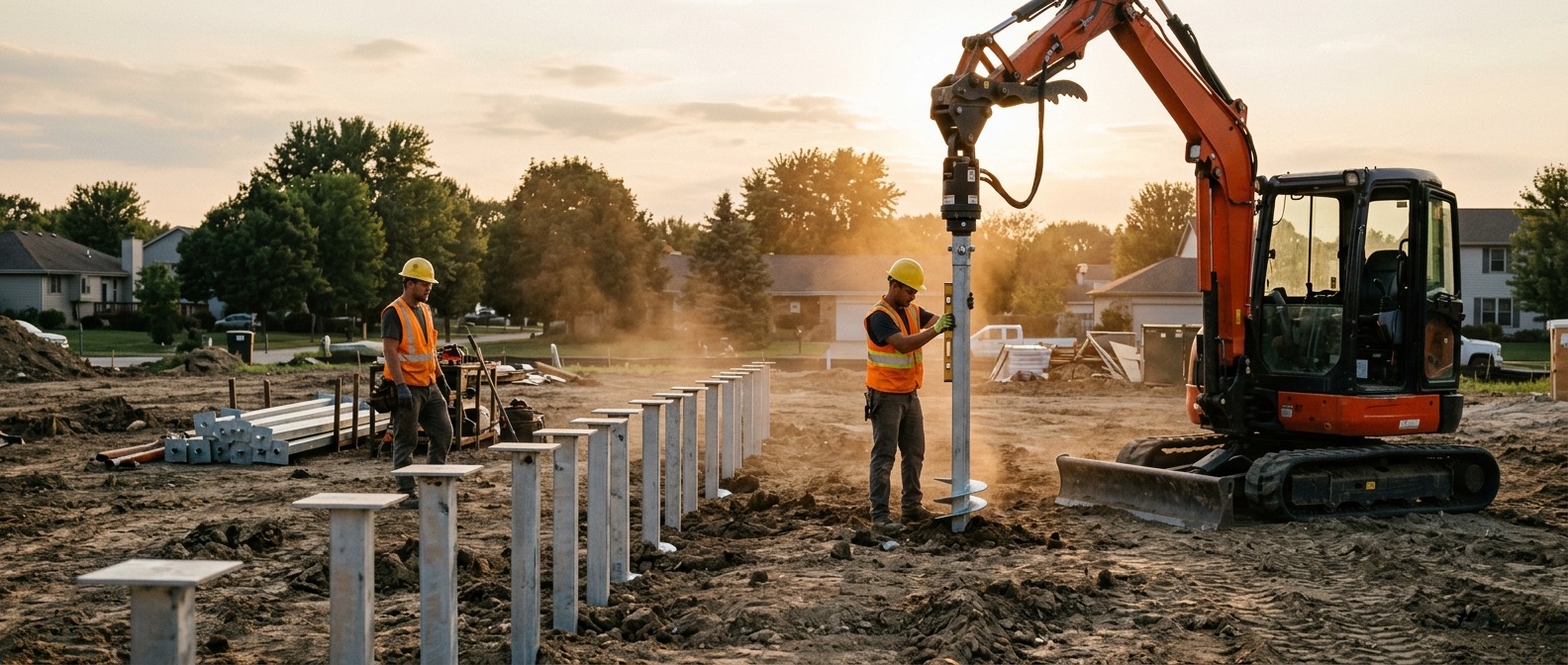
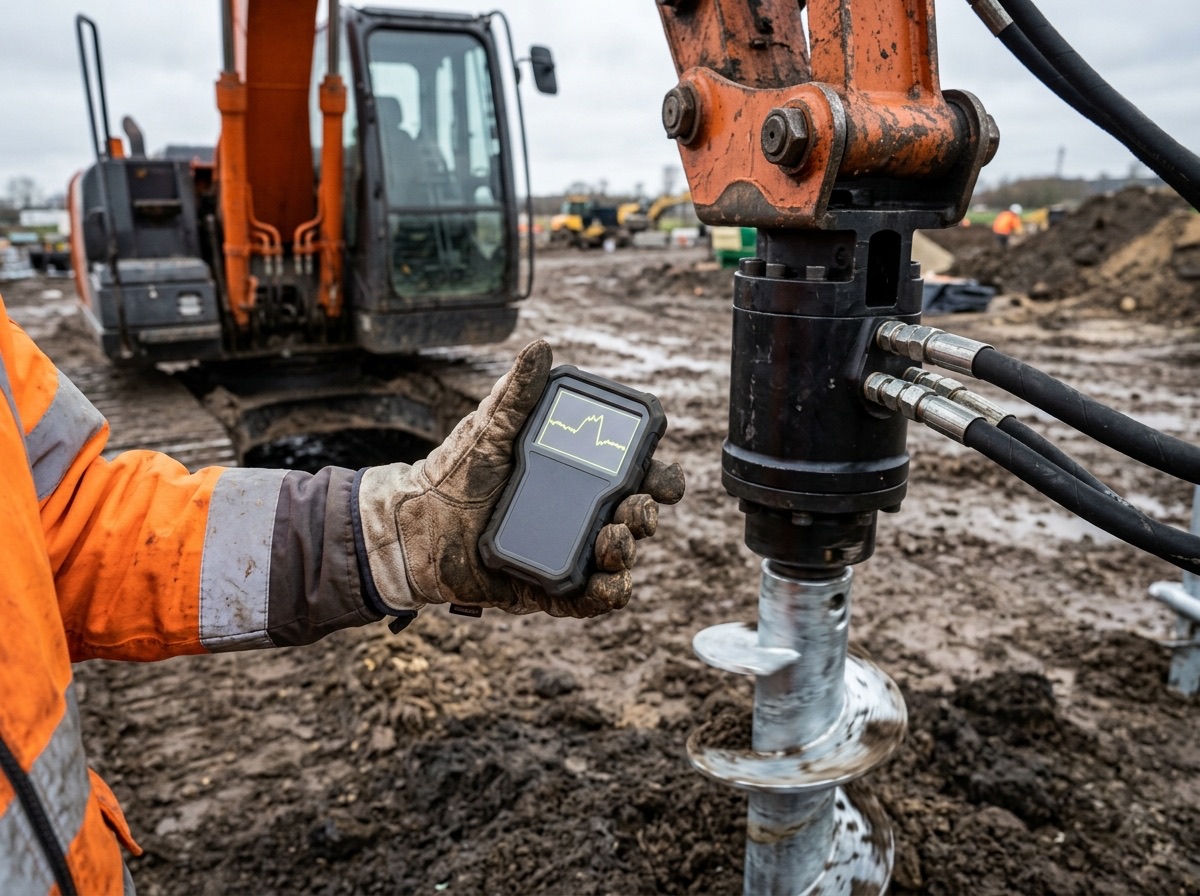
The installer mounts a hydraulic drive head on a skid steer, mini excavator or larger machine. The drive head turns the pile at low speed while pushing down just enough to keep it advancing about one helix pitch per revolution. As the helix plates bite into denser soil, the pile gets harder to turn and torque rises. Crews watch a torque indicator throughout the install and stop only when both the minimum depth and the minimum torque in the design are met.
Torque to capacity
The torque correlation is the reason helical piles can be verified pile by pile in the field. The ultimate capacity is estimated as:
Qult = Kt × T
where T is the final installation torque in foot-pounds and Kt is an empirical factor that gets smaller as the shaft gets larger. AC358 assigns these default values to conforming systems:
| Shaft size | Kt (ft-1) |
|---|---|
| 1.5 in. and 1.75 in. square | 10 |
| 2.875 in. round | 9 |
| 3.0 in. round | 8 |
| 3.5 in. round | 7 |
Source: ICC-ES AC358, Section 3.13.1.1. Other sizes must be verified by load tests, and their values are capped by a formula in the same section.
Worked example: a 2.875-inch round pile finished at 4,000 ft-lb of torque has an estimated ultimate capacity of 9 × 4,000 = 36,000 lb. With the factor of safety of 2 built into AC358, the allowable load is about 18,000 lb. The engineer works backward from the design load to set the required torque. The code allows capacity to be set by torque correlation, by bearing-capacity analysis or by load testing (IBC 1810.3.3.1.9). Torque is a good field check, but the research that created it warns it should not be the only design method (Hubbell). Our guide to how much weight a helical pile can hold goes further.
How deep do they go?
As deep as it takes to reach the design torque, and at least deep enough to clear frost and weak soil. CHANCE's rule of thumb is at least 5 times the largest helix diameter below the bottom of the foundation, or 3 times the diameter below the zone of seasonal soil change such as frost (Hubbell). See how deep helical piles go for typical ranges.
Where are helical piles used?
- Decks, porches and sunrooms. A very common residential use. See helical piles for decks.
- Additions and new homes, often tied into a grade beam or pile cap.
- Foundation repair and underpinning of settling houses. See helical piers for foundation repair and push piers vs. helical piers.
- Commercial and infill buildings, where vibration, noise or limited access rule out driven piles. Our news desk covered vibration-free helical underpinning of a Jersey City brick building.
- Solar farms, battery storage and utility structures, where uplift and fast installation matter. See the Cyntech large-diameter energy project.
- Tiebacks and anchors for retaining walls, towers and guy wires.
- Boardwalks, docks and sensitive sites, where a small machine footprint protects the ground.
Pros and cons of helical piles
| Advantages | Limitations |
|---|---|
| Installed in hours or days, with no concrete to cure, so framing can start right away | Cobbles, boulders, debris-filled fill and shallow bedrock can stop or deflect a pile |
| Capacity is checked on every pile through torque | Accuracy depends on calibrated torque equipment and a careful operator |
| Small machines fit side yards, backyards and basements | Heavy loads or very soft soils need larger shafts, more plates or grouted piles, which raises cost |
| Little spoil, noise or vibration | Steel needs a corrosion allowance or galvanizing in aggressive soils |
| Work in winter and in high groundwater | Not every contractor is certified on every system, and quality varies |
| Resist compression, tension and, with round shafts, some lateral load | Square shafts have limited lateral and buckling resistance |
Corrosion is manageable with good design. AC358 requires designers to subtract a sacrificial thickness over a 50-year design life: 0.013 inch for zinc-coated steel and 0.036 inch for bare steel (AC358, Section 3.9). Our article do helical piers rust? covers galvanizing and soil testing. For a head-to-head with concrete, read helical piles vs. concrete piers.
How much do helical piles cost?
Price depends mostly on the application, depth to bearing soil, shaft size and site access. Published ranges:
| Application | Typical installed cost | Source |
|---|---|---|
| Deck, porch or accessory structure | $350 to $700 per pile | Helical Anchors Inc. |
| Addition or light commercial new construction | $500 to $1,200 per pile | Helical Anchors Inc. |
| Marine, dock or boardwalk | $2,500 to $3,500 per pile | Helical Anchors Inc. |
| Foundation repair pier | About $3,000 per pier, $15,000 to $30,000 for a typical 5 to 10 pier job | Today's Homeowner |
| Structural engineer's inspection | $300 to $600 | Today's Homeowner |
| Soil report | $1,000 to $2,000 | Today's Homeowner |
Helical Anchors Inc. also notes that extensions beyond the quoted depth typically add $20 to $25 per linear foot, so depth is the biggest swing factor. Canadian screw pile prices are quoted in CAD and vary by province, so ask local installers. For state-by-state detail and what drives a quote, see our helical pier cost guide.
Are helical piles code-approved?
Yes. The IBC covers helical piles directly in Chapter 18 and requires special inspection of commercial installs. Under the International Residential Code, they are usually accepted as an approved alternative based on an ICC-ES evaluation report (ESR) issued under AC358, or on an engineer's design. For example, ESR-2794 covers CHANCE square and round shaft systems. In Canada, residential screw piles typically rely on Canadian Construction Materials Centre (CCMC) evaluations, such as CCMC 13691-R for Almita screw piles, and Techno Metal Post lists CCMC 13059-R in its spec book. Our guide to helical pile permits and building codes has the details.
How to get helical piles installed
Start with an installer who is certified by the manufacturer of the system they use, and who can show you the evaluation report and a sample torque log. Our step-by-step guide to helical pile installation shows what happens on site. How to hire a helical pile contractor lists the questions to ask. You can compare manufacturers such as CHANCE, Techno Metal Post and Magnum Piering on our manufacturer directory. Then find a helical pile installer in your state or province.
Frequently asked questions
What is a helical pile in simple terms?
It is a steel post with screw-like plates at the bottom. A machine screws it into the ground until it reaches firm soil, and then the structure is attached to the top.
How long do helical piles last?
They are designed as permanent foundations. Code-evaluated systems account for corrosion over a 50-year design life, and galvanizing adds protection in aggressive soils. Actual life depends on soil chemistry and coating.
Are helical piles better than concrete footings?
Often, for decks, additions, poor soils, tight access and cold weather, because they install quickly and are verified by torque. Concrete can be cheaper where good soil is shallow and access is easy.
Can helical piles be installed in rocky soil?
Scattered small stones are usually fine. Cobbles, boulders and shallow bedrock can stop a pile short of its target depth. Installers then relocate the pile, pre-drill or choose a different foundation type, subject to the engineer's approval.
Do helical piles need an engineer?
Commercial projects always do. For residential work it depends on the building department. Many accept a manufacturer's evaluation report for decks and small structures, while additions and foundation repair usually need an engineer's letter or stamped design.
Is a screw pile the same as a helical pile?
Yes. “Screw pile” is the common Canadian and U.K. term for the same kind of foundation. Some ground screws are formed differently, but they work on the same principle.
Subscribe to our weekly email newsletter
Industry news, featured projects, new products, and installer spotlights from across the helical pile industry, delivered to your inbox.


Latest articles

Get the Helical Pile Industry Brief
New installers, manufacturer news, cost updates, and fresh guides for the U.S. and Canadian helical pile industry. Short, occasional emails. Unsubscribe any time.
