

Helical Piers for Sale: Where to Buy Helical Piles and Suppliers
Where to buy helical piers and piles: dealers, distributors, online suppliers and retail kits, what to specify, material prices and top manufacturers.

You can buy helical piers from three places: a manufacturer's regional distributor or authorized dealer, an online supplier that ships pile sections to your door, or a big-box store that stocks small screw-in deck footings. Structural piles from the major brands (CHANCE, Magnum, Supportworks, Ram Jack, IDEAL and others) are sold mainly to trained contractors, so most homeowners buy them as part of an installed job. Expect roughly $300 to $1,000 of steel inside a typical foundation repair pier, and under $150 for a retail deck footing kit.
Key takeaways
- Main channel: Most manufacturers sell through distributors, dealer networks or franchised installers rather than to the public.
- Homeowner options: Light-duty screw footings are sold online and in home improvement stores, but they are not the same product as an engineered helical pile.
- What to specify: Shaft size and wall thickness, helix count and diameter, hot-dip galvanizing, the right bracket or cap, and a current ICC-ES evaluation report.
- Material price: Online lead sections start near $290 and extensions near $190, while material is about 15 to 25 percent of an installed repair pier.
- Why installers control sales: Capacity is verified from installation torque, and some evaluation reports require the manufacturer's certified installers.
Where to buy helical piles and piers
Where you buy depends on what you are building and who is doing the work. Here are the four routes, from most common to least.
1. Manufacturer distributors and dealer networks
This is how the large majority of structural helical piles change hands. A manufacturer ships steel to regional distributors or to authorized dealers, who stock leads, extensions and brackets, provide engineering support and train installers. CHANCE, for example, sells through a distributor network that also connects buyers with its certified installers. Supportworks, Ram Jack, Techno Metal Post, Postech and GoliathTech rely on dealer or franchise networks, where the company that sells you the pile is also the company that installs it.
If you are a contractor, call the distributor or dealer for your region and ask about opening an account and getting certified. If you are a homeowner or developer, the distributor will usually refer you to a local installer.
2. Independent online suppliers
A handful of suppliers sell pile sections directly online. MilSpec Anchors lists a 5-foot square-shaft lead with an 8, 10 or 12 inch helix at $289.99, with 5-foot extensions at $192.55 and 7-foot extensions at $225.55. Brackets and larger round-shaft piers are quoted by phone. Buying this way makes sense for experienced contractors who own a drive head and torque monitoring, but check whether the product carries an ICC-ES report before your engineer specifies it.
3. Building supply and big-box stores
Home improvement chains stock short, lightweight screw-in footings for decks, sheds and patios. These are usually a small steel tube with a single helix and a post saddle, driven with a large impact wrench and an adapter. They are useful for light ground-level structures, but they are a different class of product from a 2-7/8 inch engineered pile. Your local building department decides whether they are acceptable for a permitted deck, so ask before you buy.
4. Self-install kits online
Some suppliers sell complete DIY kits. Nolan Structural Products sells a 24-inch non-frost-protected kit from $74.99 and a 56-inch frost-protected kit from $149.99, plus a $32.99 socket bundle and an $11.99 adapter for hand installation. Our guide to DIY helical piles explains where these kits make sense and where they do not.
Major helical pile manufacturers and how they sell
The table below covers the larger manufacturers active in the U.S. and Canada. An ICC-ES evaluation report (ESR) shows that a product line was reviewed for compliance with the International Building Code, and inspectors and engineers often ask for it. Where we did not confirm a report number, ask the dealer for the current report or Canadian evaluation. Browse all profiles in our helical pile manufacturers directory.
| Manufacturer | Headquarters | How it sells | ICC-ES report |
|---|---|---|---|
| CHANCE (Hubbell) | Centralia, Missouri | Regional distributors, installed by CHANCE certified installers | ESR-2794 |
| Magnum Piering | Cincinnati, Ohio area | Sold to contractors and installers | ESR-2997 |
| Foundation Supportworks | Papillion, Nebraska | Independent authorized dealer network | ESR-3074 |
| Ram Jack | Ada, Oklahoma | Dealer and installer network | ESR-1854 |
| IDEAL Foundation Systems | Webster, New York | Regional distributors | ESR-3750 |
| Earth Contact Products | Olathe, Kansas | Installing contractors | ESR-3559 |
| GoliathTech | Magog, Quebec | Franchised certified installers | ESR-3726 |
| Techno Metal Post | Quebec | Dealer network | Ask dealer |
| Postech | Sherbrooke, Quebec | Certified dealer network | Ask dealer |
| Grip-Tite | Iowa | Certified dealers | Ask dealer |
| Almita | Alberta | Direct and through dealers | Ask manufacturer |
Can homeowners buy helical piles?
Yes, but with limits. Anyone can order retail deck footings or a self-install kit, and a few online suppliers will sell structural sections to the public. What you generally cannot do is walk into a major brand's distributor and buy an engineered pile system for a house without a contractor. Many dealers only sell installed work, and franchise networks exist precisely so the brand controls installation.
For a shed, fence or low deck, buying a retail product can be reasonable. For foundation repair, a home addition, or anything an inspector will review, buy the work from an installer. Our guide on helical pile permits and building codes covers what inspectors typically ask for.
What to specify when buying helical piles
Whether you are a contractor ordering steel or a homeowner comparing quotes, these are the details that decide what you are actually getting.
Shaft size and wall thickness
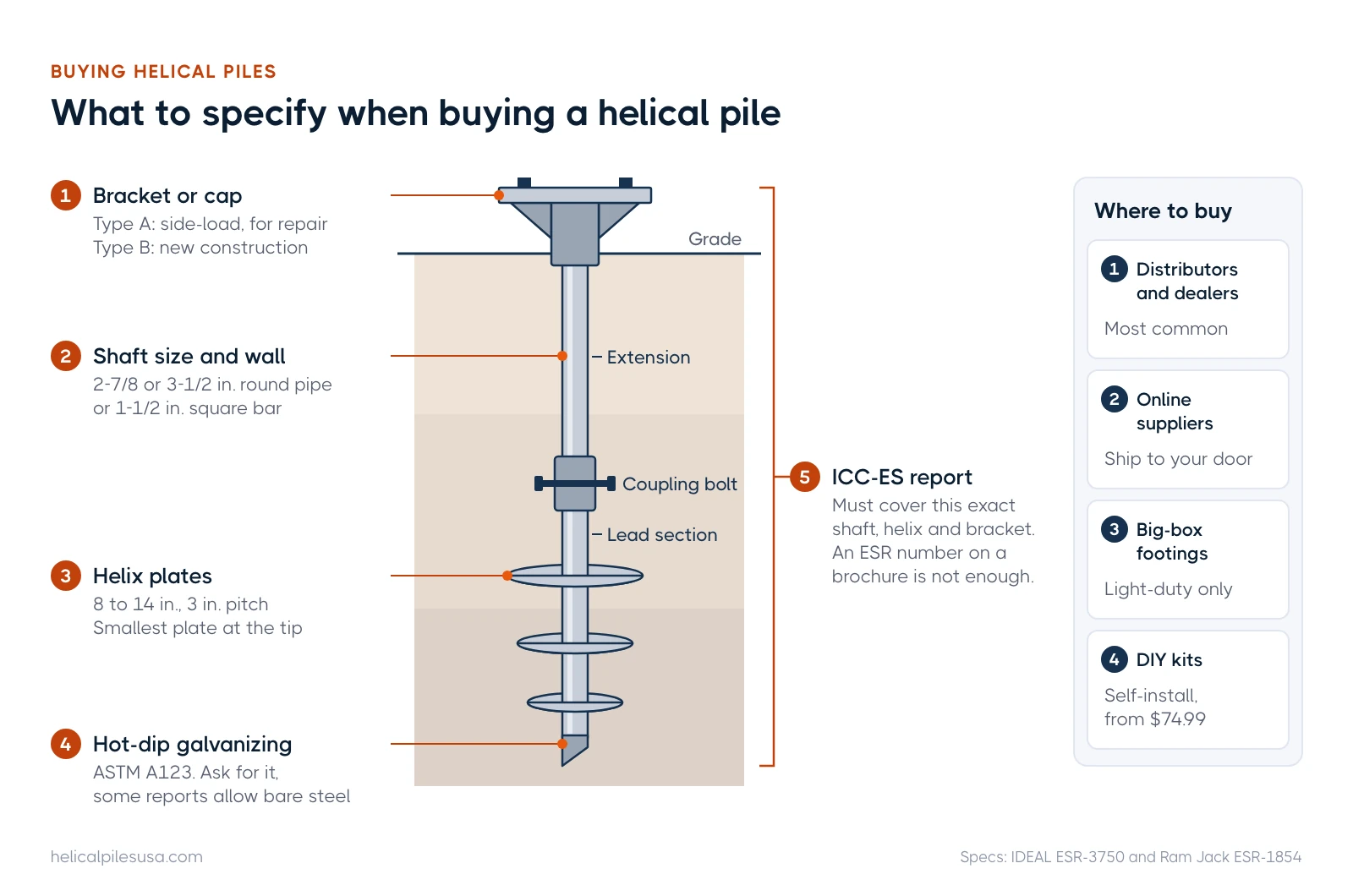
Residential and light commercial piles commonly use 1-1/2 inch solid square bar or 2-7/8 and 3-1/2 inch round pipe. In IDEAL's evaluation report, the 2-7/8 inch shaft comes in 0.203 or 0.276 inch wall, the 3-1/2 inch shaft in 0.216 or 0.300 inch wall, and sections run from 2.5 to 20 feet long. Square shafts drive well in dense soil and carry compression and tension; round shafts resist bending and lateral load better. See our helical pile shaft sizes chart for a side-by-side comparison.
Helix configuration
Ask for the number of helix plates, their diameters and thickness. The IDEAL report lists 8, 10, 12 and 14 inch plates with a 3-inch pitch, spaced three helix diameters apart, with the smallest plate at the tip. Ram Jack's ESR-1854 uses the same 8 to 14 inch range on 2-7/8 or 3-1/2 inch pipe. More or larger plates add bearing area in softer soil.
Corrosion protection
Specify hot-dip galvanizing. Several reports allow bare or galvanized steel, so this is something you must request. IDEAL references ASTM A123 for shafts and brackets, and the CHANCE report calls for ASTM A153 coating on hardware. Our article do helical piers rust? explains when bare steel is acceptable.
Evaluation report coverage
An ESR number on a brochure is not enough. Confirm that the exact shaft, helix and bracket you are buying appear in the current report. Magnum's ESR-2997, for example, lists specific pile models along with the caps and brackets covered, and Earth Contact Products' ESR-3559 names its TA-150 and TA-288 lines among others.
Brackets and caps
The top connection matters as much as the pile. Repair work uses side-load (Type A) brackets bolted to an existing footing, and new construction uses direct-load (Type B) brackets or caps cast into a footing, pile cap or grade beam. Deck and post jobs use saddles or plates sized for the post. Make sure the bracket is rated for the load and covered by the same report as the pile.
Helical pile prices: material vs installed
Material is only part of what you pay. On foundation repair piers, material typically makes up 15 to 25 percent of the installed price, and installed repair piers run $2,000 to $4,000 each. That puts the steel in a repair pier at roughly $300 to $1,000.
| Item | Typical price | Source |
|---|---|---|
| Retail self-install footing kit (24 to 56 in.) | $74.99 to $149.99 | Nolan Structural Products |
| 5 ft square-shaft lead section | $289.99 | MilSpec Anchors |
| 5 ft or 7 ft extension | $192.55 or $225.55 | MilSpec Anchors |
| Installed pile, deck or porch | $350 to $700 | Helical Anchors Inc. |
| Installed pile, addition or light commercial | $500 to $1,200 | Helical Anchors Inc. |
| Installed foundation repair pier | $2,000 to $4,000 | Helical Anchors Inc. |
| Added depth beyond quoted length | $20 to $25 per foot | Helical Anchors Inc. |
Using the online prices above, a 12-foot pile built from a 5-foot lead and a 7-foot extension costs about $516 in steel before brackets, freight and tax. Distributor pricing for contractors varies by volume and region and is rarely published. For a fuller breakdown, read our helical pier cost guide.
Why most manufacturers sell only through certified installers
A helical pile's capacity is not fully known until it is in the ground. Installers record the final installation torque, and the evaluation reports convert that torque into capacity using a published correlation factor, then apply a factor of safety of 2. That only works if the installer uses calibrated equipment, the right drive head and the correct procedure. Our installation process guide walks through those steps.
Some reports make this a condition of approval. The CHANCE report states that its systems must be installed by Hubbell-trained and certified installers, with at least one certified crew member on site. Other brands reach the same result through dealer agreements or franchising, which also protects their warranties and their reputation. For the buyer, the practical effect is simple: when you buy a branded pile, you are usually buying a trained crew with it.
Find a helical pile supplier or installer near you
The fastest way to buy helical piers for a real structure is to get quotes from local installers who carry an evaluated product. You can find a helical pile installer in your state or province in our directory, then use our checklist on how to hire a helical pile contractor to compare them. Ask each one which manufacturer they buy from, request the ESR number, and confirm the shaft size, helix configuration, galvanizing and bracket type in writing.
Frequently asked questions
Does Home Depot or Lowe's sell helical piles?
They stock small screw-in footings for decks, sheds and patios. They do not carry engineered helical pile systems for foundation repair or new home foundations, which come through manufacturer distributors and dealers.
Can I buy CHANCE or Supportworks piles directly?
Usually not as a homeowner. CHANCE sells through regional distributors and Supportworks through authorized dealers, and both typically route homeowners to a trained installer.
How much does a helical pile cost without installation?
Online lead sections start around $290 and extensions around $190 to $230, so a 10 to 12 foot pile is roughly $480 to $520 in steel. Retail DIY footing kits cost $75 to $150.
What is an ICC-ES evaluation report?
It is a third-party review showing that a specific helical pile system meets International Building Code requirements. Building officials and engineers use the ESR number to check approved capacities and components.
Are cheaper imported helical piles worth buying?
Only if they come with mill certifications, galvanizing records and an evaluation your engineer and building department will accept. Without that paperwork, an inspector may reject them.
Do I need a permit if I buy and install piles myself?
Often yes, especially for decks attached to a house and any foundation work. Check with your local building department before ordering material.
Subscribe to our weekly email newsletter
Industry news, featured projects, new products, and installer spotlights from across the helical pile industry, delivered to your inbox.


Latest articles

Get the Helical Pile Industry Brief
New installers, manufacturer news, cost updates, and fresh guides for the U.S. and Canadian helical pile industry. Short, occasional emails. Unsubscribe any time.
