

Screw Piles: What They Are, Uses, Cost, Pros and Cons
Screw piles explained: the Canadian and UK name for helical piles, how they differ from ground screws, uses, installed costs, pros and cons, and frost.
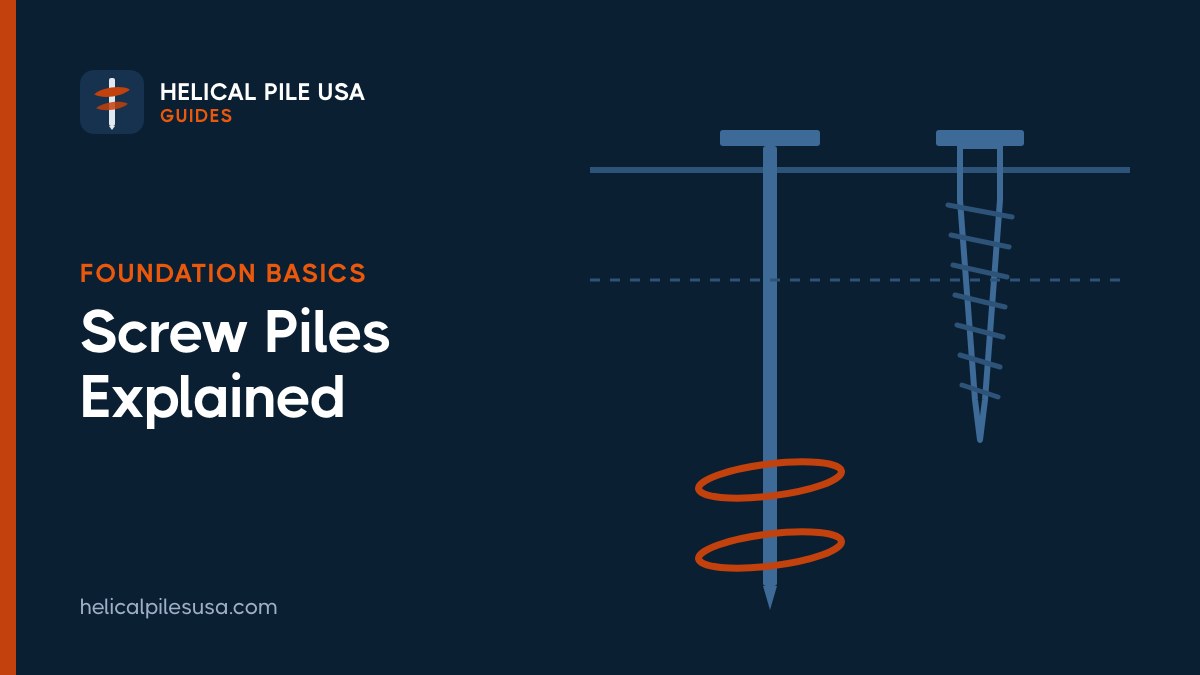

A screw pile is a steel shaft with one or more helical plates welded near the tip that is screwed into the ground to carry a building, deck or other structure. "Screw pile" is simply the name Canadians, Britons and Australians most often use for what Americans call a helical pile or helical pier, so the two terms describe the same product. A ground screw is a lighter cousin with a continuous thread along a tapered tube, meant for fences, small sheds and similar light loads. Installed screw piles commonly run a few hundred dollars each for decks and sheds and climb into the thousands for foundation repair.
Key takeaways
- Same thing, different name: Screw pile, helical pile and helical pier all mean a steel shaft with helix plates; regional habit decides which word you hear.
- Ground screws are not the same: They carry load mostly through friction along a continuous thread and suit light, non-critical structures, while screw piles bear on their helix plates.
- Typical cost: One 2026 U.S. guide puts decks, porches and accessory structures at $350 to $700 per pile and foundation repair at $2,000 to $4,000 per pier.
- Frost friendly: Helix plates set below the frost line anchor the pile against frost jacking, which is why screw piles are common across Canada and in permafrost regions.
- Wide range of uses: Homes, additions, decks, sheds, pole barns, cottages and solar arrays all sit on screw piles.
- Choose on proof: Hire an installer who records installation torque, works from engineered drawings and uses evaluated products.
What is a screw pile?
A screw pile has three parts: a round or square steel shaft, one or more helix plates (flat spiral blades) welded near the lead end, and a bracket or cap on top that connects to the structure. A hydraulic drive head turns the pile into the soil and the plates pull it down like a wood screw. Once the plates reach firm soil, they carry the load in end bearing, much like a small footing buried deep underground. Our guide on what a helical pile is covers the parts and engineering in more depth.
Screw pile vs helical pile: why two names?
The names describe the same foundation. "Helical" refers to the spiral shape of the plates, while "screw" describes how the pile is installed. In the United States, contractors and building codes mostly say helical pile or helical pier. In Canada the word screw pile is everywhere; the City of Winnipeg housing bulletin on these foundations notes that augured piles are also called screw piles and helical piles, and Canadian manufacturers such as Techno Metal Post use the two terms interchangeably. Screw pile is also the everyday term in the UK.
Ground screws: the lighter cousin
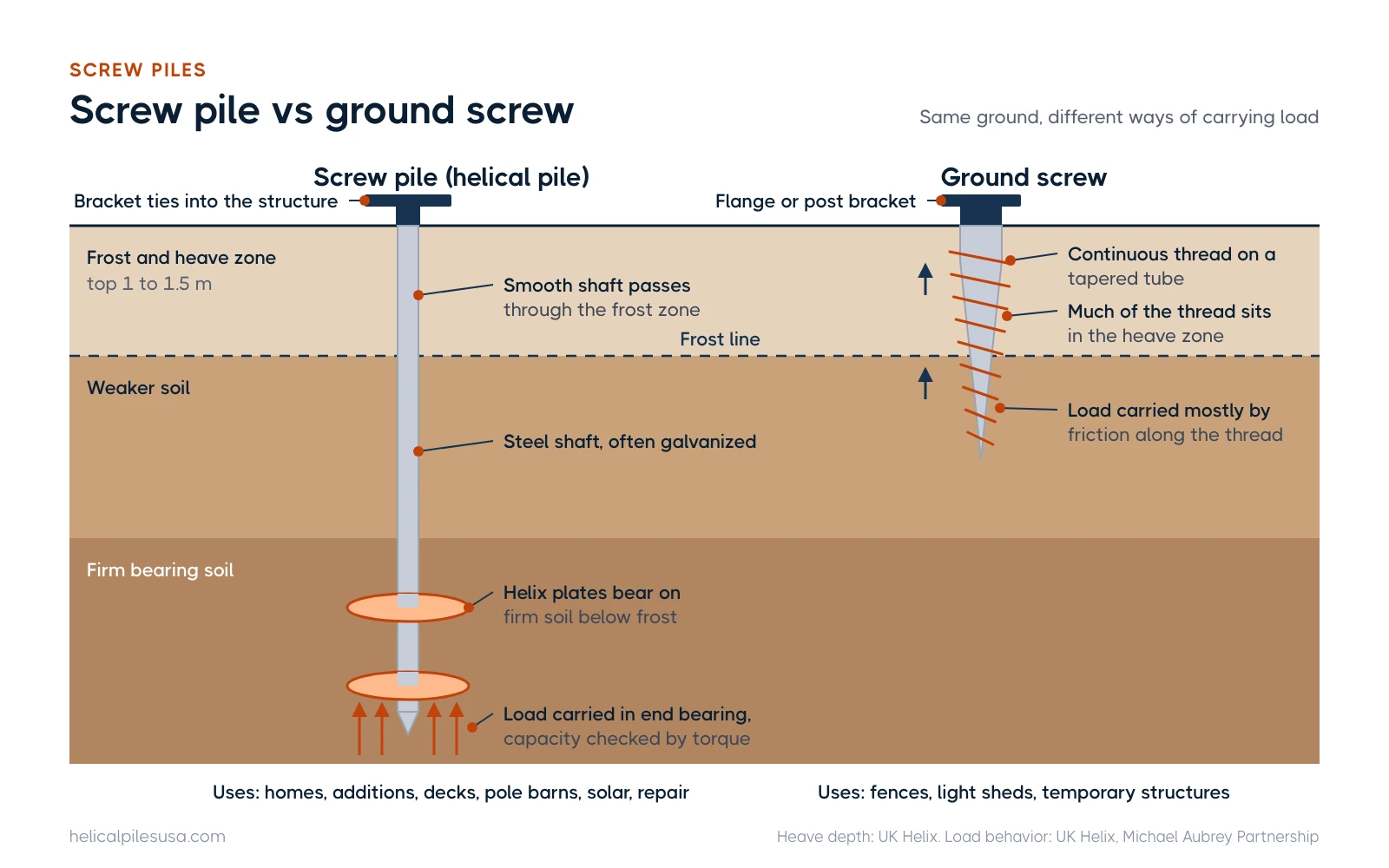
A ground screw looks different. Instead of discrete plates on a straight shaft, it has a continuous thread wrapped around a tapered tube that ends in a point. UK installer UK Helix explains that ground screws carry load through friction between the thread and the surrounding soil, while screw piles carry load mainly on the helix plate at the end. By its rough estimate, nine helical piles do the work of about 20 ground screws for a small to medium garden room. A UK structural engineering firm, Michael Aubrey Partnership, adds that ground screws are usually picked from standard manufacturer data with no capacity check during installation, whereas helical piles are designed for the specific structure and soil and verified by installation torque.
| Feature | Screw pile | Helical pile | Ground screw |
|---|---|---|---|
| Where the name is common | Canada, UK, Australia | United States | Everywhere, often sold for DIY |
| Shape | Straight shaft with one or more helix plates | Same as a screw pile | Tapered tube with a continuous thread |
| How it carries load | End bearing on the helix plates | Same as a screw pile | Mostly friction along the thread |
| Capacity check | Installation torque, recorded per pile | Same as a screw pile | Usually assumed from catalog data |
| Typical installer | Trained crew with hydraulic drive head | Same as a screw pile | Homeowner or light equipment |
| Typical uses | Homes, additions, decks, pole barns, solar, repair | Same as a screw pile | Fences, light sheds, temporary structures |
| Frost behavior | Plates set below frost line resist jacking | Same as a screw pile | Thread in the frost zone is exposed to heave |
What screw piles are used for
Screw piles cover almost every light to medium structure that needs a foundation, and many heavy ones. Common uses include:
- Homes and additions: New houses, sunrooms, mudrooms and one-storey additions where a full basement is not needed or access for a concrete truck is poor.
- Decks and porches: The biggest residential market. See our guide to helical piles for decks for spacing and sizing.
- Sheds and garages: Piles level a shed on sloped or soft ground with no slab to pour.
- Pole barns: A pile with a column bracket replaces the concrete-filled post hole.
- Cottages and cabins: Remote lots, lakefront sites and frozen ground suit a foundation installed in a day with small equipment.
- Solar arrays: Piles resist wind uplift on ground mounts and solar farms, covered in our guide to helical piles for solar.
- Foundation repair: Piles with retrofit brackets lift and stabilize settling foundations, explained in helical piers for foundation repair.
Screw piles for sheds
A shed is light, so it is the one job where a homeowner can reasonably consider DIY. A plain-language shed foundation guide estimates about $40 for a 50 inch Pylex screw pile, so ten piles cost about $400 plus tax, compared with at least $200 per pile for a contractor-installed pile that is longer and wider. It quotes roughly 6,000 lb per Pylex pile in sand and 4,000 lb in clay. Read our Pylex helical piles and DIY helical piles guides before buying a hand-driven product.
Screw piles for pole barns
Post-frame buildings normally set wood columns in concrete-filled holes. A screw pile with a column bracket removes the concrete from the hole entirely. Hansen Pole Buildings' Pole Barn Guru estimates screw piles add about $200 per column location, need a special attachment for a skid loader, and use the same building engineering as wet-set brackets in concrete piers. The column-to-pile connection has historically been the weak point, so ask to see the bracket detail.
How much do screw piles cost?
Price depends on pile count, size, depth to firm soil, access, and whether the job is new work or repair (repair needs excavation and retrofit brackets). Helical Anchors Inc. says extensions beyond the quoted depth usually add $20 to $25 per linear foot, and that material is only 15% to 25% of a repair pier's cost. Canadian prices from Screw Piles Quotes run $300 to $600 CAD per pile, with Ontario and Quebec at the low end and Alberta and British Columbia at the high end.
| Project | Typical installed cost | Source |
|---|---|---|
| Shed, DIY with 10 small piles | About $400 in piles | Shed foundation guide |
| Shed, contractor installed | At least $200 per pile | Shed foundation guide |
| Deck, porch or accessory structure | $350 to $700 per pile (USD) | Helical Anchors Inc. |
| Standard residential deck, 6 to 10 piles | $1,500 to $4,500 total | Postech |
| Small deck, 4 to 6 piles | $2,000 to $3,500 CAD total | Screw Piles Quotes |
| Pole barn | About $200 extra per column vs concrete | Hansen Pole Buildings |
| Addition or light commercial | $500 to $1,200 per pile (USD) | Helical Anchors Inc. |
| Home addition | $9,000 to $15,000 CAD total | Screw Piles Quotes |
| Custom home foundation | $16,000 to $25,000 CAD total | Screw Piles Quotes |
| Foundation repair | $2,000 to $4,000 per pier (USD) | Helical Anchors Inc. |
| Full underpinning, 5 to 10 piers | $15,000 to $30,000 total (USD) | Helical Anchors Inc. |
For deck pricing, Postech puts a standard residential deck on 6 to 10 piles at $1,500 to $4,500 installed. For a detailed U.S. breakdown, including how per-pier prices change with depth and load, see our helical pier cost guide.
Pros and cons of screw pile foundations
Advantages
- No curing time: Piles take load as soon as they are installed, so framing can start the same day.
- Year-round installation: Techno Metal Post notes its piles can be installed in any season, including frozen ground where concrete work stalls.
- Verified capacity: Installation torque correlates to capacity, so every pile is checked as it goes in rather than assumed.
- Small footprint: No large excavation or concrete trucks on tight lots.
- Removable: Piles can be unscrewed and reused or recycled when a temporary structure or solar array comes out.
Disadvantages
- Upfront cost: On easy, accessible sites a few poured footings can be cheaper for a small deck or shed.
- Rock and cobbles: Boulders and shallow bedrock can stop a pile short; see helical piles in rocky soil.
- Specialized equipment: Proper installation needs a calibrated drive head and a trained operator, which limits true DIY to small, light jobs.
- Corrosion: Aggressive soils call for galvanized steel or a larger shaft; our guide on whether helical piers rust explains the options.
- Product confusion: Cheap ground screws are sometimes sold as screw piles and used for loads they were never designed to carry.
Screw piles in frost and permafrost
Frost is the main reason screw piles are so common in Canada. When wet soil freezes, it grips anything passing through it and lifts, a process called frost jacking. A screw pile works differently because its helix plates sit below the frost line in soil that does not freeze, where they act as an anchor against the upward pull. UK Helix notes that seasonal heave typically happens in the top 1 to 1.5 m of soil, and that a screw pile's end plate almost always sits below that zone, while a ground screw's load-carrying thread runs through it.
Building officials expect this to be designed, not assumed. Winnipeg's bulletin requires engineered piles to be installed below frost depth or otherwise address frost jacking, and it treats multiple helix plates as adding together for end bearing. It also sets a line at 5,000 lb per pile: decks larger than 300 sq ft or loaded beyond 5,000 lb per pile need sealed engineering plans. Our guide on how deep helical piles go covers frost depths by region.
In permafrost, the advantage is larger. A 2024 review of foundations in northern Canadian permafrost published in Geotechnics worked a design example for a 75 kN (about 16,900 lb) axial load in permafrost at minus 1.5 °C over a 50-year design life. It found a 12 m steel pipe pile or a 7 m screw pile would be needed, so the helices cut the required length by about 40%. The same review cautions that climate warming can speed up long-term creep settlement of piles in permafrost, so northern designs need site-specific ground temperature data.
How to choose a screw pile installer
The pile is only as good as the installation. When you compare quotes, check that the installer:
- Records torque for every pile: Ask for an installation log showing final torque and depth, which is how capacity is confirmed.
- Works from engineered drawings: Larger decks, additions and homes need sealed plans that name the pile model and capacity.
- Uses evaluated products: In Canada look for a CCMC evaluation number; in the U.S. look for an ICC-ES evaluation under AC358, explained in our permits and building codes guide.
- Quotes the depth assumption: A clear per-foot extension price avoids surprises if firm soil is deeper than expected.
Our checklist on how to hire a helical pile contractor lists questions to ask, and you can find a helical pile installer in your state or province in our directory.
Frequently asked questions
Are screw piles and helical piles the same thing?
Yes. Both terms describe a steel shaft with helix plates that is screwed into the ground; screw pile is the common term in Canada, the UK and Australia, while helical pile or helical pier is more common in the United States.
Are screw piles better than concrete?
They are faster, need no curing time, can go in during winter and confirm capacity through torque, but a few concrete footings can cost less on easy, accessible sites. Our comparison of helical piles and concrete weighs the tradeoffs.
How long do screw piles last?
Galvanized screw piles in typical soils are expected to last for decades, and corrosive soils are handled with heavier zinc coatings or thicker shafts. Ask the installer for a soil-specific corrosion assessment on larger projects.
Can I use ground screws instead of screw piles for a shed?
For a small, light garden shed, ground screws can work in suitable soil. For a heavier shed, a garage or anything that needs a permit, use engineered screw piles installed to torque.
How many screw piles does a deck need?
A typical residential deck uses 6 to 10 piles, depending on its size, height, beam layout and soil. See how far apart helical piers need to be for spacing rules.
Subscribe to our weekly email newsletter
Industry news, featured projects, new products, and installer spotlights from across the helical pile industry, delivered to your inbox.


Latest articles

Get the Helical Pile Industry Brief
New installers, manufacturer news, cost updates, and fresh guides for the U.S. and Canadian helical pile industry. Short, occasional emails. Unsubscribe any time.
