

DIY Helical Piles: Can You Install Them Yourself?
Can you install helical piles yourself? What DIY screw piles can handle, real rental and kit costs, torque, permits, and when to hire a professional.

Yes, you can install some helical piles yourself, but only small ones carrying light loads. Hand-installed ground screws for sheds, fences, pergolas and small ground-level decks are realistic DIY projects, and a confident owner can rent a mini excavator with a hydraulic drive head for bigger post work. Anything that needs verified capacity, an inspected permit or support for an existing house (foundation repair) belongs with a trained installer who monitors torque and stands behind a warranty.
Key takeaways
- What works for DIY: Short, hand-driven helical footings for sheds, fences, pergolas and low decks, installed with a heavy impact driver or a manual bar.
- What does not: Foundation repair, home additions, heavy loads, and any job where an inspector or engineer needs a documented capacity.
- Torque is the test: Pile capacity is estimated from final installation torque, and homeowners rarely have calibrated gauges to measure it.
- Costs: Self-install kits start under $100 per footing, while a rented mini excavator runs roughly $200 to $350 per day before attachments and delivery.
- Warranty: Major brands tie their warranties to certified installers, so a DIY install usually has no product warranty.
- Call before you dig: Contact 811 in the U.S. or use Click Before You Dig in Canada for every project, even a single fence post.
What DIY can realistically handle
Most "DIY helical piles" are really light-duty ground screws: a short steel shaft with one helix and a bracket on top. They are designed for structures where a slightly settled post is an annoyance, not a safety problem. If you are new to the product, start with our guide to what a helical pile is and how it differs from a commercial-grade pile.
Hand-installed ground screws
These are the most common DIY screw piles. Retail kits for 4x4 and 6x6 posts come in short and frost-depth lengths. Nolan Structural Products sells self-install kits starting at $74.99 for a 24-inch non-frost pier and $149.99 for a 56-inch frost-protected pier, driven with an impact driver and a socket adapter. Buyers on that page note that a standard cordless impact may struggle, so plan on a high-torque corded or heavy-duty tool. Good uses include:
- Garden sheds and small storage buildings
- Fence and gate posts
- Pergolas and shade structures (check wind uplift)
- Low, freestanding platform decks that are not attached to the house
- Boardwalks, hot tub steps and other light outdoor features
Renting a drive head on a mini excavator
The next step up is a hydraulic drive head mounted on a rented machine. According to CHANCE (Hubbell), mini excavators suit jobs needing less than 15,000 ft-lb of torque, and the machine's weight is what resists that torque. The same article stresses that results depend on the operator. An Ontario rental guide says residential drive heads deliver 5,000 to 12,000 ft-lb and suggests hiring an experienced operator for a few hours if you have never run hydraulic attachments. This route can install real piles for a large deck or cabin, but it also takes you into the territory where permits and capacity checks apply.
What DIY cannot do
The physical act of screwing a pile into the ground is the easy part. The hard part is proving the pile will carry its load. Here is where DIY falls short.
Torque monitoring and capacity verification
Helical pile capacity is estimated with the torque correlation method: ultimate capacity equals a correlation factor (Kt) times final installation torque. Foundation Supportworks explains that ICC-ES AC358 sets default Kt values of 10 ft-1 for 1.5 to 1.75-inch square shafts and 7 to 9 ft-1 for 2.875 to 3.5-inch round shafts. So a 3.5-inch shaft that reaches 5,000 ft-lb has an ultimate capacity of about 35,000 lb before any safety factor. Measuring that torque requires dual pressure gauges, a differential gauge matched to the drive head, or an electronic torque transducer, and readings should be logged at least at the end of every section. An impact driver gives you none of this, so a hand-installed screw has no documented capacity. For the theory, see our torque-to-capacity chart.
Permits, engineering and inspection
Under the International Building Code, helical piles must be installed to the embedment depth and torque criteria set by a registered design professional, and installers may not exceed the manufacturer's rated maximum torque. Most attached decks, additions and habitable buildings need a permit, and inspectors typically want stamped drawings, product evaluation reports and an installation log. A homeowner can pull a permit, but the inspector still needs that paperwork. Read our guide to helical pile permits and building codes before you buy anything.
Foundation repair
Do not attempt DIY foundation repair. Underpinning means digging beside a loaded footing, mounting a retrofit bracket to old concrete and lifting part of a house. A mistake can crack walls, break plumbing or drop a footing that was stable before you started. Helical Anchors, Inc. notes that steel is only about 15 to 25 percent of a repair pier's installed price, so the savings from doing it yourself are smaller than they look, while the risk is much larger. Our page on helical piers for foundation repair explains what a proper repair involves.
Heavy loads and difficult soil
Two-storey decks, screened porches, roofed structures, additions and anything carrying snow load need sized piles and a soil-specific design. Rock, cobbles, fill and soft clay also change the depth and helix configuration. See how much weight a helical pile can hold and how deep helical piles go for typical numbers.
DIY vs professional helical piles compared
| Factor | DIY | Professional installer |
|---|---|---|
| Equipment | Heavy impact driver or manual bar for kits; rented mini excavator and drive head for larger piles | Excavator, skid steer or hand-portable drive matched to required torque (up to 15,000 ft-lb on mini excavators) |
| Torque verification | Usually none; gauges may be offered as a rental add-on | Calibrated gauges or electronic transducers with a written log per pile |
| Typical cost | About $75 to $160 per kit footing; $200 to $350 per day for a mini excavator plus attachments and $100 to $300 delivery | $350 to $900 per pile for new decks and light structures; $2,000 to $4,000 per pier for foundation repair |
| Warranty | Typically none from major pile brands | Manufacturer warranty when installed by a certified installer |
| Permit acceptance | Fine where no permit is needed (many sheds, fences); hard to pass inspection without engineering and a torque log | Installers supply product evaluation reports, engineering and installation records inspectors expect |
Sources for the table: kit prices from Nolan Structural Products, rental rates from Skid Steers Direct, installed costs from Helical Anchors, Inc. and torque ranges from CHANCE.
What DIY helical piles cost
For a small shed on six to nine footings, kit costs land in the hundreds of dollars plus a heavy-duty driver if you do not own one. Equipment rental changes the math. Skid Steers Direct puts 2026 mini excavator rates at $200 to $250 per day for a 1 to 2 ton machine and $250 to $300 for a 2 to 4 ton machine, with attachments adding about $40 to $150 per day, delivery at $100 to $300 round trip and a damage waiver of about 10 to 15 percent. Drive heads are a specialty attachment, so get a firm quote that includes the torque gauge. In Ontario, listed daily rates range from $225 to $500.
Then add the piles themselves (commercial-grade piles are sold through distributors, see helical piers for sale), a permit, and possibly an engineer's letter. Compare that total against a professional quote of $350 to $900 per pile for deck work, which includes equipment, crew, torque records and a warranty. For a 10-pile deck, the gap is often smaller than expected. Our helical pier cost guide breaks down pricing further.
Safety: call before you dig
A helical pile is a long steel auger, and it will cut through a gas line or buried cable just as easily as through soil. Always request a free utility locate first:
- United States: Contact 811 a few business days before digging. The service is free, and failing to call is the leading cause of utility damage, which costs about $30 billion a year. Shovels are the second most common tool involved, so small projects count.
- Canada: Use Click Before You Dig, which routes homeowners to the locate service in every province and territory.
Other safety points: keep piles plumb (a leaning shaft loses capacity), never exceed the product's rated torque, keep hands and loose clothing away from a turning drive head, and remember that a twisting impact driver can kick hard when a helix hits a rock. Private lines such as those to a garage, septic system or hot tub are not marked by public locates, so trace them yourself.
How to decide: DIY or hire a pro
Work through these questions in order. A single "yes" to questions 2 through 5 means hire a professional.
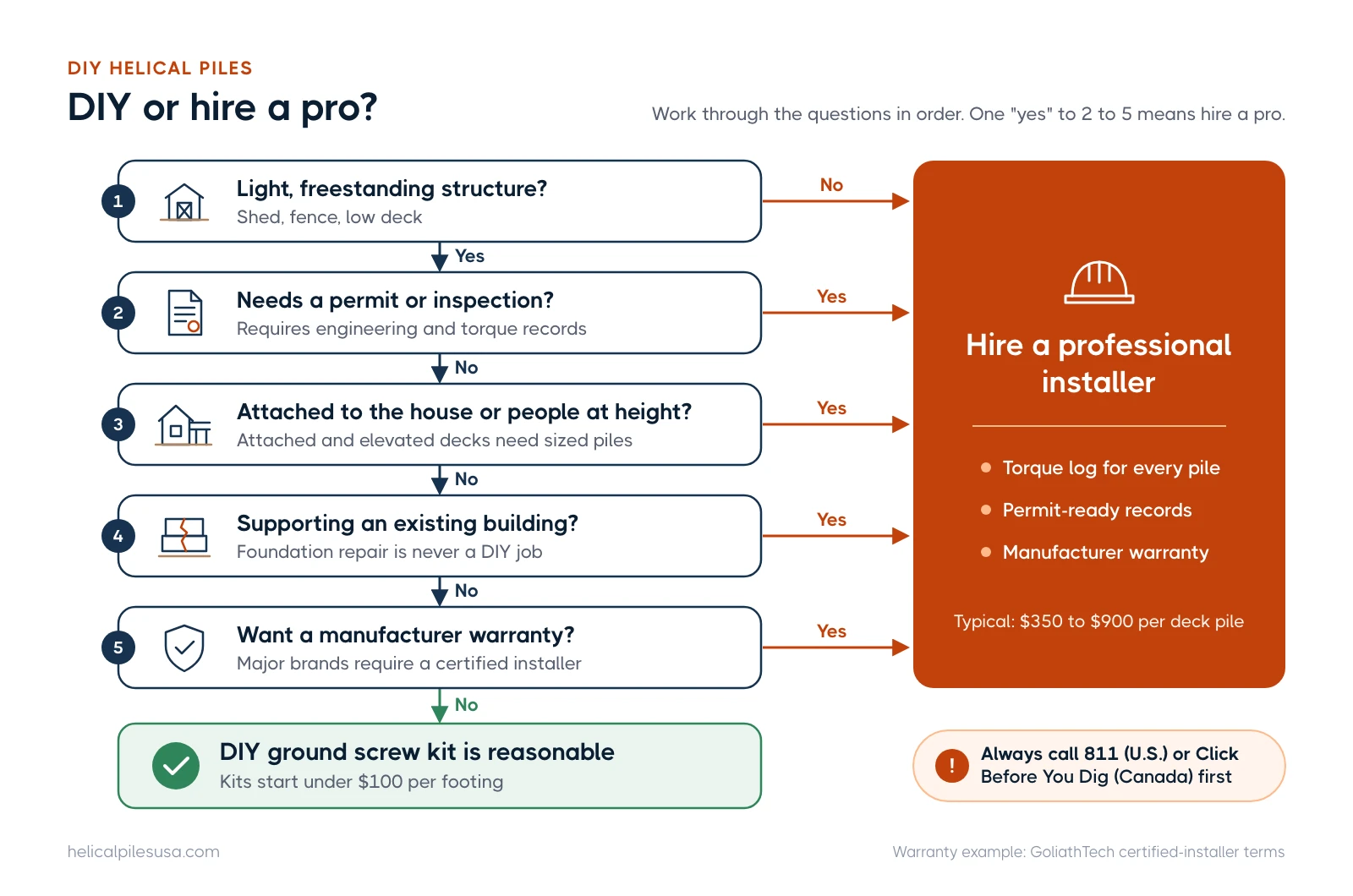
- Is it a light, freestanding structure such as a shed, fence or low platform deck? If yes, DIY kits are a reasonable option.
- Does it need a permit or inspection? If yes, you will need engineering and torque records that kits cannot provide.
- Is it attached to the house or does it carry people at height? Attached and elevated decks need sized piles. See helical piles for decks.
- Is it supporting an existing building? Foundation repair is never a DIY job.
- Do you want a warranty? GoliathTech's warranty, for example, applies only when its piles are installed by a certified installer, and other major brands work the same way.
Find a professional installer
If your project fails any of the tests above, a local installer can quote it, pull the permit and provide a torque log. Use our directory to find a helical pile installer in your state or province, and read how to hire a helical pile contractor before you sign. You can also compare brands on our helical pile manufacturers page.
Frequently asked questions
Can I install helical piles myself?
Yes, for light structures like sheds, fences and low freestanding decks using hand-installed ground screw kits. For attached decks, additions or anything needing a permit, hire an installer who can document torque and capacity.
What tool do I need for DIY screw piles?
Small kits are driven with a high-torque impact driver and a socket adapter, or a manual bar. Larger piles need a hydraulic drive head on a mini excavator or similar machine.
Can I rent a helical pile drive head?
Some equipment rental yards and pile distributors rent drive heads with mini excavators. Ask for a torque gauge matched to that drive head, because without one you cannot estimate capacity.
Will a building inspector accept DIY helical piles?
Possibly, but only with engineering, an approved product and a torque log for every pile. Most inspectors expect the documentation a professional installer provides.
Can I use DIY helical piers to fix my foundation?
No. Foundation repair involves excavating beside loaded footings and lifting the structure, and errors can cause serious damage or injury. Hire a qualified foundation repair contractor.
Are DIY helical piles cheaper?
For a small shed or fence, usually yes. For a deck needing rented equipment, a permit and engineering, the savings over a professional quote of $350 to $900 per pile are often modest.
Subscribe to our weekly email newsletter
Industry news, featured projects, new products, and installer spotlights from across the helical pile industry, delivered to your inbox.


Latest articles

Get the Helical Pile Industry Brief
New installers, manufacturer news, cost updates, and fresh guides for the U.S. and Canadian helical pile industry. Short, occasional emails. Unsubscribe any time.
