

Do Helical Piers Rust? Corrosion, Galvanizing and Lifespan
Do helical piers rust? Soil corrosion rates, ASTM A123 galvanizing, AC358 sacrificial steel, how long helical piles last, and when to add protection.

Yes, helical piers rust, but slowly, and the rate is predictable enough to design for. A hot-dip galvanized pier in ordinary undisturbed soil loses its zinc first and its steel only after that, so the evaluation criteria most manufacturers use (ICC-ES AC358) assume just 0.013 inch of steel loss over 50 years for galvanized shafts. Corrosion becomes a real design issue in low-resistivity, acidic, salty or contaminated soils, in loose fill, and in the top few feet where air and water come and go. Those sites need testing and extra protection.
Key takeaways
- Rust is designed in, not ignored: AC358-based evaluation reports reduce shaft strength for a scheduled 50-year loss, 0.013 inch for galvanized steel and 0.036 inch for bare (black) steel.
- Undisturbed soil is gentle: The National Bureau of Standards found no appreciable corrosion on steel piling in undisturbed soil below the water table after up to 40 years of service.
- Soil chemistry sets the rate: Resistivity, pH, chlorides, sulfates, moisture and oxygen supply decide how fast zinc and steel are consumed.
- Galvanizing buys decades: ASTM A123 requires 75 to 100 microns (3.0 to 3.9 mils) of zinc on most pile steel, and the zinc corrodes before any steel does.
- Real-world life: CHANCE cites a typical service life of 75 to 100 years, and dug-up foundations from 1983 still had zinc on them after 32 years.
- Test when in doubt: Resistivity below 1,000 ohm-cm, pH below 5.5, sulfates above 1,000 ppm, landfill or mine waste put a site outside the scope of typical evaluation reports.
How steel corrodes in soil
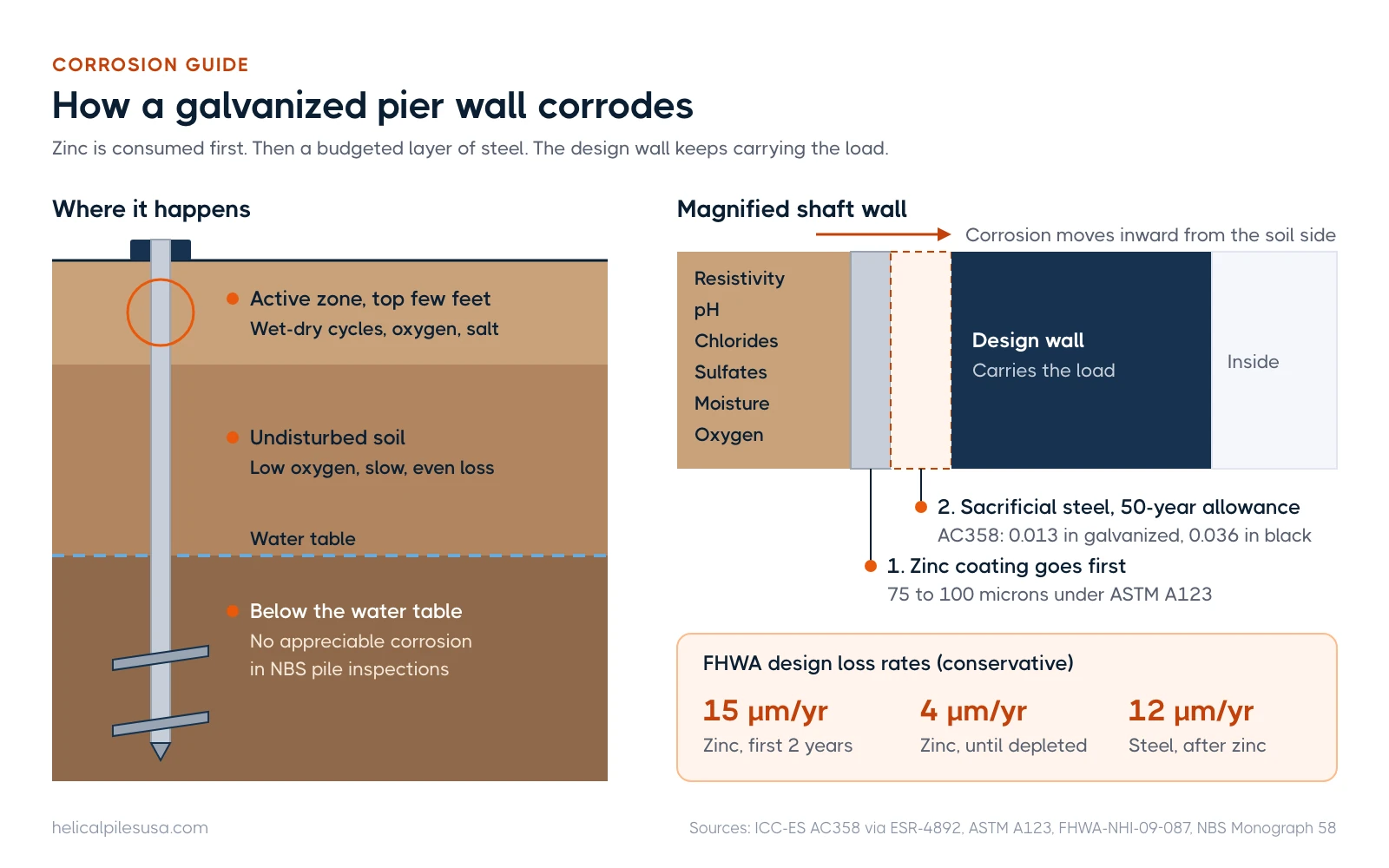
Buried steel corrodes through an electrochemical cell: one part of the surface (the anode) gives up iron, another (the cathode) consumes oxygen, and soil moisture carries the current. In his 1962 study for the National Bureau of Standards, Melvin Romanoff identified uneven oxygen and moisture along a buried member as the main driver: the areas with the least oxygen become anodes and corrode. Six soil properties control how strong that cell becomes.
- Resistivity: The single best screening number. Low resistivity means the soil conducts current easily, usually because it is wet and full of dissolved salts. AC358-based reports treat anything under 1,000 ohm-cm as potentially corrosive, and the FHWA criteria for mildly corrosive soil call for more than 3,000 ohm-cm.
- pH: Acidic soil attacks both zinc and steel. The American Galvanizers Association (AGA) notes soil pH ranges from 2.6 to 10.2 and that galvanized steel performs best in neutral to slightly basic soil.
- Chlorides and sulfates: Salts lower resistivity and break down protective films. Chlorides come from seawater, road salt and some fills; FHWA notes acid sulfate soils can carry 1,000 to 9,000 ppm sulfate.
- Moisture: The longer the steel stays wet, the faster it corrodes. The AGA adds that corrosion rates roughly double as soil temperature rises from 40°F to 68°F.
- Oxygen: Corrosion needs oxygen at the cathode. Deep, saturated, undisturbed soil has very little, which is why the lower shaft and helix of a pile below the water table see little loss.
- Disturbed vs undisturbed soil: Romanoff found that corrosion data from specimens buried in disturbed soil does not apply to piling driven into undisturbed ground, and that losses in fill were variable. A helical pile is screwed in without excavation, so most of its length sits in undisturbed ground.
The zone that needs the most attention is usually the top few feet, where soil wets and dries, oxygen is plentiful, and backfill or de-icing salt may be present. Hubbell flags the above-grade zone and the top 2 meters of soil as where extra coatings are sometimes used.
Published corrosion rates for steel and zinc in soil
There is no single corrosion rate for soil. These are the published figures engineers use most.
NBS field inspections (Romanoff)
The NBS Monograph 58 study inspected steel piling that had been in service up to 40 years across a wide range of soils. Its finding still shapes design: no appreciable corrosion in undisturbed soil below the water table, and variable but not serious corrosion above it and in fill.
FHWA and AASHTO design rates
For galvanized steel in tested, select backfill, the FHWA corrosion manual (FHWA-NHI-09-087) gives the AASHTO uniform-loss model: zinc at 15 microns (0.58 mil) per year for the first 2 years, then 4 microns (0.16 mil) per year until the zinc is gone, then carbon steel at 12 microns (0.47 mil) per year. The steel rate already includes a factor of 2 for uneven corrosion. These are deliberately conservative maximums; at one monitored site with 15,000 ohm-cm fill, FHWA reports measured zinc rates of about 0.5 to 2.7 microns per year. Hubbell uses the same model in its service life guidance for CHANCE anchors and piles.
Eurocode loss by soil type
Eurocode 3 Part 5 (EN 1993-5), the European standard for steel piling, publishes thickness loss by soil category. Its values for 5 and 25 years come from measurements and the longer periods are extrapolated. The table below uses the values reproduced in the GEO5 reference for EN 1993-5 Table 4.1, with inch conversions added. These are for bare steel; galvanizing delays the start of steel loss.
| Soil category (EN 1993-5) | Loss at 25 years | Loss at 50 years | Loss at 100 years |
|---|---|---|---|
| Undisturbed natural soil (sands, clays, shales) | 0.30 mm (0.012 in) | 0.60 mm (0.024 in) | 1.20 mm (0.047 in) |
| Non-compacted, non-aggressive fill (clays, marl, sands) | 0.70 mm (0.028 in) | 1.20 mm (0.047 in) | 2.20 mm (0.087 in) |
| Polluted natural soil and industrial sites | 0.75 mm (0.030 in) | 1.50 mm (0.059 in) | 3.00 mm (0.118 in) |
| Aggressive natural soil (swamps, marshes, reed beds) | 1.00 mm (0.039 in) | 1.75 mm (0.069 in) | 3.25 mm (0.128 in) |
| Non-compacted, aggressive fill (ashes, slags) | 2.00 mm (0.079 in) | 3.25 mm (0.128 in) | 5.75 mm (0.226 in) |
The standard says to halve the fill values when the fill is compacted. At 50 years, aggressive fill removes more than five times as much steel as undisturbed native soil.
How hot-dip galvanizing protects a helical pier
Most helical piers are hot-dip galvanized after fabrication. Zinc protects the steel twice: it is a barrier, and because zinc is more active than steel it corrodes sacrificially at scratches and cut edges, so the steel underneath stays intact until the zinc nearby is used up. The AGA says galvanized steel in most soils performs well with a service life of over 75 years, and that sandy, well-aerated soil with neutral pH most likely corrodes zinc at less than 5 microns (0.2 mil) per year.
Coating thickness is set by two ASTM standards. Shafts, helix plates and brackets fall under ASTM A123, which sets a minimum average coating by material category and measured steel thickness, shown below from the AGA summary of ASTM A123 Table 1. Bolts, nuts and small hardware fall under ASTM A153; the AGA summary of A153 lists 2.1 mils (53 microns) for Class C fasteners over 3/8 inch diameter and 1.7 mils (43 microns) for Class D fasteners under 3/8 inch.
| ASTM A123 category | Over 1/8 to under 1/4 in steel | Over 1/4 to under 5/8 in steel | Over 5/8 in steel |
|---|---|---|---|
| Pipe and tubing (round shafts) | 75 microns (3.0 mils) | 75 microns (3.0 mils) | 75 microns (3.0 mils) |
| Plate (helix plates, brackets) | 75 microns (3.0 mils) | 75 microns (3.0 mils) | 100 microns (3.9 mils) |
| Strip and bar (square shafts) | 75 microns (3.0 mils) | 75 microns (3.0 mils) | 100 microns (3.9 mils) |
| Structural shapes | 75 microns (3.0 mils) | 100 microns (3.9 mils) | 100 microns (3.9 mils) |
These are minimums, and real coatings often run heavier. Hubbell gives 4 mils as the average galvanizing on CHANCE products, and one evaluation report, ICC-ES ESR-4892, requires at least 64 microns (1.486 oz/ft²) on the piles it covers. Owners who want more margin can specify it: New York City's 2025 helical pile specification (SB 25-001) calls for a minimum of Grade 75 (3.0 mils, 1.7 oz/ft²) on all pile materials.
Design codes still budget for steel loss because, at FHWA's maximum design rates, an 85-micron coating is consumed in about 16 years. Measured rates in good soil are a fraction of that, which is how recovered foundations still carry zinc after three decades.
How long do helical piles last?
Two different numbers get quoted, and it helps to keep them apart. Design life is the period the engineer budgets steel loss for. Service life is how long the pile actually keeps carrying its load, which is usually longer.
- AC358 design basis (50 years): ICC-ES evaluation reports size the shaft after a scheduled 50-year loss under Section 3.9 of AC358. ESR-4892 bases its capacities on zinc-coated steel losing 0.013 inch, and Supportworks gives 0.036 inch for black steel. Supportworks stresses that this 50-year figure is a design criterion, not a service life. See our guide to helical pile ICC-ES evaluation reports for how these reports work.
- Public-agency specs (75 years): NYC SB 25-001 requires the structural corrosion check at a minimum 75-year design life using the most stringent corrosion rates, plus a separate corrosion analysis in marine settings, corrosive soils or where stray currents are a concern.
- Manufacturer service life (75 to 100 years): CHANCE puts typical service life at 75 to 100 years, highly dependent on site corrosivity and soil resistivity. Its earlier guidance, based on FHWA rates in mildly corrosive soil, estimates more than 50 years before the zinc is gone and about 10% of the steel is lost.
What dug-up foundations show
Field data backs up the estimates. In a 2026 longevity review by CHANCE, a galvanized steel foundation installed in December 1983 at a Centralia, Missouri substation was excavated in March 2016, after more than 32 years in poorly drained clay that was saturated in places. The galvanizing was still present, the upper and middle shaft showed minimal corrosion, and the most wear was near the lower shaft, helix and base plate. The most conservative measurement put zinc loss at about 0.19 mil per year. CHANCE adds that well-drained soils above about 2,000 ohm-cm can support a service life of more than 50 years. Our news summary of the CHANCE field data covers the other sites in the review. These are manufacturer-reported results, so treat them as evidence, not a guarantee.
Corrosion allowance in helical pile design
A corrosion allowance is extra steel the engineer assumes will be lost. The pile is checked for strength using the thinner, corroded section, not the wall thickness that left the factory. In practice that works like this:
- Start from the design wall thickness. ESR-4892, for example, lists a 3-inch shaft with a 3/16-inch nominal wall and a 0.162-inch design wall after its scheduled corrosion loss.
- Subtract the sacrificial thickness. Use the AC358 value for the coating (0.013 inch galvanized, 0.036 inch black) for ordinary soil, or a site-specific rate where testing shows the soil is aggressive. NYC SB 25-001 takes half of the sacrificial thickness off each face of the wall.
- Recompute section properties and capacity. Area, moment of inertia and section modulus all drop, which lowers axial, buckling and bending capacity.
- Compare with the other limits. The pile's allowable load is the lowest of the corroded structural capacity, torque-correlated soil capacity, helix strength and bracket strength.
The Supportworks worked example shows how much margin there usually is. A 2.875-inch black steel shaft has 2.11 square inches of steel and 75.9 kips of allowable structural capacity on day one. After the 0.036-inch 50-year loss, it has 1.82 square inches and 65.3 kips. The pile was only rated for 35 kips by installation torque, so corrosion would not govern until the loss reached somewhere between 0.135 and 0.140 inch, nearly four times the black steel allowance and more than ten times the galvanized one. For the full design sequence, see our helical pile design guide, and for how capacity is set by size and torque, see how much weight a helical pile can hold.
When to add more corrosion protection
Standard galvanizing and the AC358 allowance cover most residential and light commercial sites. Engineers add measures when testing or site history points to aggressive ground:
- Thicker shaft walls: The simplest fix. A heavier wall carries more sacrificial steel. NYC SB 25-001, for instance, sets a minimum round shaft of 4.5 inches outside diameter with a 0.337-inch wall for its public projects. See the helical pile shaft sizes chart.
- Thicker helix plates: Helices sit deepest, often in the wettest soil, and the Centralia foundation showed its most wear there. Where corrosion is expected near the bearing layer, ask the manufacturer for a heavier plate and confirm the helix capacity still governs correctly.
- Epoxy and duplex coatings: Coal tar epoxy or marine-grade coatings over galvanizing. In one Hubbell project in a Georgia tidal marsh, sections were sized thicker and given heavy-duty galvanizing with a tar epoxy overcoat.
- Cathodic protection and sacrificial anodes: CHANCE lists cathodic protection among its options for harsh sites. A zinc or magnesium anode connected to the pile corrodes in its place.
- Galvanic isolation: Keep pile steel from touching rebar, building steel or other metals. ESR-4892 requires this, and it also forbids mixing materials with different coatings in contact.
How to test a site's corrosivity
A soil corrosivity package is inexpensive next to the foundation, and many geotechnical reports already include one. These are the tests and limits most often used for helical piles:
| Property | Test method | AC358 / ESR outside-scope trigger | FHWA mildly corrosive limit | NYC SB 25-001 limit |
|---|---|---|---|---|
| Resistivity | ASTM G57 or AASHTO T-288 | Under 1,000 ohm-cm | Over 3,000 ohm-cm | Min. 1,000 ohm-cm |
| pH | ASTM G51 or AASHTO T-289 | Under 5.5 | Over 5 and under 10 | 5.5 to 9.0 |
| Sulfates | ASTM C1580 or D4327 | Over 1,000 ppm | Under 200 ppm | Max. 1,000 ppm |
| Chlorides | ASTM D4327 or AASHTO T-291 | Not listed | Under 100 ppm | Max. 100 ppm |
| Organic content | ASTM D2974 or AASHTO T-267 | "High" organic content | 1% max. | 1% max. |
| Landfill or mine waste | Site history and borings | Outside scope | Not addressed | Not allowed |
Sources: ESR-4892 Section 5.4, FHWA-NHI-09-087, and NYC SB 25-001 Table 70.14.1.1. A site outside the ESR limits is not banned from helical piles. It means the evaluation report no longer covers the design, and an engineer must justify the protection, usually with a site-specific corrosion rate.
Test each soil layer the pile passes through, and test fill separately from native soil. Check the water table and site history too: former industrial use, ash, cinders and marine fill push a site toward the aggressive rows of the Eurocode table. Some building departments require these tests; see helical pile permits and building codes.
Find an installer who designs for your soil
Ask any contractor which evaluation report their pile is built to, what coating it carries, and whether their engineer has checked your soil for corrosivity. You can find a helical pile installer in your state or province in our directory, and our guide on how to hire a helical pile contractor lists more questions to ask.
Frequently asked questions
Do galvanized helical piles rust?
The zinc coating corrodes first, slowly and sacrificially, and the steel only starts to rust where the zinc is gone. In ordinary soil that takes decades, which is why evaluation reports budget only 0.013 inch of steel loss over 50 years for galvanized shafts.
How long do helical piles last?
CHANCE gives a typical service life of 75 to 100 years, depending on soil corrosivity. Codes design for at least 50 years of steel loss, and some public agencies use 75 years.
Are black steel helical piles acceptable?
Yes, in many soils. AC358-based reports allow black steel with a larger 0.036-inch sacrificial thickness over 50 years, about three times the galvanized allowance, so the shaft needs more spare wall.
Does concrete or grout stop a helical pile from rusting?
Grout inside a shaft protects the interior surface, but the outside wall and helix plates still sit in soil. Steel must also be kept from touching rebar, since contact between different metals can speed up corrosion.
Are helical piles OK near the ocean?
They are used in coastal and marsh sites, but chlorides, tidal wetting and low resistivity call for testing and extra protection such as thicker steel, epoxy over galvanizing or cathodic protection.
Last reviewed October 2026 by the Helical Pile USA editorial team. Found an error? Tell us.
Subscribe to our weekly email newsletter
Industry news, featured projects, new products, and installer spotlights from across the helical pile industry, delivered to your inbox.


Latest articles

Get the Helical Pile Industry Brief
New installers, manufacturer news, cost updates, and fresh guides for the U.S. and Canadian helical pile industry. Short, occasional emails. Unsubscribe any time.
