

How Much Weight Can a Helical Pile Hold? Capacity Chart by Size
Helical pile capacity by size and use: rated torque and allowable loads from CHANCE, Supportworks, Ram Jack, Magnum and GoliathTech ICC-ES reports.

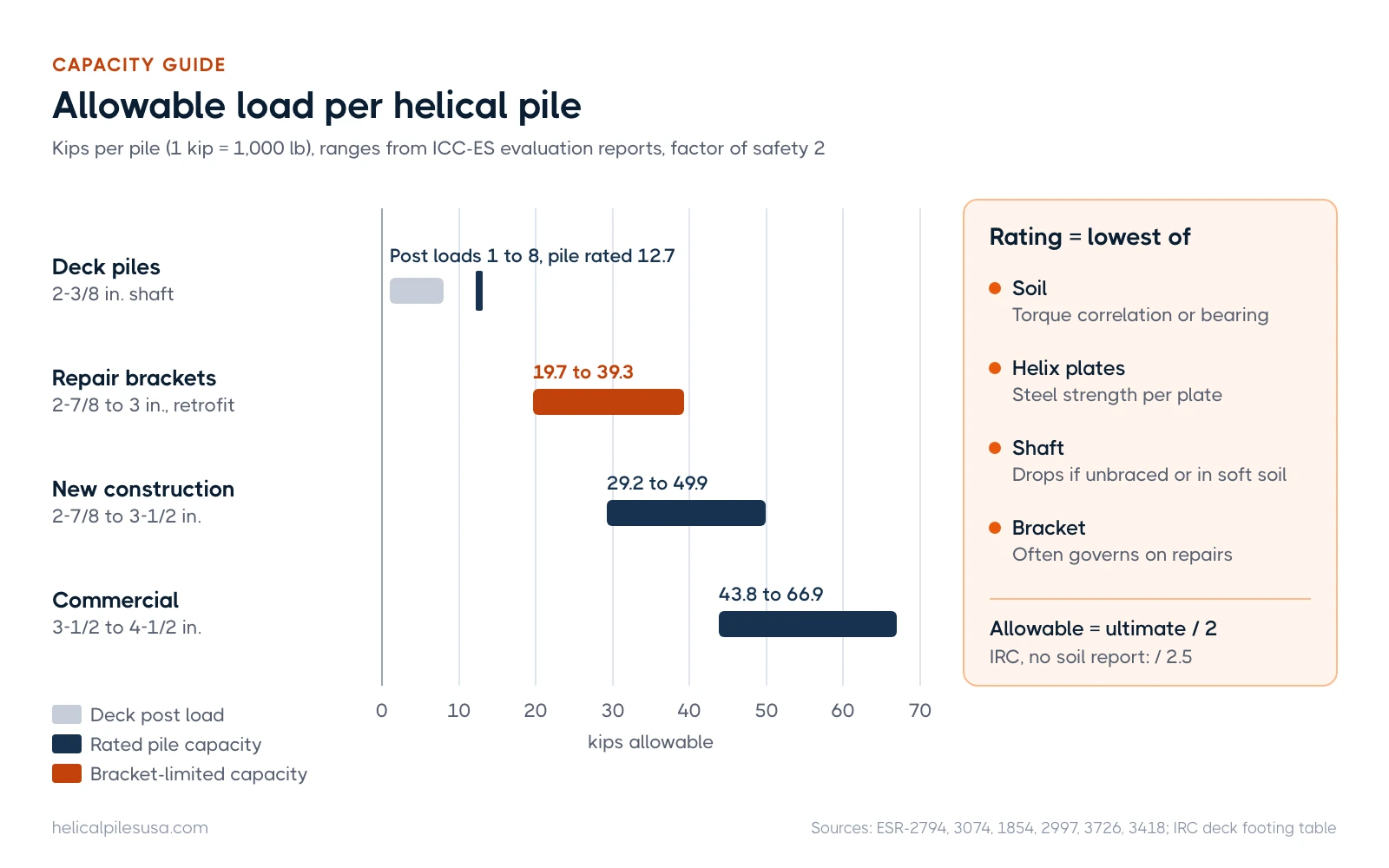
A helical pile can hold anywhere from about 12,700 lb to about 67,000 lb of allowable working load, depending on its size, the soil and how it is attached. In the manufacturer evaluation reports cited below, small 2-3/8 inch deck piles are rated up to 12.7 kips (1 kip = 1,000 lb), 2-7/8 and 3 inch repair and new-home piles land around 20 to 50 kips, and 3-1/2 to 4-1/2 inch commercial piles reach roughly 44 to 67 kips. The number that applies to your pile is the lowest of four limits: the soil, the helix plates, the steel shaft and the bracket.
Key takeaways
- Allowable, not ultimate: Codes take the ultimate capacity and divide by 2 (a factor of safety of 2) to get the working load you can design for. Some residential cases use 2.5.
- Size sets the ceiling: Each shaft has a maximum installation torque, and torque correlation caps capacity at that torque. A 2-7/8 inch shaft tops out around 30 to 37 kips allowable in compression.
- The weakest link governs: A Supportworks HP288 retrofit system is rated 24.0 kips even though its shaft is good for 63.6 kips, because the bracket controls.
- Exposed shaft loses strength fast: A Ram Jack 2-7/8 inch shaft drops from 57.5 kips fully braced to 18.0 kips with 8 feet of effective unbraced length in soft soil.
- Tension and lateral are lower: Tension ratings often run below compression, and tested lateral capacities for single piles are only about 0.9 to 3.7 kips.
- Every pile is proven: Final installation torque is logged on every pile, and static load tests confirm the correlation on larger jobs.
Helical pile capacity chart by size and product
The table below pulls rated torque and torque-correlated capacity straight from current ICC-ES evaluation reports. Ultimate capacity equals the torque correlation factor (Kt) times the maximum installation torque; allowable is half of that. Where a report caps capacity below the torque math, the cap is shown. Values are in kips.
| Product (report) | Shaft | Max installation torque (ft-lb) | Kt (ft-1) | Ultimate / allowable, compression (kips) |
|---|---|---|---|---|
| GoliathTech 2-3/8 in. (ESR-3726) | 2.375 in. OD x 0.154 in. wall | 2,453 | 10 | 25.4 / 12.7 (tension 20.4 / 10.2) |
| Magnum MS150BG (ESR-2997) | 1.5 in. solid square bar | 7,360 | 10 | 73.6 / 36.8 |
| CHANCE SS175 (ESR-2794) | 1.75 in. solid square bar | 10,500 | 10 | 62.7 / 31.4 (capped by the report) |
| CHANCE RS2875.203 (ESR-2794) | 2.875 in. OD x 0.203 in. wall | 6,710 | 9 | 60.4 / 30.2 |
| Supportworks HP288 (ESR-3074) | 2.875 in. OD | 7,898 | 9 | 71.1 / 35.5 (tension allowable 27.6) |
| Ram Jack 2-7/8 in., threaded coupler (ESR-1854) | 2.875 in. OD | 8,200 | 9 | 73.8 / 36.9 |
| GoliathTech 2-7/8 in. (ESR-3726) | 2.875 in. OD x 0.25 in. wall | 7,800 | 9 | 70.2 / 35.1 (tension 57 / 28.5) |
| Magnum MH325BG / MH325BRG (ESR-2997) | 3.0 in. OD x 0.25 in. wall | 7,300 / 12,475 | 8 | 58.4 / 29.2 and 99.8 / 49.9 |
| Techno Metal Post P3 (ESR-3418) | 3.5 in. OD x 0.300 in. wall | 11,000 | 7 | 74.1 / 37.1 |
| CHANCE RS3500 (ESR-2794) | 3.5 in. OD x 0.300 in. wall | 12,500 | 7 | 87.5 / 43.8 |
| Supportworks HP350 (ESR-3074) | 3.5 in. OD | 17,500 | 7 | 122.5 / 61.3 |
| Ram Jack 4-1/2 in. (ESR-1854) | 4.5 in. OD | 21,850 | 5.5 | 120.2 / 60.1 |
| CHANCE RS4500 (ESR-2794) | 4.5 in. OD x 0.337 in. wall | 24,320 | 5.5 | 133.8 / 66.9 |
Two notes on reading it. First, these are soil capacities proven by torque at the shaft's maximum rating. A pile that stops at a lower torque is rated lower, which is why the helical pile torque to capacity chart matters on every job. Second, product literature can lag the current report. The 2018 CHANCE RS2875.203 data sheet lists a 7,000 ft-lb rating and 63 kips ultimate (31.5 allowable), while the May 2026 reissue of ESR-2794 lists 6,710 ft-lb for that lead section. Engineers design to the current report. For shaft dimensions by use, see the helical pile shaft sizes chart.
Typical capacity by application
Most people asking how much weight a helical pile can hold have one of four jobs in mind. The ranges below come from the products above and from code load tables.
Deck piles and light residential
Deck loads are small. The IRC deck footing table, as adopted in Minnesota Rule 1309.0507, assumes 40 psf live load plus 10 psf dead load and covers tributary areas from 20 to 160 square feet per footing. That works out to about 1,000 to 8,000 lb on a single post. A 2-3/8 inch pile such as the GoliathTech model in ESR-3726 is rated up to 12.7 kips allowable in compression, which covers that range with room to spare when the shaft is fully embedded. Snow loads, hot tubs and roofed decks raise the demand. See helical piles for decks for layout and cost.
Foundation repair (retrofit brackets)
Repair piles are usually 2-7/8 or 3 inch shafts attached to an existing footing with a side-load bracket. Here the bracket, not the soil, often sets the number. Rated bracket capacities in the reports include 19.70 kips (Ram Jack 4038.1), 23.2 kips (CHANCE C1500121 bracket with the C2780001 T-pipe on RS2875.203), 24.0 kips (Supportworks FS288BL2), 33.65 kips (Ram Jack 4021.1) and 35.0 to 39.3 kips (Magnum MP-series on 3 inch shafts, with 5,000 psi concrete required for the higher two). Read more in helical piers for foundation repair.
New home construction
New-construction piles carry a cap plate or bracket cast into a grade beam, so the bracket penalty mostly disappears. A 2-7/8 to 3-1/2 inch pile installed to its full torque rating gives roughly 29 to 50 kips allowable based on the table above. In practice, engineers size the pile for the actual column or wall load at each location and set a minimum torque to match. Our guide to helical piles for new home construction covers layout and inspection.
Commercial and industrial
Commercial piles move to 3-1/2 and 4-1/2 inch shafts with higher torque ratings. Torque-correlated allowable capacities in the reports run from about 43.8 kips (CHANCE RS3500) to 66.9 kips (CHANCE RS4500), and the RS4500 shaft itself is rated at up to 96.9 kips allowable in compression. Heavier loads are handled by adding piles, not by pushing one pile past its rating.
What limits helical pile capacity
Under IBC Section 1810.3.3.1.9, the allowable axial load is Pa = 0.5 Pu, where Pu is the least of four values: helix bearing area times the ultimate bearing capacity of the soil, a well-documented torque correlation, a load test result, and the structural capacity of the pile. The evaluation reports add the bracket. Whichever element is weakest sets the rating.
The ESR-3074 retrofit table shows how this plays out on a single Supportworks HP288 pile:
| Element | Allowable compression (kips) |
|---|---|
| FS288BL2 bracket (P1) | 24.0 |
| HP288 shaft, fully braced (P2) | 63.6 |
| One helix plate (P3) | 40.0 |
| Soil by torque correlation (P4) | 35.5 |
| System rating | 24.0 |
Soil and helix bearing
The helix plates carry load by bearing on soil, much like small footings stacked on a shaft. Capacity is the plate area times the soil's ultimate bearing value, so larger and more numerous plates in denser soil carry more. Each plate also has a steel limit. ESR-3074 rates each Supportworks helix at 40 kips allowable, and the 2018 CHANCE data sheet rates a single 3/8 inch thick RS2875.203 helix at 42.9 kips allowable for an 8 inch plate down to 30.5 kips for a 14 inch plate. The bearing method needs a soil report, which is one reason a helical pile design guide starts with geotechnical data.
Torque correlation
Installation torque is a running measure of soil strength at the helix. Multiplying final torque by Kt gives ultimate capacity, and Kt falls as the shaft gets bigger (10 for small square bar, 9 for 2-7/8 inch, 7 for 3-1/2 inch, 5.5 for 4-1/2 inch in the reports above). Because no pile can be installed past its torque rating, the shaft's torque rating caps what torque can prove. The full method and worked numbers are in our torque to capacity guide.
Shaft strength and buckling
A slender steel shaft is strong when soil surrounds it on all sides and much weaker when part of it sits in air, water or very soft soil. The reports show the drop clearly:
| Shaft and condition | Allowable compression (kips) |
|---|---|
| Ram Jack 2-7/8 in. threaded, fully braced / firm soil (kLu 4 ft) / soft soil (kLu 8 ft) | 57.5 / 27.5 / 18.0 |
| Ram Jack 2-7/8 in. upset coupler, 2 couplers, same three conditions | 57.5 / 9.4 / 6.6 |
| CHANCE RS2875.203, firm soil fixed head / soft soil pinned head | 41.3 / 25.1 |
| GoliathTech 2-3/8 in. galvanized, 0 / 5 / 10 ft unbraced length | 33.4 / 12.4 / 5.5 |
Couplings matter too, since each joint within the unbraced length lowers the rating. Shaft shape counts as well: the CHANCE data sheet notes that round shafts resist buckling and lateral load better than solid square shafts of similar torque strength, and ESR-2794 drops one 1.5 inch square SS5 lead section from 45.9 kips (firm soil, fixed head) to 8.1 kips (soft soil, pinned head). If your site has deep fill, peat or open water, ask whether the engineer used braced or unbraced shaft values.
Bracket capacity for repair
Side-load repair brackets are rated by full-scale tests under ICC-ES AC358, typically with 5 feet of unbraced pile and one coupling. They also depend on the footing: Ram Jack's ratings assume at least 2,500 psi concrete, and the higher Magnum ratings assume 5,000 psi. A cracked or thin footing may need a different bracket or a new beam. Our guide to helical pile brackets and caps compares bracket types.
Compression vs tension vs lateral capacity
Compression is the headline number and usually the highest. Tension (uplift) uses the same torque correlation in most reports, but other limits often pull it lower. The HP288 soil capacity is 35.5 kips in compression and 27.6 kips in tension; GoliathTech's 2-7/8 inch pile is 35.1 versus 28.5; and Ram Jack caps its 2-7/8 inch upset-coupler pile at 27 kips allowable tension. Tension matters for decks in high wind, solar racks, towers and helical anchors.
Lateral capacity of a single vertical pile is small. Tested allowable lateral values include 882 lb for a GoliathTech 2-7/8 inch pile in firm clay, 1.49 kips for Ram Jack's 2-7/8 inch threaded pile, 1,606 lb for CHANCE RS2875.203 and 3,662 lb for CHANCE RS4500, the CHANCE values in very stiff clay at about 15 feet of embedment. Outside those tested soils, a design professional must set the lateral value. Larger sideways loads are taken by the foundation design, extra piles or angled piles rather than one pile alone.
Factor of safety
The IBC uses a factor of safety of 2: allowable equals half of ultimate. Under the IRC, ESR-1854 and ESR-2794 both require a factor of safety of 2.5 with the torque method (Qall = 0.4 Qult) when no site-specific geotechnical report is available. On a 2-7/8 inch pile with 63 kips ultimate, that is the difference between 31.5 and 25.2 kips allowable. Settlement is part of the picture as well: the CHANCE data sheet notes deflections of 0.25 to 0.50 inch are typical at allowable load.
How capacity is verified in the field
- Torque logs on every pile: Installers record torque at set intervals and at termination. ESR-2794 defines final torque for multi-helix and tension piles as the average of the last three readings at 1-foot intervals; ESR-3418 averages the last 2 feet. Torque is read from calibrated hydraulic gauges, a load cell or a shear pin indicator, per ESR-1854.
- Static load tests: Test piles are loaded in increments while settlement is measured, following ASTM D1143 for compression. A test result is one of the four IBC paths to Pu and can confirm or adjust Kt. See helical pile load testing.
- Engineer oversight above residential loads: ESR-3418 requires a Techno Metal Post engineer to supervise installs where a pile carries more than 9.5 kips, and on all commercial and industrial jobs.
- Proof loading on repair jobs: Repair piles are often loaded with hydraulic rams during lifting, which gives a direct check against the structure's weight.
Why no single number applies
Ask five installers how much weight a helical pile holds and you may hear five answers, and each could be right for its pile. Capacity depends on the shaft and wall thickness, the helix count and size, how deep the plates sit in firm soil, how much shaft is unbraced, the bracket and concrete, whether the load is compression or uplift, and which factor of safety the code applies. A rating from one product's report never transfers to another brand, even at the same diameter. Depth and spacing also change group behavior; see how deep helical piles go and how far apart helical piers need to be.
For a first estimate, try our free helical pile capacity calculator, then confirm the result with the report for the exact product and an engineer's design. The ICC-ES evaluation reports guide explains how to read the tables. Product details are on the CHANCE, Supportworks, Ram Jack, Magnum, GoliathTech and Techno Metal Post profiles.
Find an installer who can prove capacity
A qualified installer will name the product, its evaluation report and the target torque before work starts, and hand over torque logs when it ends. Find a helical pile installer in your state or province, and read how to hire a helical pile contractor before you sign.
Frequently asked questions
How much weight can one helical pier hold?
The products in this guide are rated from about 12.7 kips (12,700 lb) for a small deck pile to about 67 kips (67,000 lb) for a 4-1/2 inch commercial pile, allowable, per their ICC-ES reports. A 2-7/8 inch repair pier is commonly limited to 20 to 34 kips by its bracket.
Can a helical pile hold more than a concrete pier?
It can, depending on the soil and the design, because the helix plates bear in deeper, firmer soil and every pile's torque is measured. See are helical piles better than concrete for the trade-offs.
Is helical pile capacity the same in tension and compression?
Not always. Many reports list lower tension values, for example 27.6 kips in tension versus 35.5 kips in compression for the Supportworks HP288 soil capacity.
Does a bigger helix plate mean more capacity?
A bigger plate bears on more soil, but it also needs more torque to install and has a lower steel rating per plate. In the CHANCE data sheet, a 14 inch helix is rated lower than an 8 inch helix on the same shaft.
How many helical piles does a house need?
The count comes from the total load divided by the allowable capacity per pile, with spacing limits and the foundation's ability to span between piles. An engineer sets it for each project.
How do I know my piles reached their rated capacity?
Ask for the installation log showing final torque on every pile, compare it with the required torque on the drawings, and ask whether load tests were run.
Last reviewed October 2026 by the Helical Pile USA editorial team. Found an error? Tell us.
Subscribe to our weekly email newsletter
Industry news, featured projects, new products, and installer spotlights from across the helical pile industry, delivered to your inbox.


Latest articles

Get the Helical Pile Industry Brief
New installers, manufacturer news, cost updates, and fresh guides for the U.S. and Canadian helical pile industry. Short, occasional emails. Unsubscribe any time.
