

Helical Pile Drivers: Drive Heads, Machines, Rental and Cost
Helical pile driver guide: drive head torque classes, skid steer and excavator carriers, hydraulic flow, torque monitoring, makers, and buy vs rent costs.

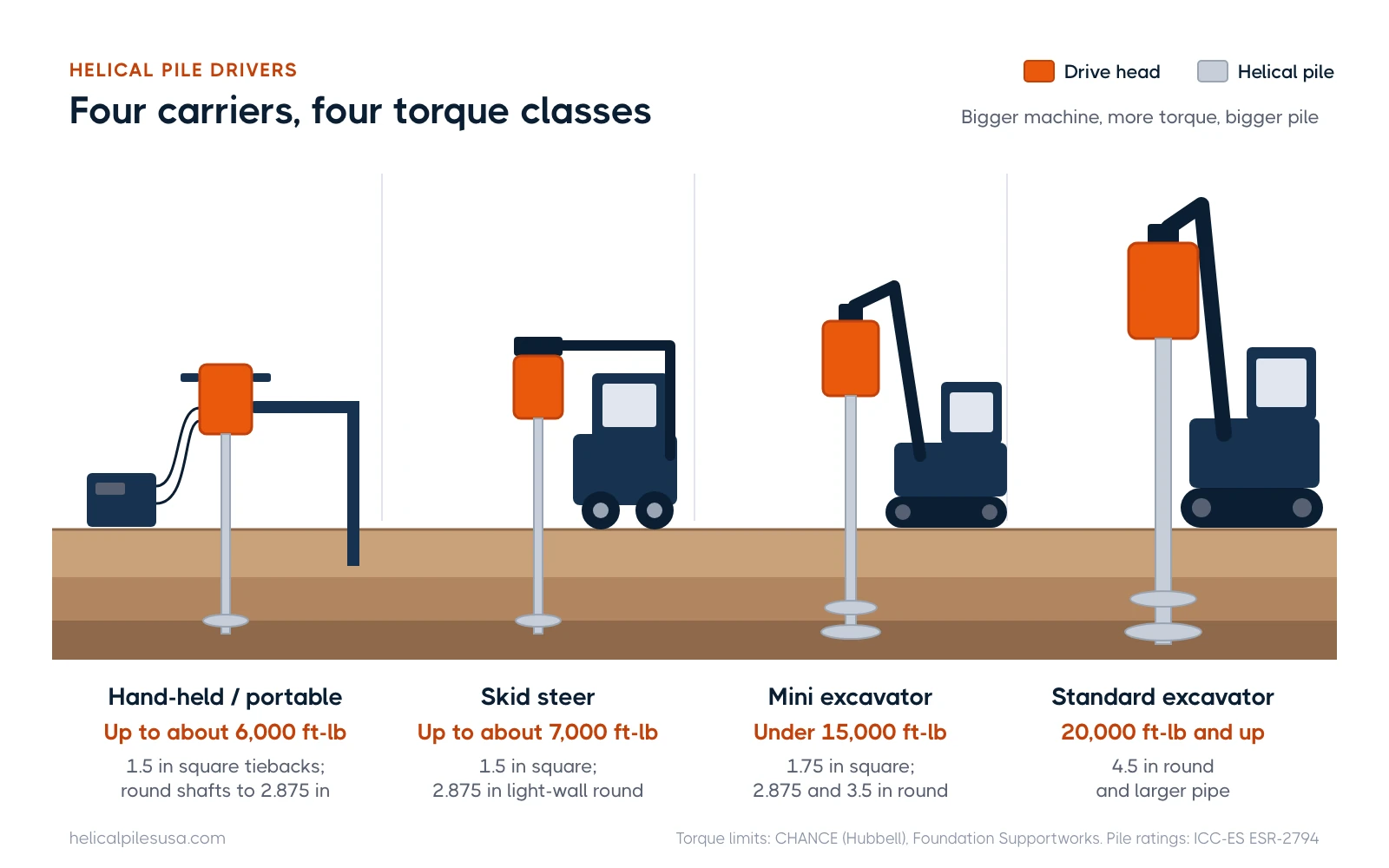
A helical pile driver is a hydraulic drive head (a planetary gearbox and hydraulic motor) that hangs from a carrier machine and screws steel piles into the ground. Match the head to the pile, not the other way around: portable heads top out around 6,000 ft-lb, skid steers around 7,000 ft-lb, mini excavators below 15,000 ft-lb, and full-size excavators carry heads of 20,000 ft-lb and up. Plan on roughly $11,000 to $30,000 to buy a compact package, or rent the machine and head for occasional jobs.
Key takeaways
- Size by pile torque: ICC-ES evaluation reports call for a drive head that can deliver at least 10 percent more torque than the pile's maximum installation torque rating.
- The carrier sets the ceiling: Machine weight, auxiliary flow and pressure limit what a head can actually deliver, so a big head on a small machine gains you little.
- Monitoring is not optional: Capacity is estimated from final torque, so every rig needs differential pressure gauges or an inline torque transducer.
- Tooling matters as much as the head: Kelly bar adapters, drive tools and pins all carry their own torque ratings, and the weakest one governs.
- Buy vs rent: Published package prices run from about $11,000 for a mini skid steer setup to $275,000 for large excavator heads, while compact machines rent for about $200 to $350 a day.
Drive head torque classes and the machines that carry them
Drive heads are sold by peak torque, usually in ft-lb. The carrier matters because the machine's weight and hydraulics resist and supply that torque. CHANCE (Hubbell) groups installation machines into four common carriers: skid steers, which are limited to about 7,000 ft-lb and pile sections shorter than 7 feet; mini excavators and backhoes, for jobs under 15,000 ft-lb; and standard excavators, which handle more than 20,000 ft-lb and sections up to 15 feet or longer.
Hand-held and portable heads
When no machine can reach the work, such as in a basement or crawl space, a small head is mounted on a hand-held frame. Foundation Supportworks notes that hand-held equipment is typically limited to 6,000 ft-lb, needs at least two technicians, and is best suited to 1.5-inch square shaft tiebacks and round shaft piles up to about 2.875 inches. The power unit can sit outside with long hoses, which keeps exhaust out of the building.
Skid steers and mini skid steers
Skid steers fit alleys, buildings and tight lots, but their light weight limits them to smaller piles and short sections. They pair well with residential deck and porch work using 1.5-inch square bar and light-wall 2-7/8-inch pipe.
Mini excavators and backhoes
The mini excavator is the workhorse for residential new construction and repair. Most can be hauled on a 20 to 24 foot trailer, according to CHANCE. Backhoes offer similar reach but run on rubber tires with higher ground pressure.
Standard and large excavators
Commercial piles with 4.5-inch and larger shafts call for full-size excavators. These machines carry heavy two-speed heads, long sections and the weight needed to resist high torque. At the top end, manufacturers build heads well above 100,000 ft-lb for large-diameter energy and infrastructure piles.
Matching drive head, carrier and pile size
The ICC-ES evaluation report for CHANCE helical piles (ESR-2794) requires a motor that can exert at least 10 percent more torque than the pile's maximum installation torque rating, plus enough crowd (down pressure) to advance the pile about 3 inches per revolution. The table below combines those shaft ratings with the carrier limits above. The engineer's specified torque always governs.
| Drive head class | Typical carrier | Typical pile shafts | Example max installation torque of the pile |
|---|---|---|---|
| Up to about 6,000 ft-lb | Hand-held frame with portable power unit | 1.5 in square tiebacks; round shafts up to 2.875 in | 1.5 in square (SS5): 5,700 ft-lb |
| Up to about 7,000 ft-lb | Skid steer or mini skid steer | 1.5 in square; 2.875 in light-wall round | 2.875 x 0.203 in round: 6,710 ft-lb |
| Under 15,000 ft-lb | Mini excavator or backhoe | 1.75 in square; 2.875 in heavy-wall and 3.5 in round | 1.75 in square (SS175): 10,500 ft-lb; 3.5 in round: 12,500 ft-lb |
| 20,000 ft-lb and up | Standard or large excavator | 4.5 in round and larger pipe | 4.5 in round (RS4500): 24,320 ft-lb |
Pile torque ratings are from ESR-2794, Table 7. Other brands publish their own ratings, so check the evaluation report for the product you will install. Our helical pile shaft sizes chart lists common diameters across manufacturers.
Hydraulic flow and pressure requirements
A drive head turns oil flow into rotation and oil pressure into torque. Flow (gpm) sets speed, and the pressure drop across the motor sets torque. Before you buy or rent, compare the head's spec sheet with your machine's auxiliary circuit. Ranges published by Digga North America show how wide the spread is:
- Lightweight drives of 6,500 to 10,000 ft-lb run on 7 to 15 gpm.
- Mini machine drives of up to 10,000 ft-lb run on 2 to 18.5 gpm.
- Two-speed 9,000 to 12,000 ft-lb drives accept 8 to 48 gpm.
- Two-speed 20,000 to 30,000 ft-lb drives accept 8 to 48 gpm.
Pressure needs the most care. Danbro Distributors warns that drive head motor pressure ratings have not kept up with the working pressures of modern machines, so line pressure must be limited to the head's rating or the motor will be damaged. The same source recommends choosing a head at least 20 percent stronger than the highest torque you expect, for reasonable service life, and one whose flow range fits your machine. ESR-2794 also caps installation speed at under 25 rpm, so a two-speed head that spins fast for travel and slow for final torque is worth the extra cost.
Torque monitoring
Helical pile capacity is verified with the torque correlation method: ultimate capacity equals a factor (Kt) times final installation torque. A driver without a reliable torque reading cannot prove capacity. Foundation Supportworks describes the main options:
- Dual pressure gauges: One gauge on the feed line and one on the return. The difference, multiplied by the drive head's gear motor multiplier (GMM), gives torque. A feed-only gauge can overstate torque.
- Differential pressure gauges: One body with both ports and a dial printed in ft-lb. Each gauge matches one specific drive head.
- Electronic pressure indicators: Transducers on both lines with a digital torque readout, often with data logging.
- Inline torque transducers: Strain-gauge units bolted between the head and the tool string that read torque directly and can be recalibrated.
ESR-2794 requires measuring equipment accurate to plus or minus 10 percent of the termination torque. Readings should be logged at least at the end of each lead and extension. To turn those readings into capacity, use our helical pile torque to capacity chart.
Adapters, kelly bars and drive tools
The drive string runs from the head's output shaft (commonly a 2 or 2.5-inch hex, or a 100 mm square on bigger heads) through adapters to the drive tool that grips the pile. On utility trucks, the torque motor's output shaft is the Kelly bar. Hubbell explains that a CHANCE Kelly bar adapter is a cast socket that fits that bar and locks with a pin. Standard CHANCE tooling is rated for 10,000 ft-lb, and its heavier Tough One tooling for 15,000 ft-lb. Every piece of the string has a rating, and the lowest one governs the whole assembly.
Ask your supplier for the full string when you buy or rent: mount or bail, hose kit, output adapter, drive tools for square or round shaft, pins, and a torque monitor. IDEAL Foundation Systems sells packages built this way, including a differential pressure kit and drive adapter, and fabricates custom Kelly and drive adapters.
Who makes helical pile drive heads
A few specialist gearbox makers build most drive heads, and pile manufacturers and dealers bundle them into packages. Representative names:
- Eskridge: An anchor drive maker now presented under Ramsey Industries, with 13 anchor drive models and torque capacities from 1,500 to 375,000 ft-lb.
- Digga: Its anchor drives run from lightweight and mini machine units up to heavy drives above 100,000 ft-lb.
- Pengo: Builds anchor drive heads. Danbro reports running a Pengo 6,500 ft-lb drive head alongside Eskridge 12,000 and 20,000 ft-lb units.
- Auger Torque: Builds screw pile torque heads including 100,000 and 150,000 N-m models (roughly 74,000 and 111,000 ft-lb) for 21 to 50 tonne excavators.
- Hubbell CHANCE: Supplies the tooling side, including Kelly bar adapters, rated drive tools and torque indicators, plus training for its certified installers.
- IDEAL Foundation Systems: A pile manufacturer that distributes drive heads from leading makers, from 2,500 to 375,000 ft-lb, rather than building its own gearboxes.
For pile brands and their installer programs, see our helical pile manufacturers directory, including the CHANCE and IDEAL profiles. If you also need piles, read where to buy helical piers.
Buy vs rent: cost ranges
Buying makes sense when you install piles every week. Renting fits a contractor testing the market or a one-off project.
Buying a drive head package
Nortek Helical Piles publishes package prices in U.S. dollars:
| Package | Drive head torque offered | Package price (USD) |
|---|---|---|
| Mini skid steer | 5,000 to 12,000 ft-lb | $11,000 to $15,000 |
| Full-size skid steer | 5,000 to 25,000 ft-lb | $12,000 to $30,000 |
| Mini excavator | 5,000 to 30,000 ft-lb | $11,000 to $25,000 |
| Crawler excavator | 20,000 to 375,000 ft-lb | $20,000 to $275,000 |
These prices cover the head, mount and monitoring options, not the carrier machine. Budget separately for drive tools for each shaft size you install.
Renting the machine and head
Compact carriers are easy to rent. 2026 rate surveys put mini excavators at about $200 to $250 a day for 1 to 2 ton machines and $300 to $350 or more for 4 to 6 ton machines. Add $100 to $300 for round-trip delivery and a damage waiver of about 10 to 15 percent. Weekly rates usually run 3 to 4 times the daily rate. Drive heads themselves come from specialist helical dealers rather than general rental yards, and most quote rates on request. The same survey notes that if you keep renting the same attachment, buying it often pays off within one season.
If you only need a handful of piles, hiring an installer usually beats both options. See DIY helical piles for what owners can realistically install and the helical pile installation process for what a pro crew does on site.
Safety around helical pile drivers
High torque stored in a steel drive string is the main hazard. Hubbell warns that if one tooling component fails, the torsional energy can be released violently. Key practices:
- Never exceed the rating of the head, adapters, drive tools or the pile.
- Do not mix installation tools from different manufacturers.
- Limit hydraulic pressure to the head's rating.
- On hand-held rigs, brace the torque arm against the ground, a wall, a column or another structure that can resist the reaction, and use at least two trained technicians.
- Keep the control valve close to the work so the operator can stop rotation instantly.
- Stand clear of the rotating string and keep hands off the pile while it turns.
CHANCE's evaluation report requires installation by trained and certified installers, and other brands have similar programs. Check those requirements before you buy equipment for warranted work.
Find an equipped installer
Most homeowners never need to buy or rent a drive head. A local crew arrives with a matched carrier, head and calibrated torque monitor. Find a helical pile installer in your state or province, and use our guide on how to hire a helical pile contractor to ask about their equipment and torque logs.
Frequently asked questions
How much torque does a helical pile driver need?
At least 10 percent more than the maximum installation torque rating of the pile, per ESR-2794. A 3.5-inch CHANCE round shaft rated at 12,500 ft-lb therefore needs a head that can deliver about 13,750 ft-lb.
Can I put a helical drive head on a skid steer?
Yes. Skid steers work well for small residential piles in tight spaces, but CHANCE puts their practical limit at about 7,000 ft-lb and pile sections under 7 feet.
Can I use an auger drive as a helical pile driver?
Only if it is rated for the torque and you can measure torque. Many skid steer auger drives produce far less torque than piles need, and without a calibrated monitor you cannot verify capacity.
How much does a helical pile machine cost?
Published drive head packages run about $11,000 to $30,000 for skid steer and mini excavator setups and up to $275,000 for large excavator heads, not including the machine.
Where can I rent a helical pile driver?
Specialist helical pile dealers and distributors rent drive head kits, usually by quote. You can rent the mini excavator or skid steer from a general rental yard for about $200 to $350 a day.
Subscribe to our weekly email newsletter
Industry news, featured projects, new products, and installer spotlights from across the helical pile industry, delivered to your inbox.


Latest articles

Get the Helical Pile Industry Brief
New installers, manufacturer news, cost updates, and fresh guides for the U.S. and Canadian helical pile industry. Short, occasional emails. Unsubscribe any time.
