

Helical Piles in Rocky Soil: Cobbles, Boulders and Bedrock
Can helical piles go into rock? How cobbles, boulders, till and bedrock cause refusal, the workarounds that fix it, and when to switch to micropiles.

Helical piles can work in rocky soil, but only up to a point. Scattered cobbles, dense glacial till and soft or weathered rock are usually manageable with the right lead section, a pilot hole or a small change in location. Competent, unweathered bedrock is a different story: a helix cannot screw into it, so the pile either bears on top of the rock, gets set in a drilled socket, or the job switches to micropiles or drilled piers.
Key takeaways
- Rock type matters more than "rocky": Gravel, cobbles, till and weathered rock behave very differently from sound granite or massive limestone.
- Refusal is not the same as capacity: A pile that stops advancing has hit something hard, but that does not prove it reached the torque the design calls for.
- There are several workarounds: Pre-drilling, carbide or "sea shell" lead sections, end-bearing on rock, relocating or battering the pile, and grouted rock sockets.
- Some sites need a different system: Shallow, hard bedrock often points to micropiles or drilled piers instead.
- A geotechnical report saves money: Boring logs show cobbles, boulders and rock depth before a crew mobilizes.
- Obstructions change the price: Pre-drilling through rock can add roughly $500 to $2,000 per pier.
How cobbles, boulders, till and bedrock affect helical piles
A helical pile advances like a large screw. The soil's resistance is measured as installation torque, and anything that stops the helix slicing cleanly through the ground (a large stone, a cemented layer, a rock surface) disrupts that.
The CHANCE Technical Design Manual sorts ground into classes by Standard Penetration Test (SPT) blow count. Class 0 is sound, unweathered rock such as granite, basalt and massive limestone. Class 1 covers very dense or cemented sands, coarse gravel and cobbles, with blow counts of 60 to 100 or more. Basal till, boulder clay and weathered laminated rock fall in Class 2 (about 45 to 60 blows), while glacial till and weathered shale or siltstone sit in Class 3 (about 35 to 50 blows). The manual also gives the size ranges: cobbles are 3 to 12 inches across and boulders are anything over 12 inches.
Cobbles and gravel
Small cobbles often get pushed aside as the helix turns. Tightly packed or larger stones can deflect the pile, bend a helix edge and make torque readings spike and drop.
Boulders
One buried boulder can stop a pile cold while the next pile goes in cleanly. Boulders are the classic cause of refusal well above the predicted bearing depth.
Glacial till and hardpan
Till is a dense glacial mix of clay, sand, gravel and stones, common across the northern U.S. and Canada. It makes a good bearing layer, but its stones raise torque quickly and can damage thin plates.
Weathered rock and shallow bedrock
Weathered rock (shale, siltstone, decomposed limestone) can often be penetrated. Hard bedrock cannot. Supportworks' technical manual defines hard rock as auger refusal or SPT values of 50 or more blows per 6 inches, and a CHANCE FAQ states plainly that helical piles are not meant to penetrate competent bedrock. GoliathTech notes that bedrock is mainly a problem when shallow. When it is deep, the pile gets its capacity from the steel and soil above it.
Refusal vs reaching the required torque
Required torque is the installation torque the engineer specifies so the pile reaches its design capacity. Under ICC-ES AC358, capacity is estimated by multiplying final torque by a capacity-to-torque ratio called Kt. The default Kt values are 10 for 1.5 and 1.75 inch square shafts, 9 for 2.875 inch round shafts, 8 for 3.0 inch round shafts and 7 for 3.5 inch round shafts. A 3.5 inch shaft finishing at 10,000 ft-lbs therefore points to about 70,000 lbs of ultimate capacity, before the factor of safety of 2 that AC358 applies. Our torque to capacity chart walks through more examples.
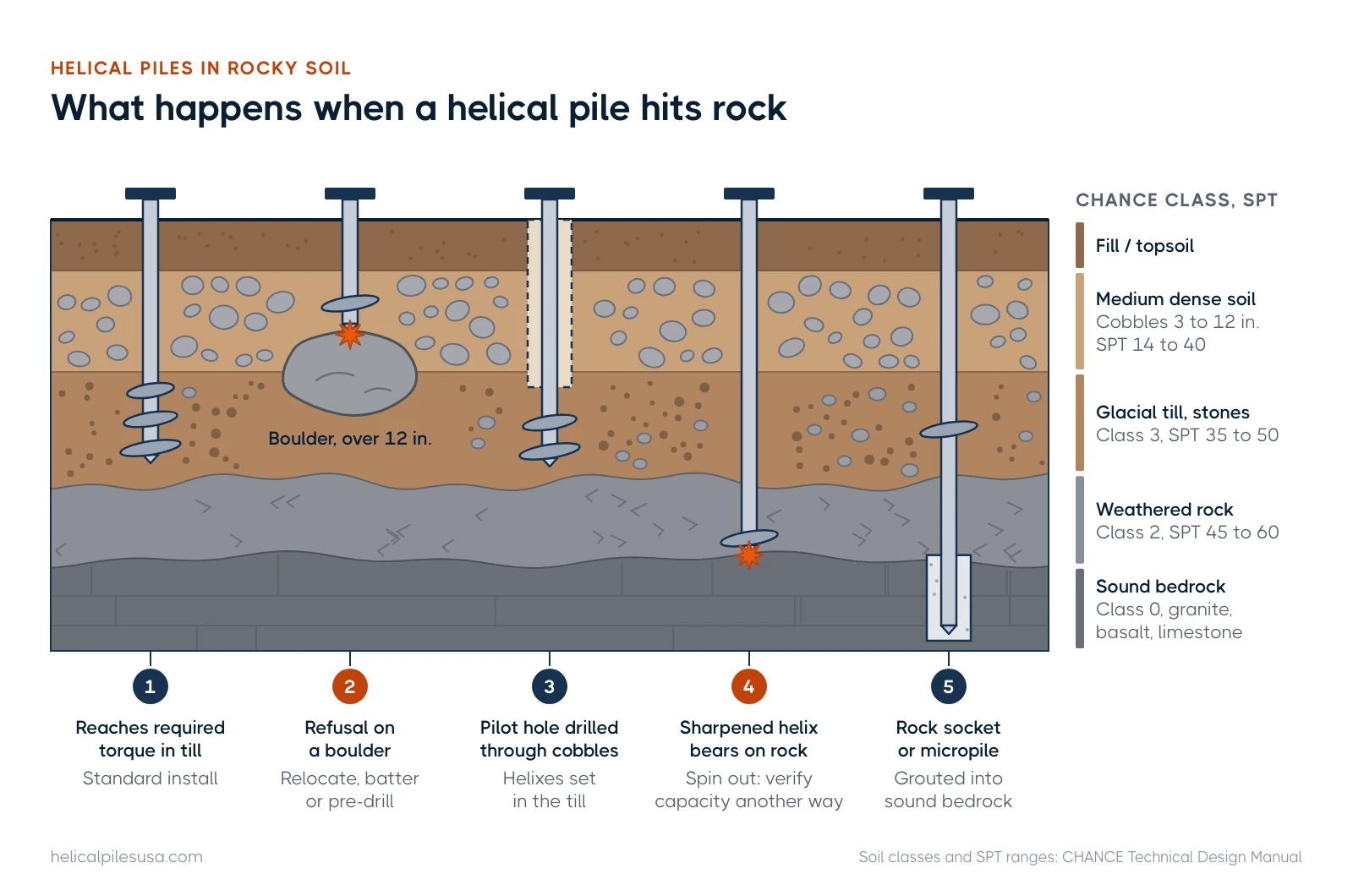
Refusal means the pile keeps turning but no longer advances. A Magnum Piering technical bulletin describes "spin out", a sudden loss of torque at a sharp soil-to-rock boundary followed by refusal. Magnum's point is that losing torque does not mean the pile has lost capacity. It means the torque correlation can no longer be used to prove capacity, so the engineer needs another way to verify it.
Magnum lists those other ways in order:
- Compare with torque logs from nearby piles that bear in the same material at the same depth.
- If every pile in an area spins out, check the boring logs. If refusal depth matches the rock depth in the borings, capacity can be estimated as the bottom helix area times the bearing strength of the rock.
- If neither is available, use the last torque reading just before spin out as a conservative estimate.
Shallow refusal on a boulder is the worst case, since the pile may be sitting on a loose stone rather than a bearing layer. A load test settles any doubt.
Workarounds when a helical pile hits rock
Pre-drilling or pilot holes
An auger or rock bit opens a path through the obstruction before the pile is screwed in. The CHANCE manual notes that in weathered rock and cemented sands, predrilling lets helix plates be installed under relatively high torque, generally above 10,000 ft-lbs, and lists it as a standard design change for hard clays and weathered rock. Supportworks adds that fill with cobbles or boulders may need pre-drilling or removal of the hard fractions.
Rock-cutting and beveled lead sections
Manufacturers make lead sections for tough ground. CHANCE offers a "sea shell" cut on the helix leading edge, a spiral cut that works in debris, cobbles and fractured rock. The trade-off is that the cut reduces the plate's bearing area, so a larger or extra helix may be needed. CHANCE also sells the ROCK-IT lead, a square shaft with a 6-8-10 helix set and a welded carbide tip. In a Hubbell article, one installer said the lead let them work in permafrost without drilling a pilot hole first.
Smaller, fewer or thicker helix plates
A single small helix pushes through stony ground more easily than a stack of large plates. The CHANCE manual says that when piles need to go deeper, it is better to reduce helix size or count, or pick a stronger shaft series, than to overpower the pile. It caps the "finishing torque" at no more than 10% over the published rating and recommends a series with at least 30% more torque rating than expected in obstruction-laden soils, to avoid fracture under impact loading. Supportworks recommends a thicker or larger shaft to resist impact and torque spikes, thicker helix plates with a V-style cut, a solid square bar "stinger" lead, and larger equipment to provide crowd (downward force). See our shaft sizes chart for typical ratings.
End-bearing on rock
Bearing directly on the rock surface is common practice. Magnum recommends a single helix for this and says the angle-cut pilot point and sharpened helix help the pile bite into irregular, weathered rock, so a blunt end is not needed. A second or third helix can help if the rock is soft or if uplift capacity matters. Magnum also notes that its piles cannot penetrate rock much above about 150 blows per foot, roughly 1,500 psi unconfined compressive strength, though dual-cutting-edge helixes can work into mudstone, soft limestone and weak sandstone.
Rock-socketed or rock-anchored helicals
Where rock is shallow and the pile must resist uplift or lateral load, an engineer may specify a hole drilled into the rock with the shaft grouted into the socket. This behaves more like a rock anchor and costs more than a standard install.
Moving, battering or digging out the pile
The CHANCE FAQ lists relocating the pile, installing it on a batter (an angle) to miss the obstruction, and excavating near-surface obstructions. GoliathTech crews also "steer" a pile by backing it out and repositioning it, or use an excavator bucket to pull a shallow boulder. Supportworks says the project engineer should be notified before any pile is offset, to decide whether other piles move or extra piles are needed.
Switching to micropiles or drilled piers
If rock is shallow, hard and widespread, it may be simpler to change systems. Micropiles are drilled and grouted, and they develop capacity by bonding into a rock socket. Drilled concrete piers can be socketed into rock as well. Our guide to helical piles vs drilled piers compares the two. The Deep Foundations Institute runs separate technical committees for helical piles and micropiles.
Soil and rock condition vs typical approach
| Ground condition | Typical SPT range (CHANCE class) | Usual helical approach |
|---|---|---|
| Medium dense sand, gravel, stiff clay | 14 to 40 (Classes 4 and 5) | Standard lead section, install to required torque |
| Glacial till, hardpan, weathered shale | 35 to 50 (Class 3) | Fewer or smaller helixes, higher torque shaft series |
| Basal till, boulder clay, weathered laminated rock | 45 to 60 (Class 2) | Sea shell or carbide lead, pilot hole if torque spikes |
| Cemented sand, caliche, coarse gravel and cobbles | 60 to 100+ (Class 1) | Pre-drill, rock-cutting lead, or relocate around obstructions |
| Scattered boulders in softer soil | Varies | Steer, batter, excavate, or shift pile location with engineer approval |
| Soft rock (mudstone, weak sandstone) | Up to about 150 blows/ft | End-bear with a single cutting-edge helix, verify capacity |
| Sound, unweathered bedrock | Not applicable (Class 0) | Bear on rock surface, grouted rock socket, or switch to micropiles or drilled piers |
Ranges come from the CHANCE soil classification table and the Magnum bulletin. The final choice belongs to the project engineer.
Why the geotechnical report matters on rocky sites
The CHANCE manual says one goal of a site investigation is to find barriers to reaching the required depth, such as rubble fill, boulders and cemented zones, that could call for pre-drilling. Boring logs show where the rock is, how weathered it is and how hard the soil above it is. That lets the designer pick the right lead and shaft before mobilization.
Where the soil data is thin, the manual suggests a helical trial probe pile. One test pile can reveal the bearing layer, rough capacity and whether cobbles, boulders or debris are present. For a sense of typical depths, see how deep helical piles go.
How contractors price obstructions
Most quotes assume clean installs. Today's Homeowner puts an average helical pier at about $3,000 installed, with materials around $1,500 to $2,000. Rock changes that math. An HBG Civil cost guide estimates pre-drilling through rock at roughly $500 to $2,000 per pier.
On a rocky site, expect some of these on the quote:
- Obstruction or refusal clause: An hourly or per-pile rate if a pile hits refusal and has to be moved or reinstalled.
- Pre-drilling: Priced per hole or per foot, often with a separate mobilization charge for a drill rig.
- Special leads: Carbide or sea shell leads cost more than standard ones.
- Extra piles: When a boulder blocks a location, the engineer may call for two piles on either side.
- Load testing: Required when torque cannot verify capacity after spin out.
Ask every bidder how they handle refusal before you sign. Our helical pier cost guide covers the base pricing, and how to hire a helical pile contractor lists questions worth asking.
Find an installer with rock experience
Look for crews that carry rock-cutting leads, can bring a pre-drilling rig and work with an engineer who will sign off on field changes. Manufacturers such as CHANCE, Magnum Piering, GoliathTech and Supportworks all publish guidance for hard ground. When you are ready, find a helical pile installer in your state or province. Ask about their recent jobs in similar soil.
Frequently asked questions
Can helical piles go into rock?
They can go into soft or weathered rock, sometimes with a pilot hole or carbide lead. They cannot screw into sound, unweathered bedrock, so they either bear on its surface or are set in a drilled and grouted socket.
What does helical pile refusal mean?
Refusal means the pile keeps rotating but stops advancing. It may have reached rock or hit a boulder, and the engineer has to decide whether capacity is proven or the pile needs to be moved, pre-drilled or load tested.
Is a pile that spins out on bedrock still good?
Often yes. Magnum notes that a loss of torque at the rock surface does not reduce bearing capacity, but capacity must then be checked through nearby torque logs, boring data or a load test.
How much extra does rocky soil add to helical pier cost?
Pre-drilling through rock can add roughly $500 to $2,000 per pier, plus any rig mobilization, special lead sections or load tests. The exact amount depends on how many piles hit obstructions.
When should I choose micropiles instead of helical piles?
When hard bedrock is shallow and widespread, or large loads must be anchored into rock. Micropiles are drilled and grouted, so they handle rock better but cost more per pile.
Do I need a geotechnical report for a rocky site?
It is strongly recommended. Boring logs reveal rock depth, cobbles and boulders so the right lead and shaft are chosen up front.
Subscribe to our weekly email newsletter
Industry news, featured projects, new products, and installer spotlights from across the helical pile industry, delivered to your inbox.


Latest articles

Get the Helical Pile Industry Brief
New installers, manufacturer news, cost updates, and fresh guides for the U.S. and Canadian helical pile industry. Short, occasional emails. Unsubscribe any time.
