

Helical Piles vs Concrete Piers: Cost, Speed & Which Is Better
Helical piles vs concrete piers compared on cost, cure time, soil, frost and uplift, with Houston repair pricing, so you can pick the right foundation.
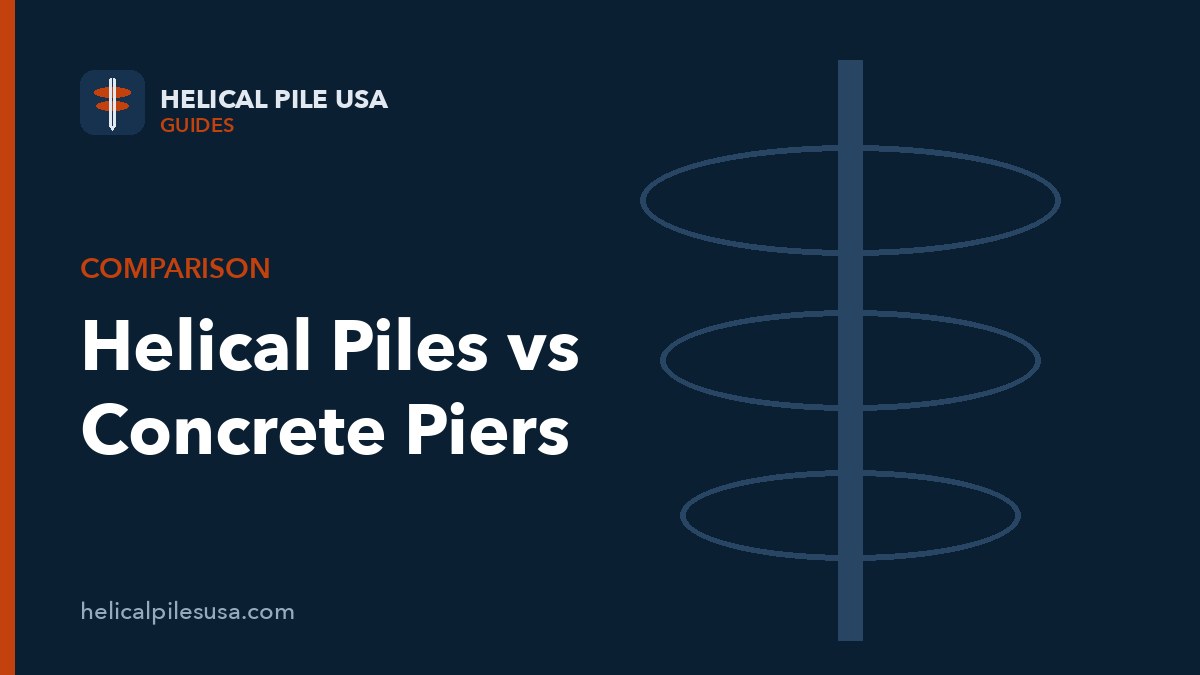

Helical piles and concrete piers can both support a structure, but they solve different problems. Concrete piers are usually cheaper per footing in firm, accessible soil and remain the default for many simple projects. Helical piles usually cost more per unit but go in faster, carry load immediately with no cure time, reach deeper competent soil without large excavations, and resist uplift. In weak, wet, frost-prone, or hard-to-reach sites, helical piles are often the better value.
Key takeaways
- Cost: for decks, a concrete footing can cost about $100 to $300 against about $300 to $700 for a helical pile. For foundation repair, concrete piers run about $1,000 to $3,000 and helical piers about $2,000 to $4,000 per pier.
- Speed: concrete needs 7 to 28 days of curing to reach design strength. Helical piles can be loaded as soon as they are installed.
- Soil: helical piles bypass weak soils without big excavations; concrete in poor soils may need casing and dewatering.
- Verification: helical capacity is checked by installation torque on every pile. Concrete capacity relies on design assumptions and inspection.
- Houston and Texas: pressed concrete pilings are common and inexpensive on expansive clays, but prices vary widely by source.
Helical piles vs. concrete piers: side-by-side comparison
| Factor | Helical piles | Concrete piers |
|---|---|---|
| Deck footing cost | About $300 to $700 per pile | About $100 to $300 per footing |
| Foundation repair cost | About $2,000 to $4,000 per pier | About $1,000 to $3,000 per pier |
| Time before loading | Immediately after installation | 7 to 28 days of curing |
| Excavation and spoils | Little to none | Digging or drilling; spoils to haul away |
| Weather sensitivity | Installs in most weather, including cold | Pours limited by freezing temperatures and rain |
| Capacity verification | Installation torque on every pile | Design assumptions, inspection, and cylinder tests |
| Uplift resistance | Yes, through helix bearing | Limited unless designed with extra mass or reinforcement |
| Access needs | Compact machines; no concrete truck | Concrete truck or pump access, or hand mixing |
Cost figures from HomeGuide, Helical Anchors, Inc., Rise, and Today's Homeowner; installation and curing details from Hubbell's CHANCE Foundation Solutions.
What are helical piles?
A helical pile (also called a screw pile or helical pier) is a steel shaft with one or more helix plates welded near the tip. It is rotated into the ground by a hydraulic drive head until it reaches soil that can carry the design load. Because the relationship between installation torque and capacity is well documented, the installer can confirm capacity on every pile as it goes in. That method is recognized in IBC Section 1810.3.3.1.9. Our article on how much weight a helical pile can hold covers capacity in more depth.
What are concrete piers?
"Concrete pier" covers several different systems:
- Poured footings and sonotube piers: a hole is dug or augered below the frost line, often with a cardboard form, and filled with reinforced concrete. This is the standard deck and post footing.
- Drilled piers (including bell-bottom piers): deeper augered shafts filled with reinforced concrete, sometimes belled at the base to spread the load. Used in new construction and repair.
- Pressed concrete pilings: short precast cylinders stacked and hydraulically pressed under a slab. Common for foundation repair in Texas and other expansive-clay regions.
These systems differ in cost and performance, so it helps to know which one a contractor is proposing.
Helical piles vs. concrete piers: cost
Decks and light new construction
For a new deck, concrete usually wins on material price. Rise estimates about $70 in materials and $30 to $230 in labor for a concrete deck pier. Helical piles cost more: HomeGuide reports $300 to $500 per pile installed for a deck, and Helical Anchors, Inc. gives $350 to $700 for decks, porches, and accessory structures.
The gap narrows once you count the full job. Concrete footings mean digging, hauling spoils, setting forms, waiting for inspection, pouring, and waiting again for the concrete to gain strength. Helical piles skip most of those steps, which saves labor and schedule time, especially on sloped lots, wet ground, or sites where concrete trucks cannot reach. Hubbell's CHANCE team notes that concrete can be cost competitive in ideal conditions, such as shallow competent soils with good access, while helicals frequently come out ahead when concrete delivery is difficult.
Foundation repair
For underpinning an existing house, published figures overlap:
- Today's Homeowner estimates concrete piers at about $1,000 each ($4,000 to $8,000 per project) against about $3,000 per helical pier ($15,000 to $30,000 per project).
- A second Today's Homeowner guide lists concrete piers at $2,000 to $3,000 per pier and helical piers at $2,500 to $3,500.
- HomeGuide puts helical piers at $2,000 to $4,000 per pier.
The variation reflects the different concrete systems being priced. Shallow poured or pressed piers are cheap; deep drilled piers can approach steel pier prices. For a full breakdown of helical pricing, see our helical pier cost guide.
Helical vs. concrete piers: what works best in Houston?
Houston and much of Texas sit on expansive clay soils that swell when wet and shrink when dry. On slab-on-grade homes, the most common repair systems are pressed concrete pilings, steel pressed pilings, and helical piers.
Pressed concrete pilings are the budget option, but price data varies widely. A Round Rock contractor reports $400 to $600 per pier location, while a 2026 Texas cost report lists pressed concrete at $1,000 to $1,800 per pier, against $1,200 to $3,000 for steel push piers and $1,500 to $3,500 for helical piers. Ram Jack's Houston office quotes $2,000 to $4,000 per helical pier and $1,500 to $3,000 for steel pressed pilings.
How to think about it:
- Pressed concrete pilings are driven until refusal against the slab's weight. They are economical and widely used, but they are usually shallower than steel systems and rely on that refusal rather than a measured capacity.
- Helical piers are a strong fit for lighter structures, additions, and new construction in Houston clays, because they can reach below the zone of seasonal moisture change and their capacity is verified by torque.
- Steel push piers are common for heavier homes where there is enough weight to drive them deep.
Whichever system you choose in Houston, drainage, gutters, and consistent soil moisture around the foundation matter as much as the piers. Compare local installers on our Texas directory page.
Installation speed and weather
This is where helical piles have a clear advantage. According to Hubbell's CHANCE Foundation Solutions, concrete foundations involve excavation or drilling, reinforcement placement, possible casing or dewatering, concrete delivery, inspection, and then 7 to 28 days of curing, and each step adds weather and logistics risk. Helical piles are installed with compact equipment, generate no spoils, and can be loaded immediately. For a new deck or addition, that can shorten the schedule by days or weeks. See how long it takes to install a helical pile.
Soil conditions, frost, and uplift
Concrete footings work well where firm soil is close to the surface. In soft clay, loose fill, or high groundwater, a shallow footing may not reach good soil, and deeper drilled piers may need casing and dewatering, which adds cost. Helical piles can be extended until they reach competent soil and the required torque.
In cold climates, deck footings must extend below the frost line. The 2021 International Residential Code, Section R507.3, requires decks to be supported on concrete footings or other approved structural systems, with footings below the frost line except for certain small, low, freestanding decks. Many jurisdictions accept engineered or code-evaluated helical piles as that approved system, but check with your local building department first. Helical plates set below the frost line also resist frost heave and wind uplift, which a plain concrete cylinder resists mainly through its own weight and friction.
Durability and lifespan
Properly designed concrete footings last for decades, and so do helical piles. For helical products, ICC-ES AC358 bases its scheduled corrosion losses on moderately corrosive soils over a 50-year period, and most components are hot-dip galvanized to ASTM A123. In very corrosive soils, both systems need attention: thicker or coated steel for helicals, and adequate cover and mix design for concrete. Read more in do helical piers rust?
Which should you choose?
Choose concrete piers when soil near the surface is firm and dry, the site is easy to access, the schedule can absorb curing time, and the lowest material cost matters most.
Choose helical piles when soils are weak, wet, or variable; the site is sloped or tight; you need to build soon or in cold weather; the structure faces uplift; or you want documented capacity for every pile.
For repair work, also compare steel options. Our guide to push piers vs. helical piers covers that choice. To get quotes, browse installers in the Helical Pile USA directory by state, including Florida and New Jersey.
Frequently asked questions
Are helical piles better than concrete?
Not in every case. Helical piles are usually better in weak or wet soils, tight or sloped sites, cold weather, and projects that need immediate loading or uplift resistance. Concrete is often the lower-cost choice for simple footings in firm, accessible soil.
Are screw piles cheaper than concrete piles?
Per unit, usually not. Concrete deck footings can cost around $100 to $300 against $300 to $700 for a helical pile. On a full project, reduced excavation, labor, and schedule time can make helical piles competitive or cheaper, especially on difficult sites.
Do helical piles need concrete?
No. Helical piles bear on soil through their helix plates and need no concrete to carry load. In new construction, they are often capped with a steel bracket or embedded in a concrete grade beam or footing that ties the structure together.
How long do helical piles last compared to concrete piers?
Both are designed for decades of service. Helical pile corrosion allowances under ICC-ES AC358 are based on a 50-year period in moderately corrosive soil, and galvanizing extends service life. Concrete longevity depends on mix quality, reinforcement cover, and exposure.
Can helical piles be used for a deck instead of concrete footings?
Yes, in most places. The IRC allows decks on concrete footings or other approved structural systems. Many building departments accept helical piles with manufacturer or engineer documentation, but confirm locally before you build.
What works best for foundation repair in Houston?
It depends on the home's weight, the depth of stable soil, and budget. Pressed concrete pilings are the most economical and common, steel push piers suit heavier homes, and helical piers suit lighter structures and additions. Get bids on more than one system from Houston-area installers.
Subscribe to our weekly email newsletter
Industry news, featured projects, new products, and installer spotlights from across the helical pile industry, delivered to your inbox.


Latest articles

Get the Helical Pile Industry Brief
New installers, manufacturer news, cost updates, and fresh guides for the U.S. and Canadian helical pile industry. Short, occasional emails. Unsubscribe any time.
