

Helical Pile Shaft Sizes Chart: Diameters, Wall Thickness and Helix Plates (in and mm)
A helical pile and screw pile size chart: square and round shaft diameters, wall thicknesses, helix plate sizes and torque factors in inches and mm, plus 1.875, 2.875 and 12.75 in to mm.
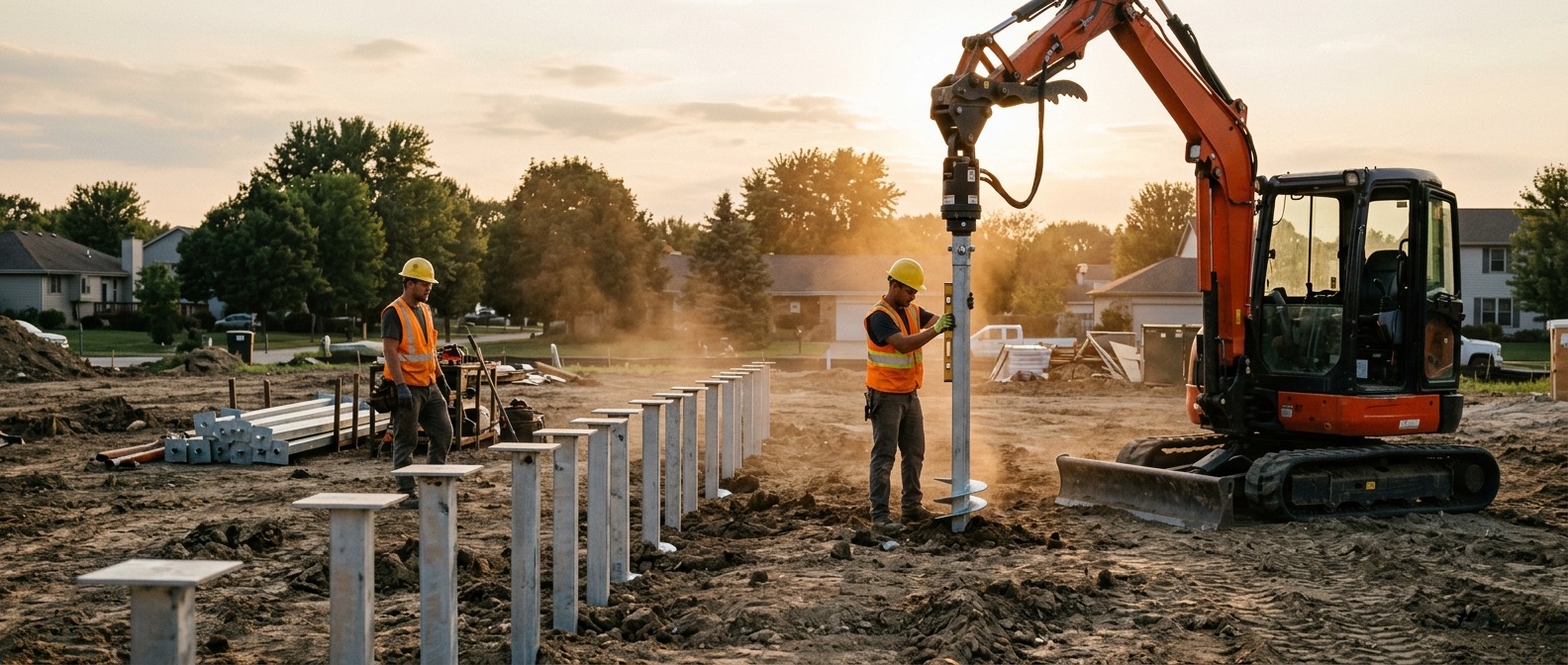

Helical pile shafts come in two families. Solid square bars run from about 1.25 to 2.25 inches across the flats (32 to 57 mm). Hollow round pipes run from 1.875 inches (47.6 mm) up to 12.75 inches (323.9 mm) and beyond. Helix plates are most often 8 to 14 inches (203 to 356 mm) in diameter, with larger plates on big shafts. The three conversions people search for most are 1.875 in = 47.625 mm, 2.875 in = 73.025 mm and 12.75 in = 323.85 mm. To convert any size, multiply inches by 25.4. The charts below list common shaft diameters, wall thicknesses, helix plates and torque factors, with the manufacturer documents they come from.
Key takeaways
- Square shafts: 1.5, 1.75, 2.0 and 2.25 inch solid bars are the common sizes. They install efficiently but have limited lateral and buckling resistance.
- Round shafts: 2.875, 3.5 and 4.5 inch pipes are core residential and light commercial sizes for brands such as CHANCE, Magnum and GoliathTech. Canadian screw pile makers also offer 1.875 to 2.375 inch pipes for light loads.
- Large diameters: 6.625 to 12.75 inch pipes (and larger) are used for heavy commercial, energy and utility work.
- Helix plates: 8 to 14 inches is standard, 3/8 or 1/2 inch thick, with a 3 inch pitch.
- Bigger shaft, lower Kt: the torque-to-capacity factor falls from 10 ft-1 for 1.5 inch square bar to about 2.4 ft-1 for 12.75 inch pipe.
Quick inch-to-mm conversions for helical pile sizes
These are exact conversions (1 inch = 25.4 mm), with the rounded metric size you'll see on Canadian and European spec sheets.
| Inches (fraction) | Inches (decimal) | Millimetres (exact) | Commonly written as |
|---|---|---|---|
| 1-7/8" | 1.875 | 47.625 mm | 47.6 mm or 48 mm |
| 1.9" | 1.900 | 48.26 mm | 48.3 mm |
| 2-3/8" | 2.375 | 60.325 mm | 60.3 mm |
| 2-7/8" | 2.875 | 73.025 mm | 73.0 mm or 73 mm |
| 3" | 3.000 | 76.2 mm | 76.2 mm |
| 3-1/2" | 3.500 | 88.9 mm | 88.9 mm or 89 mm |
| 4" | 4.000 | 101.6 mm | 101.6 mm |
| 4-1/2" | 4.500 | 114.3 mm | 114.3 mm or 114 mm |
| 5-1/2" | 5.500 | 139.7 mm | 139.7 mm |
| 5-9/16" | 5.563 | 141.3 mm | 141.3 mm or 141 mm |
| 6-5/8" | 6.625 | 168.275 mm | 168.3 mm or 168 mm |
| 7" | 7.000 | 177.8 mm | 177.8 mm |
| 8-5/8" | 8.625 | 219.075 mm | 219.1 mm or 219 mm |
| 9-5/8" | 9.625 | 244.475 mm | 244.5 mm |
| 10-3/4" | 10.750 | 273.05 mm | 273.1 mm or 273 mm |
| 12-3/4" | 12.750 | 323.85 mm | 323.9 mm or 324 mm |
| 16" | 16.000 | 406.4 mm | 406.4 mm |
Most of these outside diameters match standard steel pipe and hollow structural section (HSS) sizes. That is why the odd fractions, such as 2-7/8 and 12-3/4, show up across brands.
Square shaft helical pile sizes
Square shaft piles use a solid, round-cornered square steel bar. CHANCE describes square shafts as ranging from 1-1/4 to 2-1/4 inches across the flats. They have the highest torque correlation factor of any shaft type and are the first choice for loads up to about 50 kips in firm soil, but they are not suited to significant lateral loads (Hubbell).
| Size (across flats) | mm | Example models | Max. installation torque (ft-lb) | Common uses |
|---|---|---|---|---|
| 1-1/2" | 38.1 | CHANCE SS5; Magnum MS150B | 5,700 (SS5); 7,000 (MS150B) | Light residential piles, tension anchors, tiebacks |
| 1-3/4" | 44.45 | CHANCE SS175; Magnum MS175B | 10,500 | Residential underpinning, light commercial, tiebacks |
| 2" | 50.8 | CHANCE SS200 | See manufacturer ratings | Heavier compression and tension anchors |
| 2-1/4" | 57.15 | CHANCE SS225 | 21,000 | High-capacity anchors and piles in firm soil |
Sources: ICC-ES ESR-2794 (SS5, SS175), Magnum Piering specification tables, and the CHANCE SS225 product sheet, which lists a 210 kip ultimate compression capacity.
Round shaft helical pile sizes
Round shaft piles use hollow pipe. They have higher section properties than square bar, so they resist buckling and lateral loads better and suit soft soils (Hubbell). The table combines published sizes from four manufacturers. Wall thicknesses are nominal.
| Outside diameter | mm | Published wall thicknesses (in / mm) | Example manufacturers | Common uses |
|---|---|---|---|---|
| 1.875" | 47.6 | 0.154 / 3.9 | GoliathTech | Decks, sheds, light accessory structures |
| 1.9" | 48.3 | 0.145 / 3.68 | Techno Metal Post (P1) | Decks, fences, light structures |
| 2.375" | 60.3 | 0.154 / 3.9; 0.25 / 6.35 | GoliathTech, Techno Metal Post (P2), Magnum | Decks, porches, sunrooms |
| 2.875" | 73.0 | 0.203 / 5.16; 0.22 / 5.6; 0.25 / 6.35; 0.276 / 7.0 | CHANCE, Magnum, Techno Metal Post (P2.5), GoliathTech | Decks, additions, residential new construction and repair |
| 3.0" | 76.2 | 0.125 / 3.2; 0.27 / 6.9 | Magnum | Residential and light commercial |
| 3.5" | 88.9 | 0.21 / 5.3; 0.216 / 5.49; 0.25 / 6.35; 0.30 / 7.62 | CHANCE, Magnum, Techno Metal Post (P3), GoliathTech | Homes, additions, light commercial, repair |
| 4.5" | 114.3 | 0.25 / 6.35; 0.29 / 7.37; 0.337 / 8.56 | CHANCE, Magnum, GoliathTech | Commercial, heavier repair, soft soils |
| 5.5" to 5.563" | 139.7 to 141.3 | 0.25 to 0.47 / 6.35 to 11.9 | Magnum, Techno Metal Post (P5), GoliathTech | Commercial and industrial |
| 6.625" | 168.3 | 0.25 / 6.35; 0.375 / 9.53 | GoliathTech, Techno Metal Post (P6) | Commercial, towers, heavy lateral loads |
| 7.0" | 177.8 | 0.36 to 0.45 / 9.1 to 11.4 | Magnum | Commercial and industrial |
| 8.625" | 219.1 | 0.25 / 6.35; 0.375 / 9.53; 0.50 / 12.7 | GoliathTech, Magnum | Heavy commercial, energy, utility |
| 10.75" | 273.1 | 0.25 / 6.35; 0.375 / 9.53; 0.50 / 12.7 | GoliathTech, Magnum | Heavy commercial, energy, utility |
| 12.75" | 323.9 | 0.375 / 9.53; 0.50 / 12.7 | GoliathTech, Magnum | Heavy commercial, energy, utility |
Sources: ESR-2794 (CHANCE RS2875.203, RS2875.276, RS3500 and RS4500), Magnum Piering, GoliathTech model specification and the Techno Metal Post spec book. Postech also publishes load tables for its 1-7/8 through 6-5/8 inch models (Postech). Magnum lists even larger pipes, including 13.375, 16 and 18.625 inch diameters. The "common uses" column is a general guide only. The engineer picks the size from the loads and soils.
Large-diameter work is growing. See our news coverage of Cyntech's 160 large-diameter piles for an energy project and GoliathTech's new U.S. plant.
Wall thickness conversions (in to mm)
| Wall (in) | Wall (mm) | Where you'll see it |
|---|---|---|
| 0.145 | 3.68 | 1.9" light residential pipe |
| 0.154 | 3.91 | 1.875" and 2.375" screw pile pipe |
| 0.203 | 5.16 | 2.875" standard wall |
| 0.216 | 5.49 | 3.5" residential pipe |
| 0.250 | 6.35 | Common across 2.375" to 10.75" |
| 0.276 | 7.01 | 2.875" heavy wall |
| 0.300 | 7.62 | 3.5" heavy wall |
| 0.337 | 8.56 | 4.5" heavy wall |
| 0.375 | 9.53 | 6.625" to 12.75" pipe |
| 0.500 | 12.7 | 8.625" to 12.75" heavy wall |
Nominal vs. design wall thickness
The wall on a spec sheet is usually nominal. Capacity calculations use a reduced design thickness. AC358 requires designers to start from the design wall thickness for HSS under AISC 360 (or the nominal thickness), then subtract a sacrificial corrosion allowance over a 50-year life: 0.013 inch (318 µm) for zinc-coated steel and 0.036 inch for bare steel (ICC-ES AC358, Section 3.9). That is one reason a thicker wall or galvanizing is often specified in aggressive soils. See do helical piers rust?
Helix plate sizes
| Helix diameter (in) | mm | Typical thickness | Notes |
|---|---|---|---|
| 6 | 152.4 | 1/2 in (12.7 mm) | Offered on some square shafts, such as CHANCE SS225 |
| 8 | 203.2 | 3/8 or 1/2 in (9.5 or 12.7 mm) | Smallest size inside AC358's standard torque-correlation range |
| 10 | 254 | 3/8 or 1/2 in | Very common lead helix |
| 12 | 304.8 | 3/8 or 1/2 in | Very common trailing helix |
| 14 | 355.6 | 3/8 or 1/2 in | Largest size inside AC358's standard range |
| 16 to 24 | 406.4 to 609.6 | 3/8 to 5/8 in | Larger round shafts and softer soils |
| 30 to 42 | 762 to 1,066.8 | 1/2 in to 1 in | Large-diameter commercial and utility piles |
For a system to use AC358's standard Kt values, helix plates must be 8 to 14 inches in diameter and 3/8 to 1/2 inch thick, with a 3-inch pitch (±1/4 inch) and spacing of 2.4 to 3.6 helix diameters. Multi-helix piles must have the smallest helix at the tip and larger ones above (AC358, Table 3). CHANCE spaces its plates at 3 times the diameter of the helix below. Manufacturers publish larger plates for big shafts. GoliathTech's specification lists helix plates up to 39 inches on its 10.75 and 12.75 inch piles, and Magnum lists plates up to 42 inches. For how extra plates add capacity, see our news brief on what extra helix plates add to pile capacity.
Torque correlation factor (Kt) by shaft size
Capacity is estimated from final torque as Qult = Kt × T. Kt gets smaller as the shaft gets bigger, so large shafts need much more torque for the same capacity.
| Shaft | Kt (ft-1) | Source |
|---|---|---|
| 1.5" and 1.75" square | 10 | AC358 default; ESR-2794 |
| 2.375" round | 10 | Magnum (MH2325U) |
| 2.875" round | 9 | AC358 default; ESR-2794 |
| 3.0" round | 8 | AC358 default |
| 3.5" round | 7 | AC358 default; ESR-2794 |
| 4.5" round | 5.5 to 5.7 | ESR-2794 (5.5); Magnum (5.7) |
| 5.5" round | 4.8 | Magnum |
| 7" round | 3.9 | Magnum |
| 8.625" round | 3.3 | Magnum |
| 10.75" round | 2.8 | Magnum |
| 12.75" round | 2.4 | Magnum |
AC358 only assigns default values to square shafts from 1.5 to 3.0 inches and round shafts from 2.125 to 4.5 inches. Other values come from the manufacturer's load testing. Magnum also lists lower factors for some variants of the same shaft size (its “-6” models). Always use the value in the evaluation report or the manufacturer's current tables. For worked examples, see how much weight a helical pile can hold.
How to choose a helical pile size
- Start with the load. Pick a product series whose rated capacity meets or exceeds the design load, as CHANCE's engineering guidance recommends (Hubbell).
- Check the soil. Soft soils favor round shafts, which resist buckling better, and larger or more numerous helix plates. Dense soils favor smaller plates.
- Check lateral and uplift loads. Wind, seismic, retaining and uplift loads usually point to round shafts or to anchors. See helical anchors vs. helical piles.
- Check the torque. The required torque (design load × safety factor ÷ Kt) must stay below the shaft's maximum installation torque rating and within the capacity of the contractor's drive head.
- Allow for corrosion with a thicker wall, galvanizing or both.
- Confirm the code listing. Use a model listed in an ICC-ES report, such as ESR-2794 for CHANCE or ESR-3418 for Techno Metal Post, or a CCMC evaluation in Canada. Our permits and codes guide explains how to check one.
Depth and spacing go hand in hand with size. See how deep helical piles go and how far apart helical piers need to be. Size also drives price, which is covered in our helical pier cost guide.
Find manufacturers and installers by size
Compare product lines from CHANCE, Magnum Piering, GoliathTech, Techno Metal Post, Postech and Cyntech in our helical pile manufacturer directory. New to the topic? Start with what is a helical pile. When you're ready to build, find a helical pile installer in your state or province.
Frequently asked questions
What is 1.875 inches in mm?
1.875 inches equals 47.625 mm, usually written as 47.6 mm or 48 mm on screw pile spec sheets.
What is 2.875 inches in mm?
2.875 inches equals 73.025 mm, usually written as 73 mm. It is one of the most common round helical pile shaft diameters.
What is 12.75 inches in mm?
12.75 inches equals 323.85 mm, usually written as 323.9 mm or 324 mm. It is a large-diameter shaft size used on heavy commercial and utility projects.
What is the most common helical pile size?
For residential and light commercial work, 2.875 and 3.5 inch round shafts are core sizes for CHANCE, Magnum, Techno Metal Post and GoliathTech, and 1.5 and 1.75 inch square shafts are core sizes for CHANCE and Magnum. Most use 8 to 14 inch helix plates.
Are square or round helical piles better?
Neither is better in every case. Square shafts install efficiently and suit tension and compression in firm soils. Round shafts are better for soft soils, lateral loads and buckling resistance.
What size helical pile do I need for a deck?
It depends on the load per post, soil and frost depth, so the installer or engineer sets it. Many deck systems use round shafts from about 1.875 to 3.5 inches. See helical piles for decks.
Subscribe to our weekly email newsletter
Industry news, featured projects, new products, and installer spotlights from across the helical pile industry, delivered to your inbox.


Latest articles


Get the Helical Pile Industry Brief
New installers, manufacturer news, cost updates, and fresh guides for the U.S. and Canadian helical pile industry. Short, occasional emails. Unsubscribe any time.
