

How Long Does It Take to Install Helical Piles? Full Timeline
How long does it take to install helical piles? Minutes per pile, piles per day for decks, new builds and repairs, and cure time vs concrete.


A single helical pile usually takes between a few minutes and about half an hour to screw into the ground, depending on depth and soil. A small deck is normally a one-day job, a crew on open new-construction ground can set dozens of piles a day, and foundation repair with excavation and a lift typically runs one to three days on site. Permits, engineering and inspections, not the screwing itself, set most of the calendar.
Key takeaways
- Per pile: Techno Metal Post quotes about 30 minutes for a pile set 6 feet deep; turning time alone can be 5 minutes for 10 feet of shaft.
- Per day: rates run from about 5 piers a day on foundation repair to 30 or more on open new-construction sites.
- Whole job: most residential foundation repairs take one to three days on site, according to Ram Jack.
- No cure wait: a helical pile can carry load as soon as it reaches its torque and depth; concrete footings need a curing period of at least 7 days under PCA guidance.
- Biggest delays: paperwork, obstructions, rock, tight access, frozen ground and piles that need extra extensions to reach the required torque.
How many minutes does one helical pile take?
The turning itself is quick. The CHANCE helical pile installation instructions call for the pile to advance at roughly 3 inches per revolution and limit installation speed to less than 15 rpm. At those limits a shaft advances at most about 45 inches (under 4 feet) per minute, so pure turning time for a 20-foot pile is at least 5 to 6 minutes. A Pile Buck Magazine article gives a similar figure: at 6 to 10 rpm, about 30 seconds per foot and five minutes for 10 feet.
Real per-pile time is longer because the crew also has to locate and plumb the pile, bolt on extensions, record torque and depth, and cut and cap the shaft. Techno Metal Post puts a 6-foot residential pile at about 30 minutes. On the fast end, a CHANCE case history for a new single-family home reports 33 piers installed in 3 hours, or roughly 5 to 6 minutes each, against an estimate of 7 days for drilled, cased concrete piers.
For the order of the steps (layout, drive, torque monitoring, cutoff and capping), see our helical pile installation process guide. This page focuses on how long each part takes.
How many helical piles can be installed in a day?
Daily production depends far more on the type of project than on the pile. Open ground with a machine that can drive straight to each location is fast. Work beside an existing house, where every pier needs a hand-dug pit and a bracket, is slow.
| Project type | Reported rate | Source |
|---|---|---|
| Deck or small residential structure | About 30 minutes per pile at 6 ft; most residential projects done in one day by a two-person crew | Techno Metal Post, Postech |
| New construction, open site | 33 piers in 3 hours (single-family home) | CHANCE case history |
| General production, operator plus laborer | Up to 30 to 40 piles a day, depending on the project | Pile Buck |
| Foundation repair with excavation and lift | 10 piers over two days, then a 30-minute lift | Dalinghaus project record |
| Deep piers in winter (existing home plus new work) | 37 piers to depths over 21 ft in less than five days | Supportworks case study |
Treat the top of each range as a best case. Manufacturer case studies are chosen because they went well, and a typical residential job includes setup, layout and cleanup time that a per-pile rate hides.
Whole-project timelines, from permit to final inspection
The install is the shortest phase on most jobs. The full schedule usually runs in this order:
- Engineering: the designer sets pile type, minimum depth and minimum installation torque, and those values go on the approved construction documents the crew installs to.
- Permit review: this ranges widely by jurisdiction. Fairfax County, Virginia cut its residential deck review from about ten days to three business days in 2023; many places are slower. See our guide to helical pile permits and building codes.
- Utility locate and mobilization: the crew schedules the job, has buried lines marked and brings the machine, piles and torque monitor to site.
- Excavation (repair only): pits are dug at each pier location along the footing so a bracket can be attached.
- Installation: the minutes-per-pile and piles-per-day figures above apply here.
- Bracket and lift (repair only): brackets are set and the load is transferred to the piers. On the Dalinghaus job, lifting the back half of a house 3 inches took about 30 minutes.
- Backfill and cleanup: pits are filled and compacted, and the site is cleaned.
- Inspection: where the IBC applies, Section 1705.9 requires continuous special inspection during helical pile installation, recording equipment, pile dimensions, tip elevations and final torque. The inspector works alongside the crew, so it adds coordination rather than extra days.
| Project | Typical on-site time | What usually sets the calendar |
|---|---|---|
| Deck foundation | One day (Postech) | Permit review and the crew's schedule |
| Foundation repair with lift | One to three days (Ram Jack) | Engineering, permit, number of piers, excavation by hand |
| New home or larger building | Hours to a few days for the piles | Engineering, special inspection, pile count, depth |
To see how pile count and depth drive the price as well as the schedule, run your numbers through the helical pile cost calculator.
What slows a helical pile job down
- Depth: every extra foot is more turning plus another extension to bolt on. The CHANCE instructions require each pile to reach the minimum tip embedment in the approved documents, so a pile that hits its torque early may still need to go deeper. Our guide to how deep helical piles go covers typical ranges.
- Torque not reached: if the pile is still below the required torque at planned depth, the crew adds extensions and keeps going until it is reached. The torque-to-capacity chart explains why torque is the field check on capacity.
- Obstructions: helical piles cannot screw through buried boulders, old footings or debris. CHANCE notes that the pile can usually be backed out and reinstalled, relocated, battered at an angle, or replaced with two piles that bridge the obstruction. Each option costs time.
- Rock and dense soil: if the pile advances less than 2.5 inches per revolution, the CHANCE instructions say the torque-to-capacity correlation may not be valid and a load test is recommended. A load test adds time to the schedule. See helical piles in rocky soil.
- Access: small machines get into tight yards (the smallest Techno Metal Post machine fits through a 29-inch door frame), but they are slower than a full-size excavator, and repair piers often need hand-dug pits.
- Weather and frozen ground: piles can go in through winter, but Techno Metal Post notes it may pre-drill frozen ground with an auger or thaw it first. The Supportworks job above still finished 37 deep piers in under five days in wet winter weather.
Helical piles vs concrete footings: the cure-time gap
Concrete footings need time to gain strength before they carry load. Penn State's civil engineering course notes, which draw on the Portland Cement Association's Design and Control of Concrete Mixtures, state that for most structures the curing period above 40°F should be a minimum of 7 days or until 70% of specified strength is reached. With high-early-strength concrete above 50°F, that can drop to 3 days. In practice, even if footing holes are dug, inspected and poured on day 1, a 7-day cure puts framing on day 9 at the earliest (day 5 with a 3-day cure), while a helical pile deck can be framed on day 1. Concrete left to dry in air gains only about 50% of the strength of continuously moist-cured concrete, so skipping the cure is not a safe shortcut.
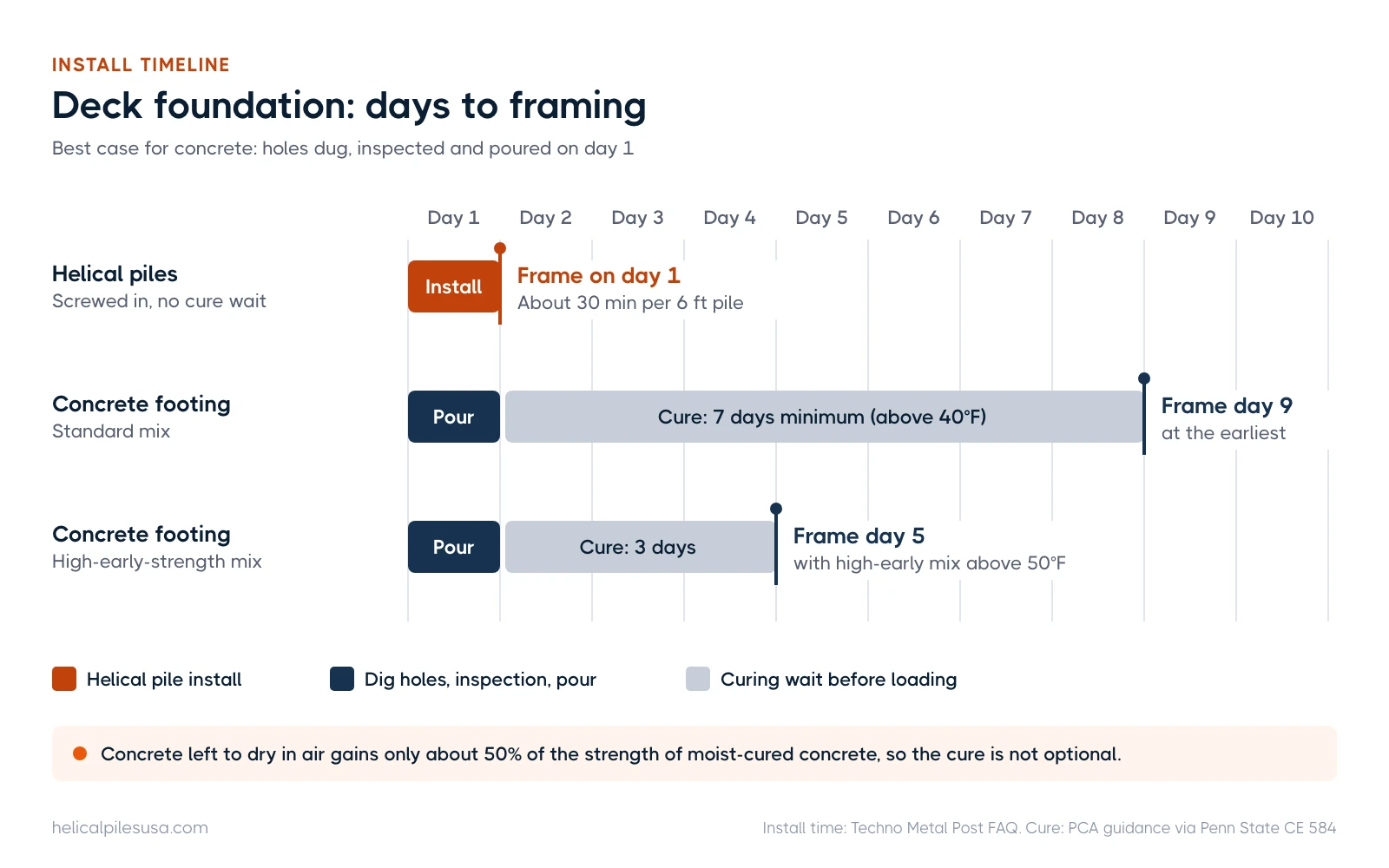
| Step | Helical pile deck foundation | Poured concrete footing |
|---|---|---|
| Holes | None; pile is screwed in | Dig each hole to frost depth |
| Inspection | Torque and depth recorded per pile | Holes are commonly inspected before the pour |
| Install or pour | About 30 minutes per 6 ft pile | Form and pour |
| Wait before loading | None once torque and depth are met | 7 days minimum curing (3 days with high-early-strength mix above 50°F) |
| Framing starts | Same day (Postech, Techno Metal Post) | After the curing period set by the spec |
Your project's engineer or specification sets the exact cure requirement, and some contractors frame earlier on footings than others. The point is that a helical pile carries its load as soon as it reaches the required torque and depth. For a wider comparison, read are helical piles better than concrete.
What the homeowner sees on install day
For a deck or new structure, expect a compact machine or mini excavator with a hydraulic drive head, a trailer of steel shafts, and a small crew. Piles are set one by one at marked locations. Each pile is turned in, extensions are bolted on as needed, and the installer reads torque at the end of each pile. There is no stack of dirt from digging holes and no concrete truck. When the last pile is cut and capped, framing can begin.
For foundation repair, the day is busier. Pits are dug along the wall at each pier location, brackets are attached to the footing, and piers are driven next to the house. If a lift is planned, the crew ties the piers into a hydraulic system and raises the structure while someone tracks elevations, then backfills the pits. You can usually stay in the home, but expect noise, a trench line along the foundation and some landscaping to replace. Our guide to helical piers for foundation repair covers the repair side in more detail, and helical piles for decks covers decks.
Find an installer and get a real schedule
Only a local crew that has looked at your soil, access and pile count can give you a firm date. Ask each bidder for a written schedule that separates engineering and permit time from field days, and states how many piles they expect to set per day. You can find a helical pile installer in your state or province in our directory, and use our checklist on how to hire a helical pile contractor.
Frequently asked questions
How long does it take to install helical piles for a deck?
Most residential deck foundations are installed in one day. Techno Metal Post puts a 6-foot pile at about 30 minutes, and framing can start the same day because there is no cure time.
How many helical piles can be installed in a day?
Anywhere from about 5 on a foundation repair with excavation to 30 or more on an open new-construction site. One CHANCE case history reports 33 piers on a new home in 3 hours.
How long does helical pier foundation repair take?
Ram Jack says most repairs take one to three days on site. Engineering and permits before the work can take longer than the repair itself.
Can you build on helical piles right away?
Yes. Once a pile reaches its required torque and depth it can take load, so there is no equivalent of the 7-day minimum concrete curing period.
What makes helical pile installation take longer?
Deep soft soil that needs extra extensions, buried obstructions, rock, tight access, frozen ground and any load testing the engineer orders when torque readings are in doubt.
Does winter delay helical pile installation?
Usually not by much. Piles can be installed year round, though frozen ground may need pre-drilling or thawing first.
Last reviewed October 2026 by the Helical Pile USA editorial team. Found an error? Tell us.
Subscribe to our weekly email newsletter
Industry news, featured projects, new products, and installer spotlights from across the helical pile industry, delivered to your inbox.


Latest articles



Get the Helical Pile Industry Brief
New installers, manufacturer news, cost updates, and fresh guides for the U.S. and Canadian helical pile industry. Short, occasional emails. Unsubscribe any time.
