

Micropiles vs Helical Piles: What Is a Micropile, Capacity, Cost
What is a micropile? How micropiles compare with helical piles on capacity, rock, headroom, vibration, testing and cost, plus grouted helical hybrids.
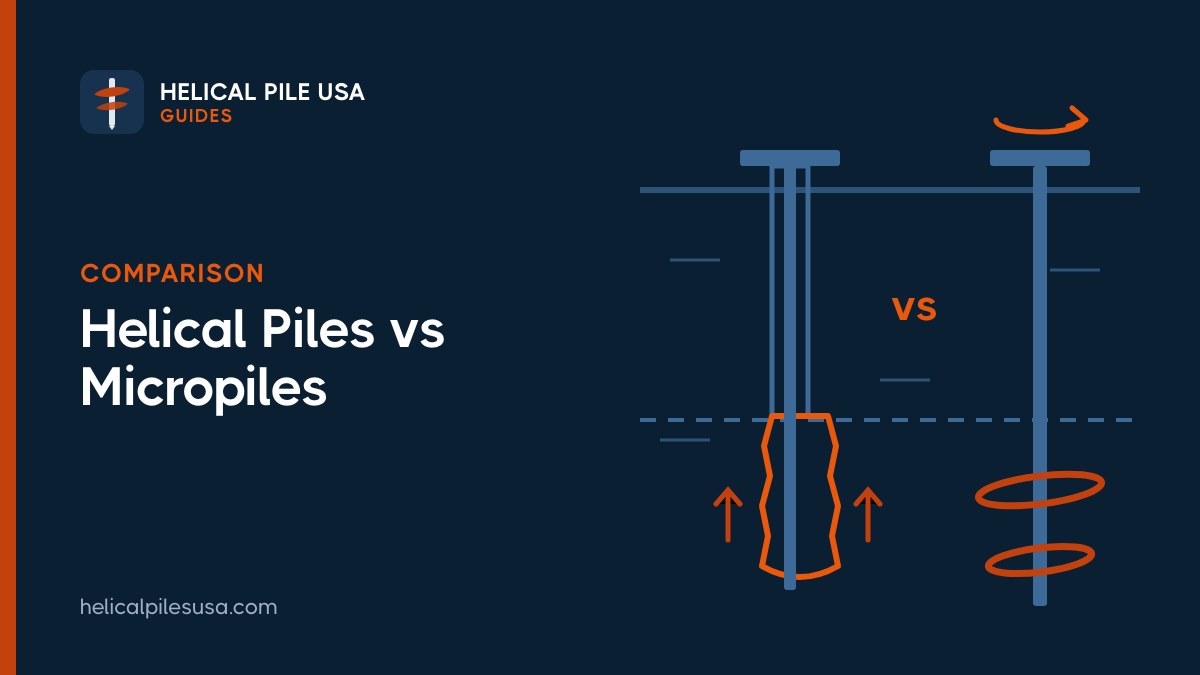

A micropile is a small-diameter pile, typically less than 12 in. across, built by drilling a hole, placing a steel bar or casing in it and filling it with cement grout. It carries load through friction between the grout and the ground. A helical pile is a steel shaft with helix plates that is screwed into the soil and carries load mainly by bearing on those plates. Micropiles win in rock, boulders, rubble fill and very high loads; helical piles win on speed, cost, cleanliness and same-day loading in soil.
Key takeaways
- Definition: The Federal Highway Administration defines a micropile as a drilled and grouted non-displacement pile, typically less than 300 mm (12 in.) in diameter, that is usually reinforced with steel.
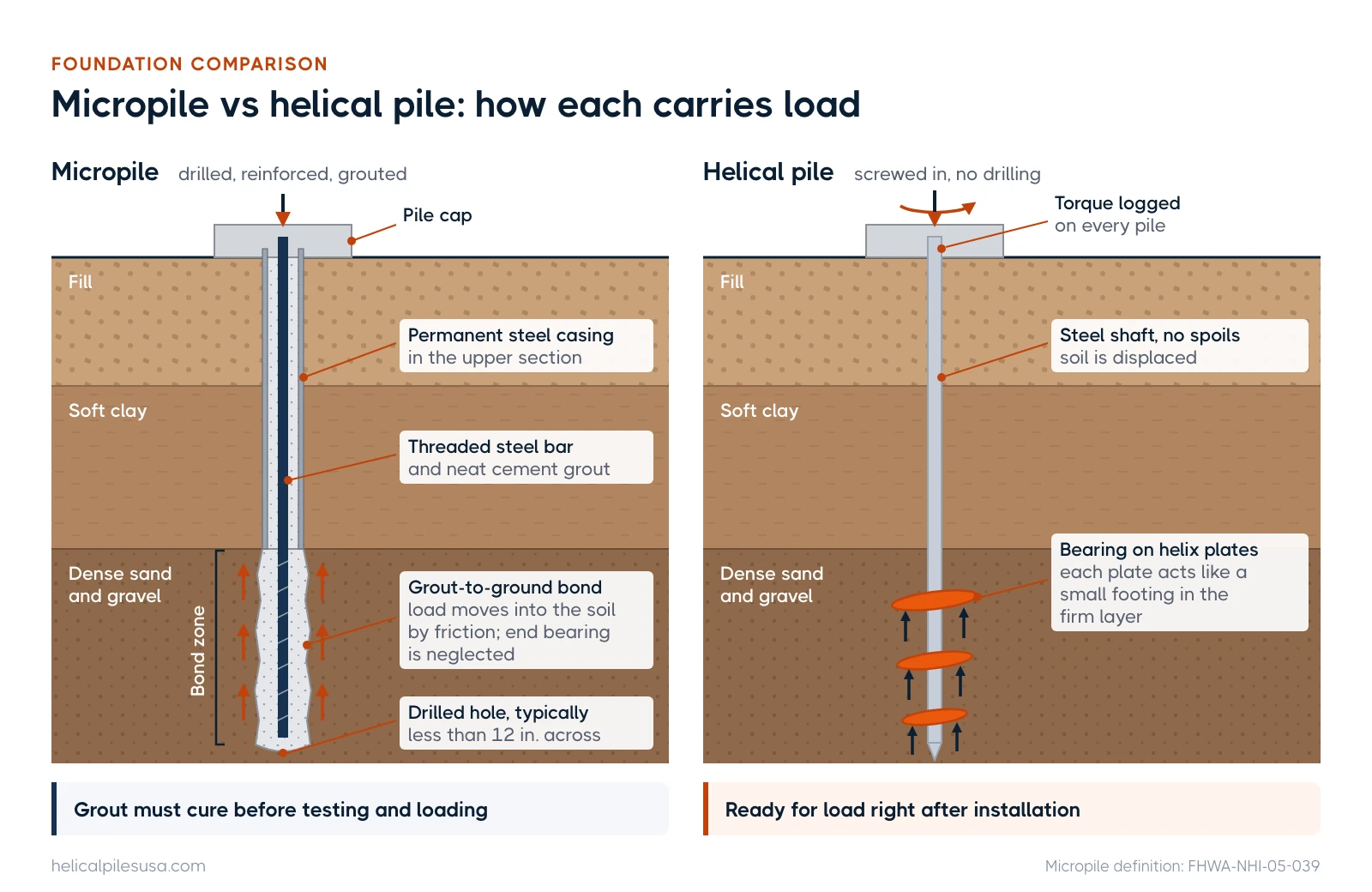
- Load transfer: Micropiles develop capacity through grout-to-ground bond along a bond zone, and end bearing is generally neglected. Helical piles develop capacity mainly through bearing on the helix plates, verified by installation torque.
- Capacity: CHANCE reports helical working loads typically under 100 kips in normally consolidated soil. FHWA reports micropiles in rock tested to ultimate loads as high as 1,000 kips.
- Where each wins: Micropiles drill through boulders, debris and rock and fit under low headroom. Helical piles install faster, produce no spoils and can be loaded right away.
- Hybrids: Grouted displacement piles such as CHANCE GroutForce, PierTech Heli Max and IDEAL STELCOR combine a screwed-in steel core with a grout column to reach micropile-range capacities without drilling spoils.
- Testing: FHWA calls for a micropile verification test to 2.0 times the design load plus proof tests. Every helical pile is checked by its torque record.
What is a micropile?
The standard U.S. reference is the FHWA Micropile Design and Construction reference manual (FHWA-NHI-05-039). It defines a micropile as a small-diameter (typically less than 300 mm, or 12 in.) drilled and grouted non-displacement pile that is typically reinforced. The steel does most of the structural work: FHWA notes that steel elements may take up as much as half of the drilled hole's cross section. The Caltrans Foundation Manual lists their other names: root piles, pin piles, needle piles and minipiles.
How a micropile is built
- Drill: A drill rig advances a hole, usually with temporary steel casing in soil so the hole does not collapse. In rock, open-hole methods such as down-the-hole hammers are common.
- Reinforce: A threaded steel bar, a steel casing, or both go in the hole. FHWA lists 5-1/2, 7 and 9-5/8 in. casings as the common U.S. sizes.
- Grout: Neat cement grout is pumped in by tremie from the bottom up. The temporary casing is pulled back through the bond zone, often while grout is injected under pressure.
- Cure and connect: The grout must harden before the pile is load tested or loaded. The FHWA guide specification asks for a 3-day grout strength of 14 MPa (about 2,000 psi) before load testing, and 28 MPa (about 4,000 psi) at 28 days is common.
Micropile grouting types A to D
FHWA classifies micropiles by how the grout is placed, because grouting method is the biggest single influence on bond capacity:
- Type A: grout placed under gravity head only. FHWA advises designers to assume Type A for bond zones in rock.
- Type B: neat cement grout injected under pressure, typically 72 to 145 psi, as the temporary casing is withdrawn. This is the default design assumption for bond zones in soil.
- Type C: gravity grout, then a single pressure injection of at least 145 psi through a sleeved pipe about 15 to 25 minutes later.
- Type D: gravity grout, then repeated post-grouting through a sleeved pipe with a packer after the first grout has hardened, so specific intervals can be treated more than once.
How each pile carries load
A micropile is a friction pile: load passes from the steel into the grout, then from the grout into the ground along the bond zone. FHWA neglects end bearing because the tip is so small. A helical pile is mainly an end-bearing pile: each helix plate acts like a small buried footing, and the soil above and below the plates resists compression and uplift.
Micropile bond capacity
The geotechnical capacity of a micropile is the bond strength times the surface area of the bond zone. The Caltrans manual describes it as grout transferring load by friction, in the same way as a ground anchor. FHWA publishes typical ultimate grout-to-ground bond strengths by ground type and grouting method:
| Ground (FHWA Table 5-3) | Type A (psi) | Type B (psi) | Type D (psi) |
|---|---|---|---|
| Silt and clay, soft to medium plastic | 5 to 10 | 5 to 14 | 5 to 21 |
| Silt and clay, stiff to very dense | 5 to 17.5 | 10 to 27.5 | 14 to 27.5 |
| Sand, fine, loose to medium dense | 10 to 21 | 10 to 27.5 | 14 to 35 |
| Sand with gravel, medium to very dense | 14 to 31 | 17.5 to 52 | 21 to 56 |
| Glacial till, medium to very dense | 14 to 27.5 | 14 to 45 | 17.5 to 48.5 |
| Soft shale | 30 to 80 | N/A | N/A |
| Sandstone | 75.5 to 250 | N/A | N/A |
| Limestone | 150 to 300 | N/A | N/A |
Rock bond values run about ten times those in soil. FHWA advises designers to use values no higher than the middle of each range unless they have local experience. As an illustration, using the middle of the Type B range for dense sand and gravel (about 35 psi, or 5 ksf) on an 8 in. bond-zone hole gives about 10.5 kips of ultimate resistance per foot of bond. A 20 ft bond zone would then give about 210 kips ultimate, or about 105 kips allowable with a factor of safety of 2.0, which matches the 2.0 times design load that FHWA uses for verification tests. Real designs use site borings and verification tests.
Helical pile capacity
Helical capacity is estimated from the helix plate areas and soil strength, then confirmed in the field with the torque correlation Qu = Kt × T. ICC-ES AC358 sets default Kt values of 10 ft-1 for 1.5 and 1.75 in. square shafts, 9 for 2.875 in. round, 8 for 3.0 in. round and 7 for 3.5 in. round shafts. A 3.5 in. round shaft installed to 10,000 ft-lb, for example, indicates about 70 kips ultimate, or 35 kips allowable at a factor of safety of 2. The CHANCE Technical Design Manual says working loads per helical pile are typically less than 100 kips in normally consolidated soil, and working tension loads are typically 100 kips or less. See our torque to capacity chart and our guide to how much weight a helical pile can hold for sizes and examples.
Capacity ranges compared
The West Virginia Division of Highways says 7 in. and 9 in. micropiles are used for structural capacities of about 200 and 400 kips, with more steel for higher loads. FHWA notes that above about 200 kips allowable, a steel casing is likely needed rather than bars alone, and reports micropiles in rock tested to ultimate loads as high as 1,000 kips. Standard helical piles sit well below that, so heavy projects use micropiles, more helical piles per cap, or the grouted hybrids below.
Where micropiles win
FHWA says micropiles usually cost more per foot than conventional piles, so they pay off where site conditions make other systems difficult:
- Rock and rock sockets: A micropile drills into bedrock and bonds to it. A helical pile stops on top of it. In West Virginia's karst, the state highway agency prefers micropiles because pinnacled bedrock can deflect driven piles and drilled shafts.
- Boulders, cobbles and debris: FHWA lists ground with boulders, cobbles, buried utilities and rubble fill as conditions where micropiles can be installed. These obstructions can stop or bend a helical lead. Our guide to helical piles in rocky soil covers when helicals still work.
- Low headroom and tight access: Small drill rigs can work inside basements and under bridge decks, with casing added in short threaded sections.
- Karst, voids and mines: FHWA also lists voids, karst and old mine workings.
- Very high loads in tension and compression: Rock-socketed micropiles reach several hundred kips per pile.
Micropiles also have limits. FHWA says vertical micropiles may be limited in lateral capacity, and their high slenderness means they may not be acceptable where liquefaction could remove lateral support. Caltrans limits their use on bridges for these reasons.
Where helical piles win
- Speed and same-day loading: CHANCE notes that helical piles can be loaded immediately with no cure time. A micropile needs its grout to cure before it is tested or loaded.
- No spoils: A helical pile displaces soil and removes none. Micropile drilling produces cuttings and flush water that must be contained.
- Capacity verified on every pile: Installation torque is logged for each helical pile, so a weak spot shows up during installation. Micropile bond capacity is confirmed by verification and proof tests on a sample of piles.
- Light equipment and lower cost: CHANCE notes helical piles install with backhoes, skid-steer loaders and mini-excavators fitted with torque motors, with no grout plant, drill crew or water handling.
For homes, decks, additions and light commercial work in soil, a helical pile is usually the simpler answer. See what a helical pile is and the helical pile installation process for the full picture.
Vibration and noise
Both systems suit low-vibration work such as underpinning. FHWA says micropile installation causes minimal vibration and noise compared with conventional piling, especially driven piles. The drilling method still matters: FHWA notes that top-drive percussive systems are relatively noisy and may cause damage through excessive vibration, while auger drilling is quiet. The CHANCE manual states that, unlike driven piles, helical piles are vibration-free, and that they have been installed inside occupied office buildings, shops and hospitals. A Jersey City underpinning project chose helical piles after nearby pile driving damaged a historic brick building.
Grouted helical piles and displacement hybrids
A growing group of systems blends the two. A steel shaft is screwed or rotated in like a helical pile, while a displacement plate or cone pushes soil aside and the gap is filled with grout. The grout column adds shaft friction, stiffens the pile against buckling in soft soil and protects the steel from corrosion, and nothing is drilled out, so there are no spoils.
| System | How it works | Published figures (manufacturer) |
|---|---|---|
| CHANCE Helical Pulldown Micropile (HPM) | A displacement plate on a standard helical pile forms an annulus that fills with gravity-fed grout as the pile advances. | Maximum ultimate capacity 300 kips; 40 to 50 piles per day (CHANCE HPM brochure) |
| CHANCE GroutForce | A steel shaft fully encased by a grout column formed during installation. | 6-5/8 in. lead: 12.75 in. grout column, 500 kip ultimate compression, 40,000 ft-lb torsion rating (CHANCE product page) |
| PierTech Heli Max | Pressure-grouted displacement helical pile with a displacement cone, pre-grouting during advance and post-grouting of the lead. | 200 to 500 tons stated capacity, standard excavator, no spoils (PierTech) |
| IDEAL STELCOR | Drilled-in displacement pile: a lateral displacement plate forms a ribbed grout annulus around an 80 ksi steel core. | Tested to 620 kips compression and 600 kips tension without failure; as little as 10 ft of headroom (IDEAL) |
These capacities are published by the manufacturers, not by an independent body, so treat them as product ratings to be confirmed by site load tests. CHANCE has added GroutForce to its HeliCAP design software, PierTech has launched the Heli Max, and IDEAL's STELCOR piles have carried a 13-story Manhattan building and replaced delayed drilled minipiles on a Brooklyn infill site. The CHANCE manual notes that grouted shaft helical piles cannot be installed in every soil.
Verification and load testing
Micropiles
FHWA requires at least one pre-production verification load test on every project, taken to at least 2.0 times the design load. Proof tests then check production piles, usually to 1.6 times the design load. FHWA notes that testing 5 percent of production piles is a common rule, and recommends at least one proof test per substructure unit for underpinning and seismic retrofit, and one per substructure unit but not less than 5 percent for new construction.
Helical piles
Every helical pile is installed to a required torque and depth set by the design professional, and the IBC (Section 1810.4.11) says the applied torque must not exceed the manufacturer's rated maximum. AC358 bases soil capacity on the IBC's helix bearing, torque correlation and load test methods, with a factor of safety of 2 or more on measured soil capacity. Load tests to ASTM D1143 (compression) and D3689 (tension) confirm the torque correlation on larger jobs. See our helical pile load testing guide.
Cost: micropile vs helical pile
Few current public prices exist for micropiles, because they are bid as engineered specialty work. The best published baseline is still FHWA's: a reasonable average of about $300 per linear meter (about $90 per foot) in 2004 dollars, before adjustments for access, headroom, pile length and testing. FHWA breaks the unit cost into 25 to 40 percent materials, 20 to 30 percent equipment, 25 to 60 percent labor and under 5 percent load testing. Costs have risen since 2004, so treat it as a floor and compare systems on cost per unit of capacity, as FHWA recommends.
Helical piles are priced more openly. PierTech cites about $30 per linear foot, or about $600 for a typical 20 ft pier, before brackets, labor and engineering. Installed home costs are in our helical pier cost guide. For the same load in soil, helical piles are usually the cheaper option, because there is no drill crew, grout plant, cure time or spoil handling. Micropiles become competitive when rock, obstructions or very high loads rule helicals out.
Micropile vs helical pile comparison table
| Factor | Micropile | Helical pile |
|---|---|---|
| Installation | Drill, place steel, grout | Screw in with a hydraulic drive head |
| Typical diameter | Less than 12 in. drilled hole | Steel shaft (AC358 default sizes 1.5 to 3.5 in.) with larger helix plates |
| Load transfer | Grout-to-ground bond (friction) | Bearing on helix plates |
| Typical capacity | About 200 to 400 kips structural for 7 to 9 in. piles; tested to 1,000 kips in rock | Working loads typically under 100 kips |
| Rock | Drills and bonds into rock | Bears on top of rock, cannot penetrate it |
| Boulders and debris | Drills through | Can be stopped or deflected |
| Spoils | Cuttings and flush water | None |
| Ready for load | After grout cures | Immediately |
| Capacity check | Verification test plus proof tests on a sample | Torque on every pile plus load tests |
| Vibration | Minimal, depends on drilling method | Vibration-free rotation |
| Cost | Higher per foot; competitive in hard ground | Lower for most soil sites |
Find a contractor
Get a geotechnical report first, since the boring logs decide which system works, then ask for bids that state the design load, testing plan and depth or torque criteria. You can find a helical pile installer in your state or province, compare helical pile manufacturers, and read how to hire a helical pile contractor. For the concrete alternatives, see helical piles vs drilled piers.
Frequently asked questions
What is the difference between a micropile and a helical pile?
A micropile is drilled, reinforced and grouted, and carries load by grout-to-ground friction. A helical pile is screwed in without drilling and carries load by bearing on its helix plates, checked by installation torque.
Are micropiles stronger than helical piles?
Per pile, usually yes. Micropiles in rock have been tested to 1,000 kips, while standard helical working loads are typically under 100 kips. Grouted displacement hybrids such as GroutForce and STELCOR are rated by their makers in the 500 to 620 kip ultimate range.
What is a grouted helical pile?
It is a helical pile with a displacement plate that opens an annulus around the shaft as it is screwed in, which is filled with grout. The grout column adds friction capacity, buckling resistance and corrosion protection, as in the CHANCE Helical Pulldown Micropile.
Can helical piles go through rock?
No. Helical piles can bear on top of rock and work through some cobbles, but they cannot penetrate competent bedrock. Where a rock socket is needed, a micropile is the usual choice.
How much does a micropile cost?
FHWA's published baseline was about $300 per linear meter (about $90 per foot) in 2004, adjusted for site constraints. Current prices are higher and project-specific, so get bids based on your geotechnical report.
Last reviewed October 2026 by the Helical Pile USA editorial team. Found an error? Tell us.
Subscribe to our weekly email newsletter
Industry news, featured projects, new products, and installer spotlights from across the helical pile industry, delivered to your inbox.


Latest articles

Get the Helical Pile Industry Brief
New installers, manufacturer news, cost updates, and fresh guides for the U.S. and Canadian helical pile industry. Short, occasional emails. Unsubscribe any time.
