

Helical Mooring Anchors: Helix vs Mushroom and Block Moorings
How helical mooring anchors compare with mushroom and block moorings: pull-test holding power, seabed fit, conservation moorings, permits and costs.

Helical mooring anchors (also sold as helix mooring anchors) are galvanized steel shafts with one or more screw-shaped plates that are turned into the seabed with a hydraulic drive, instead of sitting on the bottom like a mushroom or concrete block. In published pull tests they held several times more load than much heavier deadweight anchors, in some cases more than 20,000 pounds without breaking out. They need enough soft sediment to screw into, cost more to install, and must be approved by the local harbormaster before they go in.
Key takeaways
- Holding power: In a Vineyard Haven, Massachusetts pull test, an 8/10 helix in soft clay mud held 20,800+ lb, while a 6,000 lb cement block on sand broke out at 3,200 lb.
- Seabed fit: Helix anchors need sediment of enough type and depth. Ledge, rock and highly mobile sand are poor candidates, where deadweight blocks are still common.
- Environment: Paired with an elastic rode, a helix anchor removes the bottom chain that scours circular scars into eelgrass beds.
- Installation: A hydraulic torque motor turns the anchor in, either mounted on a small barge or work boat or handled by a diver below the surface.
- Permits: A private, single-boat mooring is normally covered by an Army Corps general permit once the harbormaster approves it, but some harbors ban helical anchors outright.
- Upkeep: Most Massachusetts towns require an inspection every 1 to 3 years, and chain still needs replacing every 2 to 4 years on a conventional rode.
How a helical mooring anchor works
A mushroom anchor and a concrete or granite block both rely mainly on their own weight, plus whatever suction or burial they gain in the mud. A helical anchor works the other way. Its plates are screwed down through soft surface silt into firmer soil, and the load is resisted by the column of soil sitting above the helix plates. That is the same principle used by helical ground anchors on land for guy wires and tiebacks, just installed underwater.
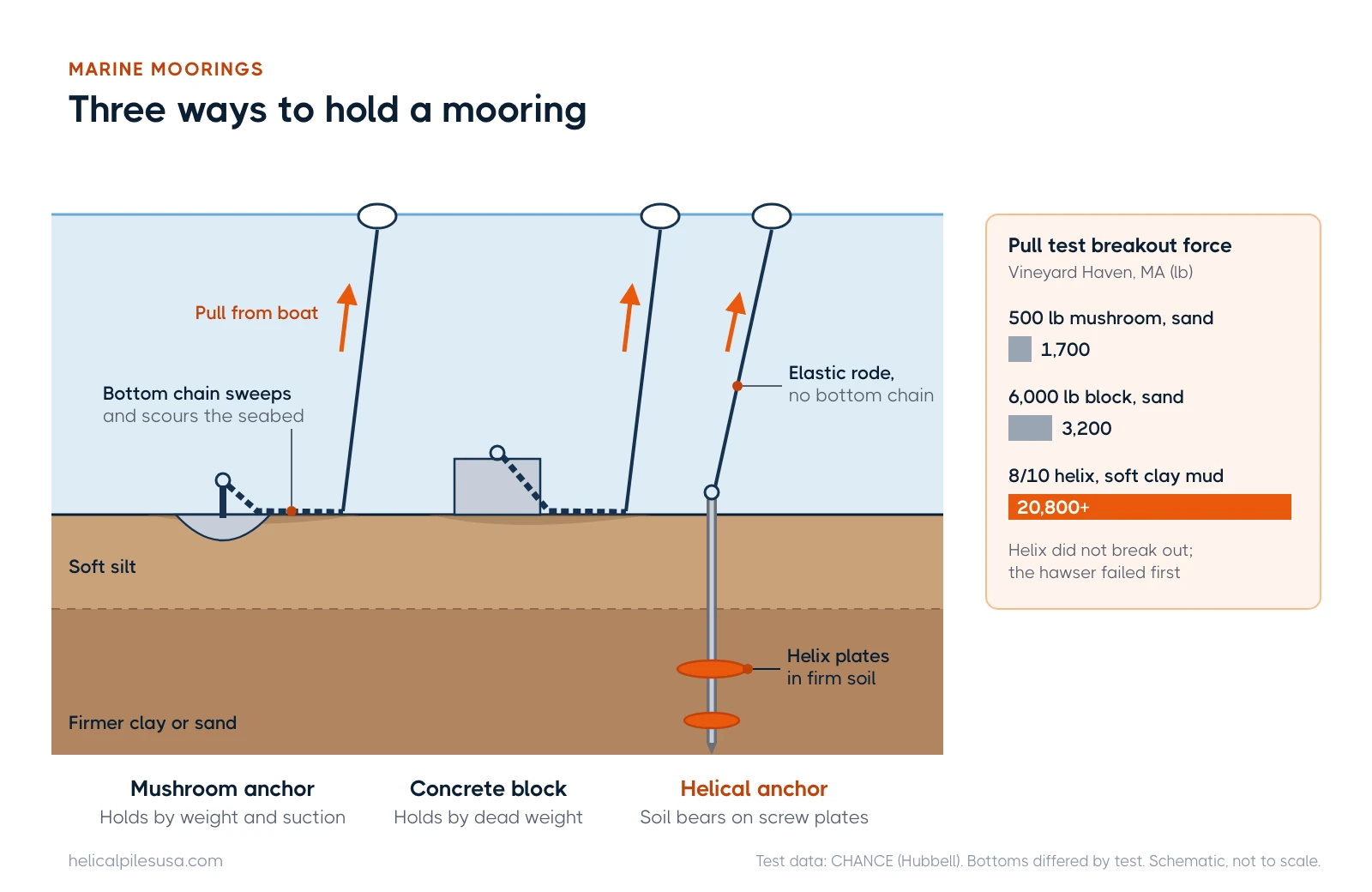
Because the anchor is held by soil rather than by mass, a light anchor can do the work of a very heavy block. Hubbell's CHANCE team says a 7-foot helical anchor weighing about 100 lb can deliver more than 20,000 lb of holding force in competent soil, and describes helical moorings as having 4 to 5 times the holding strength of the alternatives. Larger multi-anchor systems from the same product line are field proven for tensile loads up to 200,000 lb, which is how floating docks, aquaculture pens and commercial floats are held.
The direction of pull matters for every anchor. BoatUS notes that a mooring's holding power begins to drop off sharply once the angle of pull reaches about 25 degrees, which is why storm surge (which shortens effective scope) is so dangerous for deadweight moorings. A helix is loaded along its shaft and does not rely on staying flat on the bottom, so it is far less likely to drag. If you want the land-side comparison, our guide to helical anchors vs helical piles explains why the same hardware can work in tension or compression.
Holding power by seabed type: what the tests show
Two widely cited field tests compare helix anchors with traditional moorings. Neither test used identical bottoms or scope for every anchor, so treat the results as a strong indication rather than a lab-grade comparison. The University of Massachusetts Boston Conservation Mooring Study makes the same point, while noting that harbormasters report properly installed helix anchors hold boats well.
| Anchor | Bottom condition | Breakout force (lb) | Test |
|---|---|---|---|
| 350 lb mushroom | 5 ft deep in mud | 2,000 | Vineyard Haven |
| 500 lb mushroom | Sand | 1,700 | Vineyard Haven |
| 3,000 lb concrete block | Set in mud | 2,100 | Vineyard Haven |
| 6,000 lb cement block | Sand | 3,200 | Vineyard Haven |
| 8/10 helix | Soft clay mud | 20,800+ (did not break out) | Vineyard Haven |
| 500 lb mushroom (buried) | Not uniform | 1,200 | BoatUS, Cruising World, MIT |
| 8,000 lb concrete block | Not uniform | 4,000 | BoatUS, Cruising World, MIT |
| Helix | Not uniform | 12,000 (did not break out) | BoatUS, Cruising World, MIT |
The Vineyard Haven figures come from the CHANCE summary of the harbormaster-supervised pull test, where the hawser broke before the helix moved. In the BoatUS study, a 900 hp tug could not pull the helix out, and the strain gauge maxed out at 12,000 lb before a shackle burst.
Mud and soft clay
This is where helix anchors do best. The plates pass through loose silt and lock into denser material below, and longer shafts or extensions are added when the soft layer is deep. Mushrooms also improve in mud once buried: BoatUS says their holding power can rise as much as tenfold when fully set, but that takes time and is lost if a storm breaks them free.
Sand
Sand can work, but the UMass Boston study warns that helical anchors are not suited to harbors with highly mobile sediment, where the anchor could be exposed over time.
Rock, ledge and thin sediment
Deadweight blocks remain the usual choice on rocky or hard bottoms. The Maine Department of Marine Resources notes that helix moorings only work well where the sediment is of sufficient type and depth, so a probe or diver survey of the site comes first.
Mooring anchor types compared
The table below pulls together the main options for boat moorings, docks and floats. Prices are the anchor-only and installation estimates from the 2013 UMass Boston study for a 30-foot boat, so expect current quotes to be higher.
| Type | How it holds | Best seabed | Seabed impact | Anchor price (2013) | Install (2013) |
|---|---|---|---|---|---|
| Mushroom (about 400 lb) | Weight plus suction once buried | Soft mud | Can dislodge and drag in storms; bottom chain sweeps a scar | $500 to $800 | Often under $100 |
| Concrete or granite block (about 3,000 lb) | Dead weight and friction | Hard or rocky bottoms | Large footprint, scour around the block, chain scar | $370 to $630 | Often under $100 |
| Helical (helix) anchor | Soil bearing on screw plates | Mud, clay, firm sand with enough depth | Small footprint; no bottom chain when paired with an elastic rode | $400 to $700 | About $400 to $500 |
The same study found the elastic rode for a conservation mooring ranged from about $245 to $1,849 depending on the system, against roughly $603 of chain for the same boat. The helix was the most expensive to install, but conservation rodes need replacing less often, which narrows the gap over the life of the mooring.
Environmental benefits: conservation moorings and less scour
A traditional mooring keeps heavy chain on the bottom to absorb shock. As the boat swings with wind and tide, that chain sweeps a circle and rips up seagrass. The Buzzards Bay National Estuary Program reports scars up to 40 feet across, disturbing more than 1,200 square feet around some moorings, and Massachusetts surveys found scars of 40 to more than 200 square meters. Large blocks also cause scour around their base, and mushrooms can drag through beds when a storm frees them.
A conservation mooring swaps the block and chain for a helical anchor and an elastic or floating rode that stays off the bottom. The UMass Boston study notes the small helix footprint is preferred over a gravity anchor for conservation use. Recovery is not instant, though. Maine found only about 13% of a scarred area had regrown on average three years after a mooring was removed or converted, partly because old depressions trap algae and debris.
Some towns now push or require helix anchors. Marion, Massachusetts requires a helix anchor for boats 25 feet and longer after heavy losses in Hurricane Bob in 1991, and roughly 85% of its moorings now use them.
Installation: barge, work boat or diver
Helical mooring anchors are installed with hydraulic rotary equipment and an anti-torque device that keeps the drive from spinning instead of the anchor. CHANCE describes three common setups:
- Barge or work boat: a torque motor on a small barge drives the anchor in shallow water, controlled from the surface.
- Diver-operated: a submersible torque motor is placed at the bottom and guided by a diver, which is how anchors are set in water deeper than 100 feet.
- Hand installation: small round-shaft anchors with 6, 8 or 10 inch helixes on a 5.5-foot shaft can be turned in by hand with a pipe or turning bar for smaller moorings.
Installation torque correlates with holding capacity, so the installer gets a capacity check while the anchor goes in, and anchors can be proof tested if a harbor demands it. Our torque to capacity chart explains how that correlation works. The mooring can be loaded right away, with no curing or settling time.
Permits from harbormasters and agencies
For most private moorings in the U.S., the harbormaster is the first and main gatekeeper. Federal approval usually comes through a general permit: Greenwich, Connecticut, for example, explains that the Army Corps general permit covers new private, non-commercial, non-rental single-boat moorings that the local harbormaster has authorized, but not moorings in federal navigation channels or moorings you rent out. In Maryland, single recreational buoys need no state permit and are covered by Nationwide Permit 10 or the state programmatic general permit, and the rules explicitly allow a buoy drilled into the waterway bed.
Local rules can go either way on helix anchors. Some harbors require them, while others ban them. Truro's Pamet Harbor rules allow only concrete blocks and specifically prohibit mushroom and helical screw anchors. Rental moorings fall outside the general permit and need their own Corps approval, and in Maryland commercial moorings also involve the state Department of the Environment. Ask the harbormaster about anchor type, minimum helix size, scope and approved installers before you buy anything.
Inspection intervals and long-term costs
The UMass Boston study recommends maintaining any mooring at least once a year and reports that most Massachusetts towns require an inspection every 1 to 3 years by a town-approved inspector. Pamet Harbor, for example, requires a diver or harbormaster inspection every two years, recorded with the harbormaster.
- Anchor: helix anchors sit below the mudline where corrosion is slow, and installers report anchors pulled after ten years with no sign of it. See do helical piers rust for how galvanizing holds up in soil.
- Chain: bottom chain typically needs replacing every two to four years.
- Elastic rodes: suppliers report more than seven years of service, and Maine compares a ten-year replacement cycle with four years for block and chain.
- Relocation: some harbormasters note a helix is harder and more costly to move than a block if boat sizes change.
Finding a qualified installer
Mooring helix work is done by marine contractors and mooring services that own barges, hydraulic drive heads and dive gear, often using CHANCE anchors. You can review the CHANCE manufacturer profile for product background, then find a helical pile installer in your state or province and ask whether they do marine work. Use our checklist on how to hire a helical pile contractor, and confirm the installer is on your harbormaster's approved list.
Frequently asked questions
Are helix mooring anchors stronger than mushroom anchors?
In the published pull tests, yes. A helix in soft clay mud held more than 20,800 lb, while 350 lb and 500 lb mushrooms broke out between 1,200 and 2,000 lb.
Can a helical mooring anchor go into rock?
Not in solid rock or ledge. It needs sediment deep enough for the plates to embed, so deadweight blocks are still used on hard bottoms.
What is a conservation mooring?
It is a mooring that keeps the rode off the seabed, usually a helical anchor plus an elastic or floating rode. Removing the dragging bottom chain stops the circular scars it cuts in eelgrass.
Do I need a permit for a helix mooring?
Almost always, from the local harbormaster. A private single-boat mooring is usually covered by an Army Corps general permit once the harbormaster authorizes it, while rental or commercial moorings need more.
How often should a helical mooring be inspected?
Plan on yearly maintenance, and expect your town to require a formal inspection every 1 to 3 years. Most wear shows up in shackles, chain and rode, not in the anchor itself.
Subscribe to our weekly email newsletter
Industry news, featured projects, new products, and installer spotlights from across the helical pile industry, delivered to your inbox.


Latest articles

Get the Helical Pile Industry Brief
New installers, manufacturer news, cost updates, and fresh guides for the U.S. and Canadian helical pile industry. Short, occasional emails. Unsubscribe any time.
