

Helical Ground Anchors: Earth Anchor Uses, Capacity and Cost
Helical ground anchors explained: mobile home tie-downs, sheds, utility guy wires, tents and tiebacks, plus capacity by soil class, testing and cost.

Helical ground anchors (also sold as helical earth anchors, screw anchors or auger anchors) are steel rods with one or more screw-shaped plates that are turned into the soil and then loaded in tension. They hold things down or hold them back: manufactured homes against wind, sheds and carports against uplift, utility poles and towers through guy wires, tents at events, and retaining walls through angled tiebacks. Capacity runs from a few hundred pounds to tens of thousands, set mostly by soil class, helix size and installation torque.
Key takeaways
- What they are: Tension anchors. The helix bears against undisturbed soil above it and resists pull-out.
- Manufactured homes: Federal installation rules require each ground anchor to resist a working load of 3,150 lbs and an ultimate load of 4,725 lbs in its rated soil class.
- Soil drives capacity: The same CHANCE three-helix anchor is rated at 26,000 lbs in Class 7 soil and 58,000 lbs in Class 2 soil.
- Size matters: Hand-installed eye anchors range from 200 lbs to 5,000 lbs depending on length and disc size.
- Verification: Machine-installed anchors are checked by torque and, where required, a pull test.
- Cost: Mobile home tie-downs run about $30 to $70 per anchor in materials, and helical retaining wall tiebacks about $1,800 to $1,950 each installed.
Where helical earth anchors are used
Every application below uses the same principle: a helix screwed below loose surface soil, with a rod or strap running back up in line with the load. What changes is the anchor size, the install method and who sets the rules.
Manufactured and mobile home tie-downs
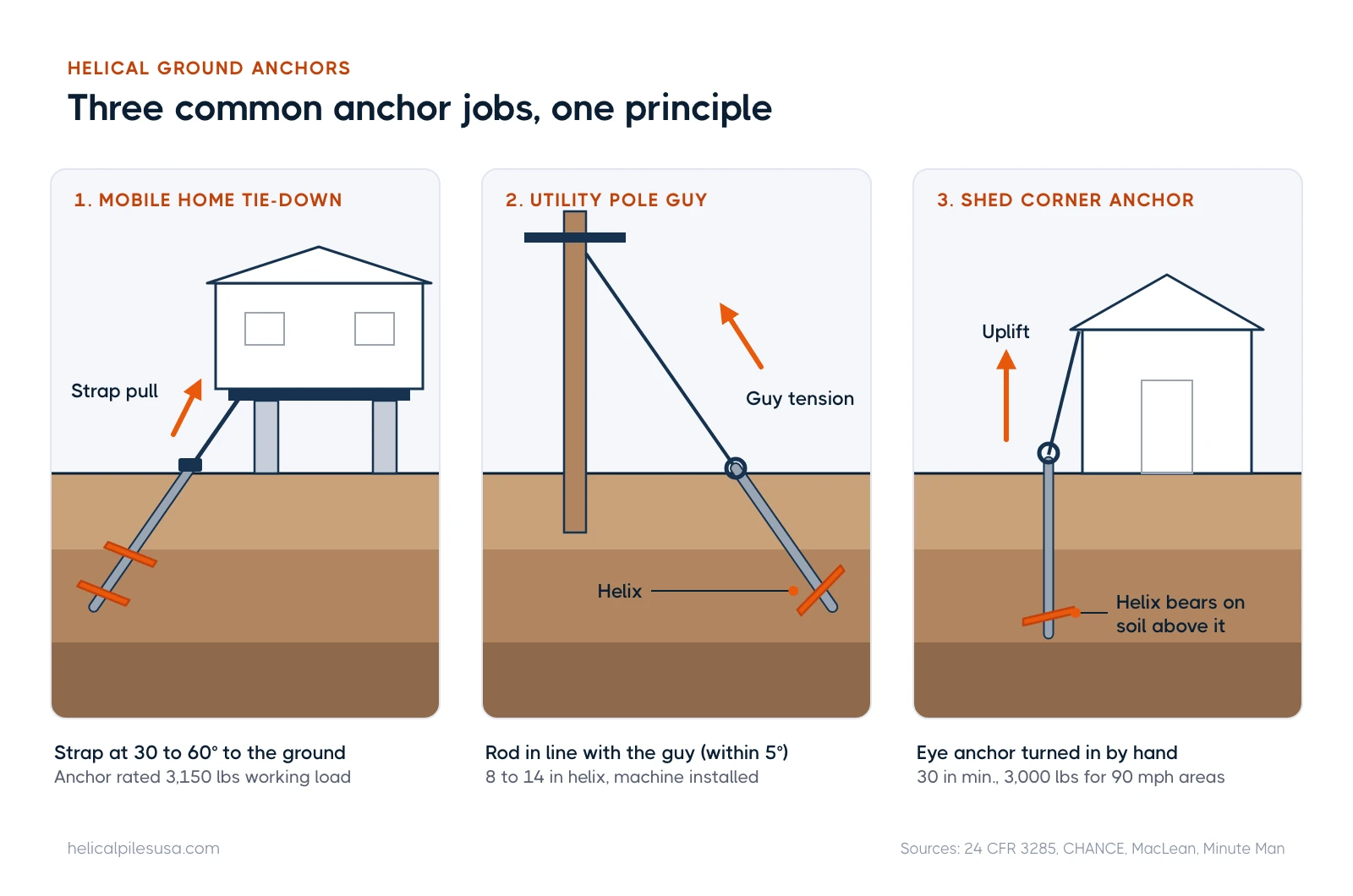
This is the most regulated residential use. HUD's Model Manufactured Home Installation Standards, 24 CFR 3285.402, require each ground anchor to be installed to its full depth and to resist at least 4,725 lbs ultimate and 3,150 lbs working load. Diagonal straps must meet the ground at 30 to 60 degrees, anchors must be listed and certified by a nationally recognized testing laboratory, and any stabilizer plate required by the listing must be installed with it.
Anchors are matched to soil, so the installer first classifies the site. The HUD soil table in 3285.202 uses torque probe readings: Class 2 soils read 550 inch-pounds or more, Class 3 reads 351 to 550, Class 4A reads 276 to 350 and Class 4B reads 175 to 275. Where clay or silt soils have no probe or blow count data, the anchor must be rated for 4B. Both the home manufacturer's installation manual and the anchor maker's listing apply, and the anchor must be certified for the soil class found on site.
Sheds and carports
Small buildings are light, so wind uplift is the risk. A typical kit uses four eye anchors, one per corner, with cable run over the roof framing. Minute Man's shed anchoring guidelines call for a minimum 30-inch anchor with a tested holding capacity of at least 3,000 lbs where 90 mph wind standards apply, and longer anchors with bigger discs in soft or sandy ground. Carports follow the same logic, with the carport maker's instructions setting the count.
Guy wires for utility poles and towers
Utilities have used power-installed screw anchors since 1959, when CHANCE introduced the PISA anchor. Today CHANCE (part of Hubbell) and MacLean Power Systems are the two best-known names in utility guy anchors. According to the CHANCE anchor catalog, a PISA anchor goes in with a wrench on the Kelly bar of a digger derrick in 8 to 10 minutes, using 3.5-foot or 7-foot rods, with a recommended maximum depth of 14 feet. The rod must line up with the guy strand within 5 degrees.
Towers and transmission structures use square-shaft multi-helix anchors. CHANCE notes in its earth anchor principles guide that guy loads once topped out around 20,000 lbs but now reach 120,000 lbs and more on guyed transmission lines, and CHANCE helical anchors are rated up to 200,000 lbs per anchor at the high end.
Temporary structures and tents
Event tents and temporary fabric buildings need anchors that go in fast and come out clean, with no concrete left behind. Screw anchors back out by reversing them and can be reused. Minute Man lists tents alongside sheds, docks, small aircraft and trellises as standard eye anchor uses. For large tents, the tent maker's anchoring schedule and the local permit office set the number and capacity of anchors.
Retaining-wall tiebacks
Tiebacks are helical anchors installed sideways at a downward angle through a wall face and into stable soil behind it. CHANCE tiebacks are installed with hydraulic rotary equipment, use 8 to 14-inch helixes on 3, 5 or 7-foot sections, and can be proof tested immediately because there is no grout to cure. For basement walls specifically, see our guide to helical wall anchors.
Anchor types by application
| Application | Typical anchor | Installed by | Typical capacity | Rules that apply |
|---|---|---|---|---|
| Manufactured home tie-down | Rod with a single or double helix and a strap head, listed for a soil class | Hand bar or powered driver | 3,150 lbs working, 4,725 lbs ultimate minimum | 24 CFR 3285, home and anchor manufacturer instructions |
| Shed or carport | Eye anchor, 1/2 to 5/8-inch rod, 4 to 6-inch disc, 30 to 48 inches | By hand | 2,500 to 4,000 lbs (3,000 lbs minimum for 90 mph areas) | Building maker instructions, local permit |
| Tent or temporary structure | Removable screw anchor or eye anchor | Hand or portable power driver | Set by tent maker's anchoring schedule | Tent maker, local permit, site pull test |
| Utility pole guy | Power-installed screw anchor, 8 to 14-inch helix, 5/8 to 1-inch rod | Digger derrick | Up to 36,000 lbs (limited by rod) | Utility standards, manufacturer torque tables |
| Tower or transmission guy | 1.5-inch square-shaft, multi-helix | Hydraulic torque motor | Up to 70,000 lbs per lead section, 200,000 lbs for the largest systems | Project engineer, manufacturer data |
| Retaining-wall tieback | Square-shaft, 8 to 14-inch helixes, installed at an angle | Hydraulic rotary equipment | Designed per wall, verified by torque and proof test | Engineer's design, building code |
The difference between a ground anchor and a helical pile is mostly the load direction. Anchors work in tension, piles mostly in compression. Our comparison of helical anchors vs helical piles covers that in detail.
Holding capacity by soil class and anchor size
Anchor makers group soils into classes by torque probe or blow counts. CHANCE's scale runs from Class 0 (sound hard rock) to Class 8 (peat, organic silt, very soft clay). Class 5 soils, such as medium dense coarse sands and stiff clays, read 300 to 400 inch-pounds on the probe, while Class 7 soils, such as loose fine sands, alluvium and medium-stiff clays, read 100 to 200. CHANCE advises extending anchors through Class 7 or 8 soil until the helix reaches a Class 5 or 6 layer below.
CHANCE's published ultimate capacities for its square-shaft (SS) anchors are below. They are field-test averages, so apply a safety factor before design.
| Helix combination | Lead length | Class 7 | Class 6 | Class 5 | Class 4 | Class 3 | Class 2 |
|---|---|---|---|---|---|---|---|
| 8 in + 10 in | 3 ft | 19,000 lbs | 23,000 lbs | 27,000 lbs | 32,000 lbs | 36,000 lbs | 41,000 lbs |
| 10 in + 12 in | 3.5 ft | 21,000 lbs | 26,000 lbs | 31,000 lbs | 36,000 lbs | 41,000 lbs | 46,000 lbs |
| 8 in + 10 in + 12 in | 5.5 ft | 26,000 lbs | 32,000 lbs | 39,000 lbs | 46,000 lbs | 51,000 lbs | 58,000 lbs |
| 10 in + 12 in + 14 in | 7 ft | 29,000 lbs | 37,000 lbs | 45,000 lbs | 53,000 lbs | 61,000 lbs | 69,000 lbs |
Source: CHANCE Anchors and Anchor Tools catalog, Section B.
At the small end, Minute Man's eye anchor ratings show how much length and disc size matter. A 15-inch anchor with a 3-inch disc holds 200 lbs, a 30-inch anchor with a 4-inch disc holds 2,500 lbs, a 48-inch anchor with a 6-inch disc holds 4,000 lbs, and the largest reach 5,000 lbs. Those figures assume hard to medium clay and drop in soft or sandy soil.
Water and frost also change the numbers. CHANCE warns that a helix sitting at the water table can lose as much as 50 percent of its capacity in granular soil, and that in permafrost the helix should sit 3 to 5 feet below the permafrost line. For the pile side of the same question, see how much weight a helical pile can hold.
Installation: by hand vs hydraulic
Small anchors go in by hand. Minute Man's shed instructions describe digging a small pilot hole, setting the disc in it, passing a bar or pipe through the eye and turning the anchor down until about 3 inches remain above grade. Manufactured home anchors can also be turned by hand or with a powered driver, after a soil test probe reading confirms the soil class.
Larger anchors need machines. Utility crews drive PISA anchors from a digger derrick, and tiebacks and tower anchors are turned by hydraulic torque motors on excavators or skid steers. Machines also let crews read torque continuously. MacLean's Power Hub selection guide states that ultimate soil holding strength equals installation torque multiplied by a torque factor (Kt), capped by the rod's mechanical rating. Its Kt values are 9 for 1-3/8-inch solid hub anchors, 7 for 2-1/4-inch socket drive anchors and 6 for 2-1/2-inch socket drive anchors.
Example: a 1-3/8-inch hub anchor turned to 3,000 ft-lbs gives 3,000 x 9 = 27,000 lbs of soil capacity. On a 5/8-inch rod (16,000 lbs ultimate) the rod governs; on a 1-inch rod (36,000 lbs) the soil governs at 27,000 lbs. MacLean recommends a 1/2-inch helix rather than 3/8-inch in gravel or cobbles. The torque to capacity chart explains Kt in more depth.
Pull testing
Torque predicts capacity; a pull test proves it. In the CHANCE method, the anchor is pulled in line with the intended guy, an initial load of about 2,000 lbs seats it, and the load is then increased in steps while movement (creep) is measured against a fixed point. CHANCE defines holding capacity as the load at 4 inches of creep, or the maximum load reached before creep totals 4 inches.
For manufactured homes, testing happens at certification: each anchor design must pass at least three tests reaching 4,725 lbs in its listed soil class. Tiebacks are proof tested on site to a load set by the engineer, right after installation.
Cost ranges
- Mobile home tie-downs: One cost guide puts materials at about $30 to $70 per tie-down plus $80 to $120 per hour of labor, with whole-home projects from $2,100 to $9,150 and most landing between $3,500 and $6,500 depending on home size, wind zone and soil.
- Retaining or basement wall tiebacks: Acculevel reports about $1,812 to $1,952 per tieback, depending on whether it can be installed by machine or must go in by hand.
- Utility and tower anchors: Priced per project, driven by helix count, extensions, equipment time and testing.
Corrosion and service life
HUD requires manufactured home anchors to have corrosion protection at least equal to a zinc coating of 0.30 oz per square foot of steel, and the same applies to metal stabilizer plates. The CHANCE catalog lists its anchor rods, helix assemblies, eye nuts and guy adapters as galvanized steel. Inspect the rod where it passes through the ground surface and the strap or cable connection first. In frost-prone areas, Minute Man advises checking cable tension periodically. Our guide on whether helical piers rust covers soil corrosivity and coating choices in more detail.
Finding an installer or supplier
Shed and small tent anchors are DIY jobs, but manufactured home anchoring, guy anchors and tiebacks belong with a contractor who has a soil probe and torque monitoring. You can find a helical pile installer in your state or province, compare manufacturers such as CHANCE and MacLean on our manufacturers page, and read how to hire a helical pile contractor before requesting quotes.
Frequently asked questions
Are helical earth anchors and helical ground anchors the same thing?
Yes. Helical earth anchors, helical ground anchors, screw anchors and auger anchors all describe a rod with a helix plate that is screwed into soil and loaded in tension.
How much weight can a helical ground anchor hold?
Small hand-installed eye anchors hold about 200 to 5,000 lbs depending on length and disc size. Manufactured home anchors must reach 3,150 lbs working load, and machine-installed multi-helix utility anchors are rated from about 19,000 lbs to 69,000 lbs depending on soil class.
Can I install helical ground anchors by hand?
Yes, for sheds, carports, tents and many manufactured home anchors, using a bar through the eye or head. Utility guy anchors and tiebacks need a digger derrick or hydraulic torque motor so torque can be monitored.
Do helical anchors work in sandy or soft soil?
Yes, with less capacity, so use a longer anchor, a larger helix or more anchors. In very soft soil (CHANCE Class 7 or 8), extend the anchor until the helix reaches firmer soil.
How is an installed anchor checked?
Machine-installed anchors are checked by final installation torque, which correlates with capacity through a Kt factor. Where the design calls for it, an in-line pull test confirms the anchor holds the required load without excessive creep.
Subscribe to our weekly email newsletter
Industry news, featured projects, new products, and installer spotlights from across the helical pile industry, delivered to your inbox.


Latest articles

Get the Helical Pile Industry Brief
New installers, manufacturer news, cost updates, and fresh guides for the U.S. and Canadian helical pile industry. Short, occasional emails. Unsubscribe any time.
