

How to Hire a Helical Pile Contractor: 12 Questions to Ask and Red Flags to Watch For
How to hire a helical pile or screw pile contractor: manufacturer certification, ICC-ES and CCMC approvals, torque logs, engineering, warranties, quote comparison and red flags.
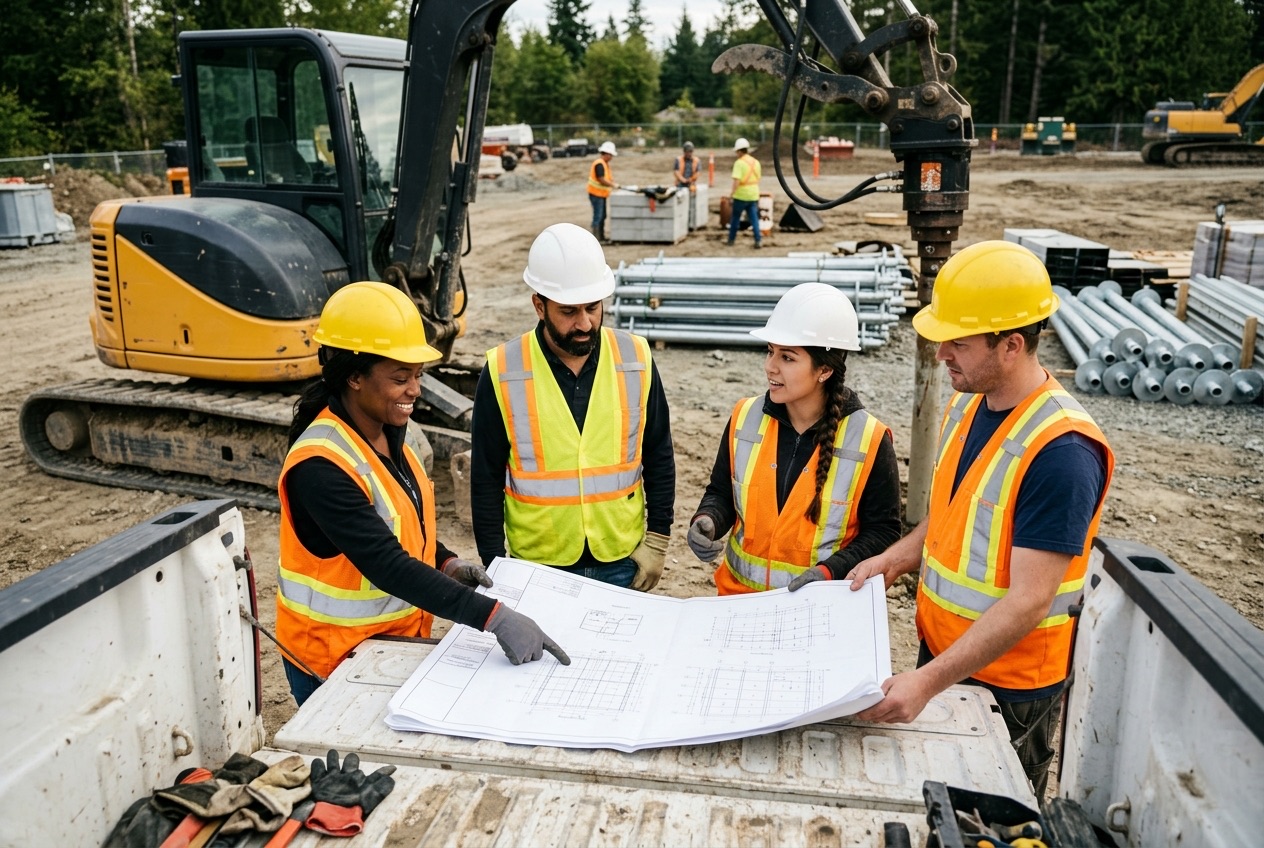

To hire a helical pile contractor, choose an installer who is certified by the manufacturer of the system they install, and whose system has a current ICC-ES evaluation report (or a CCMC evaluation in Canada). The installer should also work from an engineer's design and give you a written torque and depth log for every pile. Get two or three written quotes that list the same things: pile model, number of piles, minimum torque, minimum depth, extra-depth pricing, permits, engineering and warranty. The 12 questions below help you compare quotes on equal terms and spot the red flags that lead to problems later.
Key takeaways
- Certification matters: many evaluation reports require installation by the manufacturer's trained and certified installers, so a non-certified crew can put your code approval at risk.
- Ask for the ESR or CCMC number and check that the exact pile and bracket being quoted are listed in it.
- Torque logs are proof: every pile should have its final depth and installation torque recorded, measured with a calibrated torque indicator.
- Compare like with like: the biggest price swing is depth, so make sure each quote says what depth is included and what extra footage costs.
- Read the warranty: find out whether it covers the steel, the workmanship or further movement, and whether it transfers to the next owner.
Why choosing the right helical pile contractor matters
A helical pile is only as good as its installation. Capacity is not measured with a scale. It is inferred from the torque the pile needed to turn at its final depth, using the correlation Qult = Kt × T recognized by the International Building Code (IBC 1810.3.3.1.9). If the torque reading is wrong, the equipment is uncalibrated or the crew stops short, you won't see the problem until the structure moves. That is why the hiring decision is really a decision about the installer's process and paperwork. If you are new to the system, start with what is a helical pile.
Certifications and approvals to look for
Manufacturer-certified installer
Most helical pile brands train and certify the companies that install their products. This is often more than marketing. The ICC-ES report for CHANCE piles, ESR-2794, says the systems must be installed by Hubbell-trained and certified installers, with at least one crew member holding a current certification. GoliathTech's model specification defines a “Certified Pile Installer” as an authorized installer who has completed GoliathTech training (GoliathTech). In Canada, CCMC 13691-R for Almita screw piles requires installers certified by Almita using approved equipment. Ask for the certificate, and check it with the manufacturer if you have doubts. Our manufacturer directory links to profiles for CHANCE, GoliathTech, Techno Metal Post, Ram Jack, Foundation Supportworks and others, including their dealer networks.
ICC-ES evaluated system (AC358)
ICC-ES AC358 is the acceptance criteria that manufacturers test against to earn an evaluation service report (ESR). The report lists approved shafts, helix plates, brackets, capacities and conditions of use. It gives a building official a third-party basis for approving the product. An installer who says “it's ICC approved” should be able to give you the ESR number within minutes.
CCMC evaluation in Canada
Canadian building officials often look for a Canadian Construction Materials Centre (CCMC) evaluation for residential screw piles under Part 9 of the building code. Examples include CCMC 13691-R (Almita) and CCMC 13059-R, which Techno Metal Post lists in its spec book. CCMC 13691-R also requires a licensed professional engineer to set pile spacing, quantity and capacity.
12 questions to ask a helical pile contractor
- Which manufacturer and pile model will you use, and are you certified to install it? Get the brand, shaft size, helix configuration and bracket model in writing.
- What is the ESR or CCMC number, and are these exact components listed in it? An evaluation report covers specific catalog numbers. A different bracket or shaft may not be covered.
- Who is the engineer, and what does the design specify? Ask for the minimum torque, minimum depth, pile count and spacing. Our guide on how far apart helical piers need to be explains why spacing varies.
- Do you need a soil report? Some residential projects rely on the torque correlation alone. Heavier loads, soft soils and commercial jobs usually need geotechnical data. Today's Homeowner puts a soil report at $1,000 to $2,000.
- How will you measure torque, and when was the indicator last calibrated? ESR-2794 requires a torque indicator calibrated within the previous 12 months.
- Will I get a torque and depth log for every pile? GoliathTech's specification says installation records should show each pile's ID, diameter, helix configuration, depth, installation torque and capacity. Expect nothing less.
- What depth is included in the price, and what does extra depth cost? Helical Anchors Inc. says extensions typically add $20 to $25 per linear foot beyond the quoted depth (Helical Anchors Inc.).
- What happens if a pile hits rock or an obstruction? A good contractor has a plan: relocate the pile with the engineer's approval, add a pile, or remove the obstruction, and a price for each.
- Who pulls the permit and schedules inspections? See helical pile permits and building codes for what inspectors usually want.
- How are the piles protected against corrosion? Galvanized or bare steel, and was soil corrosivity considered? See do helical piers rust?
- What does the warranty cover, who backs it and does it transfer? See the warranty section below.
- Can I see insurance certificates and references for similar jobs? Ask for general liability and workers' compensation certificates, and two or three recent projects like yours.
Torque logs: what a good one looks like
The torque log is the single most useful document you will get from the job. Evaluation reports set a high bar. ESR-2794 requires torque to be monitored throughout installation and recorded at least every 5 feet. For multi-helix piles and tension piles, readings are also taken 2 feet and 1 foot before final depth and at final depth, and the average of those last three readings must meet the design minimum.
| Item on the log | Why it matters |
|---|---|
| Pile ID matched to a layout drawing | Ties every reading to a location you can check later |
| Pile model, shaft size and helix configuration | Confirms the installed product matches the design and evaluation report |
| Final depth | Shows the minimum embedment was met |
| Torque readings, including the final reading or final average | The field evidence of capacity |
| Torque indicator ID and calibration date | Shows the numbers came from a calibrated instrument |
| Date, operator and weather or site notes | Helps with inspection, warranty and resale questions |
For commercial projects under the IBC, a special inspector watches the installation continuously and records this information. ESR-2794 lists items the inspector must verify, starting with the product manufacturer and the manufacturer's certification of the installer. For more on how the numbers are generated, see our step-by-step installation guide.
Engineering and load testing
For an addition, new home or foundation repair, expect an engineer's letter or stamped design that specifies the pile, the load, the target torque, the minimum depth and the connection detail. Today's Homeowner estimates $300 to $600 for a structural engineer's inspection on a repair job. Larger commercial projects often add load tests. CHANCE notes that pre-production test piles are typically loaded to 200% of design load and production proof tests to 133% or 160%, following ASTM D1143 for compression and ASTM D3689 for tension (Hubbell). Ask whether testing is in the bid.
Warranties: read the fine print
Warranty terms vary a lot between brands and dealers. Two published examples:
- Foundation Supportworks offers a 25-year warranty against manufacturing defects that can transfer to a future owner.
- Ram Jack describes a transferable limited warranty for the life of the structure. It is issued by independent dealers and backed by a dealers' warranty trust if a dealer becomes inactive, and it covers movement at pile locations only.
Ask every contractor what is covered (the product, the workmanship or further settlement), how long it lasts, whether it transfers, what is excluded and who honors it if the company closes. For repair jobs, our guide to helical piers for foundation repair adds repair-specific questions.
How to compare helical pile quotes
Put the quotes side by side in a table like this. A low price that leaves out depth, engineering or permits often ends up costing more.
| Line item | Quote A | Quote B | Quote C |
|---|---|---|---|
| Manufacturer, model and ESR/CCMC number | |||
| Number of piles and bracket or cap type | |||
| Minimum torque and minimum depth | |||
| Depth included per pile and price per extra foot | |||
| Engineering, soil report and permit (included or extra) | |||
| Torque log provided (yes or no) | |||
| Corrosion protection | |||
| Warranty terms and transferability | |||
| Site restoration and cleanup | |||
| Total price and payment schedule |
As a sanity check on price, Helical Anchors Inc. puts typical new-construction piles at $350 to $900 each installed, and foundation repair piers at $2,000 to $4,000 each (Helical Anchors Inc.). Our helical pier cost guide breaks down what moves the number, and helical piles for decks covers deck-specific pricing.
Red flags to watch for
- No manufacturer named, or “our own pile” with no evaluation report or engineering behind it.
- Can't or won't give an ESR or CCMC number, or the number doesn't cover the parts being quoted.
- No torque log, or a crew that “goes by feel” instead of a calibrated indicator.
- A fixed depth with no extra-depth price. This invites short piles or surprise change orders.
- Pressure to sign today, or a large deposit before any design or permit.
- No permit for work that clearly needs one, such as additions, attached decks and most foundation repair.
- A vague “lifetime warranty” with no written terms or named backer.
- No proof of insurance or no local references.
Where to find qualified helical pile contractors
Start with the manufacturer you trust, then look at its certified dealers near you. Our directory lists more than 600 helical pile installers across the U.S. and Canada. Find a helical pile installer in your state or province, for example in New York, California, Texas or Ontario. Dealer openings and company news appear on our helical pile industry news page, such as Techno Metal Post's new Columbia River dealer.
Frequently asked questions
How do I know if a helical pile contractor is certified?
Ask for the certificate from the pile manufacturer and confirm it with the manufacturer or its dealer locator. Evaluation reports such as ESR-2794 require manufacturer-trained, certified installers, and a special inspector on commercial jobs verifies that certification.
What is a torque log for helical piles?
It is a record of each pile's location, model, final depth and installation torque. Because capacity is estimated from torque, the log is the proof that each pile meets the design.
Do I need an engineer for helical piles?
For commercial work, yes. For residential work it depends on the building department and the project. Many require an engineer's letter for additions and foundation repair even when the system has an evaluation report.
How many quotes should I get for helical piles?
Two or three written quotes is typical. Make sure each one specifies the same pile model or an equal one, the torque and depth criteria, extra-depth pricing, permits, engineering and warranty.
Is the cheapest helical pile quote a good deal?
Only if it includes the same scope. Low bids often leave out extra depth, engineering, permits or torque logs, and those gaps can cost more later.
What is the difference between ICC-ES and CCMC?
ICC-ES issues evaluation reports used by U.S. building officials, based on acceptance criteria such as AC358 for helical piles. CCMC, part of the National Research Council of Canada, issues evaluations used by Canadian officials.
Subscribe to our weekly email newsletter
Industry news, featured projects, new products, and installer spotlights from across the helical pile industry, delivered to your inbox.


Latest articles

Get the Helical Pile Industry Brief
New installers, manufacturer news, cost updates, and fresh guides for the U.S. and Canadian helical pile industry. Short, occasional emails. Unsubscribe any time.
