

Helical Wall Anchors: How Tiebacks Fix Bowing Basement Walls
How helical wall anchors (tiebacks) stabilize bowing basement and retaining walls: warning signs, install steps, costs and how they compare to other fixes.
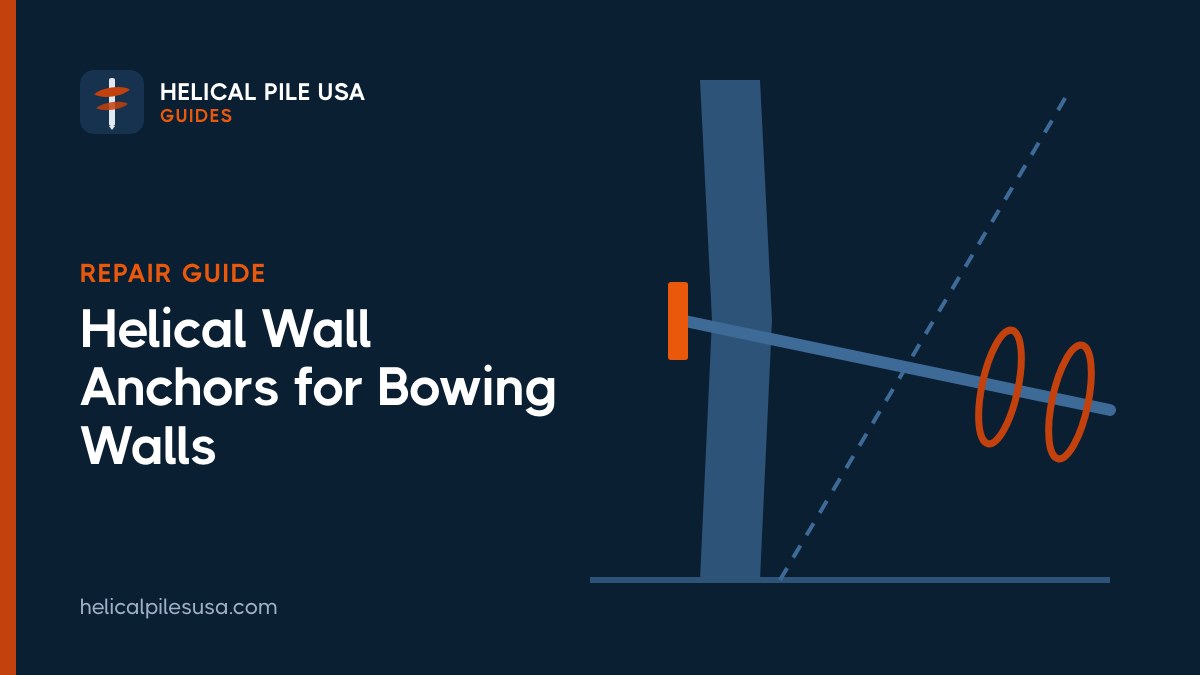

Helical wall anchors (also called helical tiebacks) are steel shafts with screw-shaped plates that are driven through a bowing basement or retaining wall at a downward angle and into stable soil behind it. Once tensioned against a bracket on the inside face, they hold the wall in place and, in many cases, let a contractor pull it back toward plumb over time. They cost more than plate anchors or straps, typically around $1,400 to $2,000 per tieback, but they need little to no digging and their capacity can be checked during installation.
Key takeaways
- What they do: A helical tieback resists the soil pressure pushing a wall inward by anchoring it to soil well beyond the zone that is moving.
- When they fit: Tiebacks are usually chosen for moderate to severe bowing, roughly 2 inches and up, and for retaining walls that are tilting.
- Cost: Expect about $300 to $360 per linear foot of wall, or roughly $6,000 to $7,200 for a 20-foot wall, before engineering, permits and finish work.
- Space needed: The anchor runs outward from the wall, so you generally need 12 to 15 feet of clear ground on that side.
- Verification: Installation torque correlates with capacity, so each tieback can be checked as it goes in rather than assumed.
- Limits: Walls pushed in more than 3 to 4 inches, partly collapsed or still failing after earlier repairs may need to be rebuilt instead.
How helical tiebacks stabilize a bowing wall
Basement and retaining walls fail inward because the soil behind them pushes harder than the wall was built to resist. Clay that swells when wet, saturated backfill, frost and surcharge loads such as driveways all add lateral pressure. A block or poured wall can only bend so far before it cracks horizontally and starts to rotate.
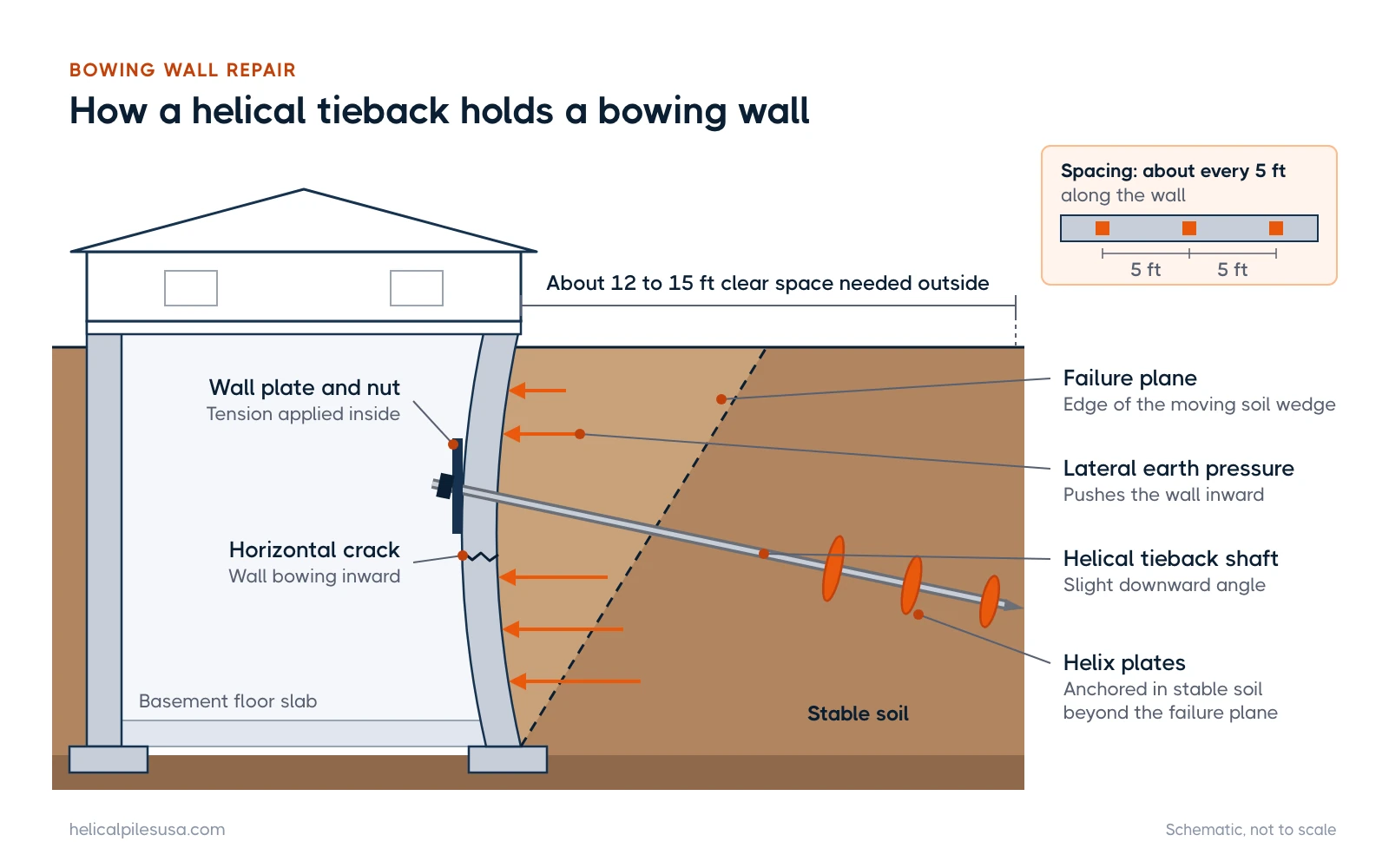
A helical tieback is the sideways cousin of a helical pile. Instead of carrying a building down into the ground, it works in tension, pulling the wall back toward the soil it is anchored in. Hubbell's CHANCE team explains that the anchor is screwed in until the helix plates sit beyond the failure plane, the wedge of soil that is actually moving, so the load is carried by end bearing on the plates in stiff clay, dense sand or similar material. No grout or bonded zone is needed.
The inside end connects to a steel plate or channel bolted against the wall. As the nut is tightened, the wall is held in place. Many systems allow periodic retightening to coax a wall back toward vertical over several months, which Supportworks describes as gradual straightening without excavation.
Why engineers like them
The main appeal is that capacity can be measured. Earth Contact Products lists installed torque correlating to capacity and the ability to load test each tieback among its key benefits. Plate anchors and straps rely more on assumptions about soil and wall strength. For more on the general difference between pile and anchor use, see helical anchors vs helical piles.
Signs your basement or retaining wall is failing
Bowing is gradual, so small changes are worth tracking. Common warning signs include:
- A horizontal crack running across the wall around mid-height, often 1/8 inch wide or more
- A visible inward bulge near the middle of the wall, or a wall that leans in at the top
- Stair-step cracks along the mortar joints of a block wall
- Doors or windows that start to stick
- New water stains or seepage along the wall
- A gap opening between the top of the wall and the floor joists or sill plate
A simple check is to hold a long straightedge or a taut string against the wall. The Basement Guide recommends calling a professional if you find more than 1 inch of inward displacement over an 8-foot span. Measuring at the same spots every few months tells you whether the wall is still moving, which matters for picking a repair.
Helical tieback installation steps
Exact methods vary by manufacturer and by engineer, but a typical residential install from inside the basement goes like this:
- Assessment and design. The contractor or engineer measures deflection, checks the wall type and confirms there is room outside for the anchors.
- Layout. Tieback locations are marked along the wall, often about 5 feet apart, at a height set by the design.
- Core through the wall. A hole is cut through the foundation wall at each location.
- Drive the anchor. A hydraulic drive head rotates the helical lead section through the hole at a slight downward angle. Extensions are added until the helices reach stable soil and the target torque is reached.
- Connect and tension. A threaded bar is attached to the shaft, a wall plate or channel is set against the inside face, and the nut is tightened to the specified load. Acculevel notes crews tension each tieback until gauge readings confirm proper installation.
- Record and seal. Torque and depth are logged for each anchor, and the wall penetration is sealed against water.
Speed is a selling point. ECP says a single tieback usually goes in within 30 minutes to 2 hours, and Ram Jack points out that its tiebacks need minimal to no excavation. For retaining walls, the same process runs from the exposed face. You can read more about general methods in our helical pile installation process guide.
Helical anchors vs plate wall anchors vs carbon fiber straps vs wall braces
Four repair methods dominate bowing-wall work. They differ in cost, how much yard space they need and whether they can straighten a wall or only hold it.
| Method | How it works | Typical cost | Outside space | Best for |
|---|---|---|---|---|
| Helical tieback | Screw anchor driven at an angle into stable soil, tensioned to an inside plate | $1,400 to $2,000 each; $300 to $360 per linear foot | About 12 to 15 ft | Moderate to severe bowing, retaining walls, cases that need verified capacity |
| Plate wall anchor | Steel rod through the wall connected to a buried earth plate outside | $400 to $800 each; $80 to $150 per linear foot | About 10 ft | Budget stabilization where the yard can be dug at each plate |
| Carbon fiber strap | Epoxied strap fixed at the floor and rim joist | $300 to $1,000 each; $85 to $275 per linear foot | None | Cracked walls or bowing under about 2 inches; holds but does not straighten |
| Steel wall brace | C-channel or I-beam set against the inside of the wall, tied to floor and framing | $500 to $600 each | None | Tight lots with no room for anchors |
Costs come from Colorado Structural Repair, Today's Homeowner and a Bob Vila cost guide. Space figures are typical, not absolute; ECP's plate anchors, for example, set the plate 9 to 13-1/2 feet from the wall.
How to choose
Straps are usually the cheapest fix for a wall that is cracked but barely bowed, but they hold the wall where it is rather than straighten it. Plate anchors are the economical choice when you can dig outside. Braces work when the property line is right against the house, though they lean on the floor and framing to resist the load. Helical tiebacks cost the most, yet they are often the choice for larger deflections, for walls next to pools, patios or utilities where digging a plate pit is a problem, and for projects where an engineer wants measured capacity. Tiebacks may not be possible where a property line, a neighbor's basement or shallow rock sits inside the anchor zone (see helical piles in rocky soil).
What helical wall anchors cost
Most published figures land in the same range. Acculevel quotes about $1,812 to $1,952 per tieback depending on whether it can be machine-installed or must go in by hand. Today's Homeowner puts tiebacks at $300 to $360 per linear foot based on one anchor every 5 feet, and the Bob Vila guide estimates $6,000 to $7,200 for a 20-foot wall.
Budget for extras as well:
- Structural engineer report: about $300 to $1,000, per Today's Homeowner.
- Permits and testing: $100 to $2,000 depending on the jurisdiction.
- Wall straightening: $340 to $550 per linear foot when combined with reinforcement.
- Interior finish: drywall and paint if the wall was finished.
Depth drives price. If stable soil is far from the wall, extra extensions add steel and labor. For pricing on vertical helical piers, see our helical pier cost guide.
Permits and engineering
Structural foundation repair usually needs a building permit, and many building departments ask for stamped drawings for wall stabilization. Requirements vary by city and county, so confirm locally. Our helical pile permits and building codes guide covers the general process.
An engineer's role goes beyond the permit. They should confirm the cause of the bowing (often drainage), set tieback spacing and design load, and specify the target installation torque. Colorado Structural Repair's advice is simple: go with what your engineer recommends. Fixing gutters, downspouts and grading at the same time reduces the soil pressure the anchors have to hold back.
Corrosion is another design item, since the shaft sits in wet soil for decades. Galvanized steel is common; see do helical piers rust for details.
When a wall needs replacing instead
Anchors work on walls that are still structurally intact. They are not a fix for a wall that has failed. The Basement Guide points to replacement when bowing exceeds 3 to 4 inches, when part of the wall has collapsed or is badly deteriorated, or when movement continues after earlier repairs. Today's Homeowner also treats 4 inches or more as a major issue needing extensive foundation work.
Replacement means excavating outside, shoring the house, tearing out the damaged section, building a new wall, waterproofing and backfilling. The same source puts it at $10,000 to $25,000 or more, roughly $500 to $1,250 per linear foot, and 1 to 3 weeks of work. That is why acting while a wall is still in the anchor range usually saves money.
Finding a qualified installer
Tiebacks need a hydraulic drive head, torque monitoring and a crew that understands lateral loads, so not every foundation company installs them. Ask for torque logs, the manufacturer's warranty terms and the engineer's design. Manufacturers such as Foundation Supportworks, CHANCE, Ram Jack, Earth Contact Products and Magnum Piering all supply tieback systems through dealer networks. Our guide on how to hire a helical pile contractor has a checklist, and you can find a helical pile installer in your state or province in our directory.
Frequently asked questions
How far apart are helical tiebacks installed?
Spacing is set by the engineer, but cost guides commonly assume about one tieback every 5 feet along the wall. Higher walls or heavier soil loads can call for tighter spacing or a second row.
Can helical tiebacks straighten a bowed wall?
Often, yes. Tightening the anchors gradually over time can move a wall back toward plumb, though some walls are only stabilized in place, depending on condition and the engineer's design.
Are helical wall anchors better than carbon fiber straps?
Neither is better for every wall. Straps are cheaper and fit walls bowed under about 2 inches, while tiebacks handle larger movement and can be load-verified, but they need room outside.
Do helical tiebacks require digging up the yard?
Usually not. They are driven through the wall from inside the basement, so the yard above them stays largely undisturbed.
How long does a helical tieback installation take?
A single tieback can go in within 30 minutes to 2 hours, and many residential walls are finished in one to two days.
Can helical tiebacks fix a retaining wall?
Yes. They are widely used to stabilize tilting retaining walls and sea walls, anchoring the wall into stable soil behind it without rebuilding.
Subscribe to our weekly email newsletter
Industry news, featured projects, new products, and installer spotlights from across the helical pile industry, delivered to your inbox.


Latest articles

Get the Helical Pile Industry Brief
New installers, manufacturer news, cost updates, and fresh guides for the U.S. and Canadian helical pile industry. Short, occasional emails. Unsubscribe any time.
