

Helical Pile Brackets and Caps: Types, Capacities and Details
Helical pile caps and brackets: new construction caps, remedial, slab and deck post brackets, embedment rules and rated capacities from ICC-ES reports.

A helical pile bracket or cap is the steel part that joins the top of the pile to the structure it carries. New buildings use a cap plate cast into a footing or grade beam, foundation repair uses a side-load bracket bolted under an existing footing, and decks use a post bracket that takes a 4x4 or 6x6. The bracket is often the weakest link: in published ICC-ES reports, repair brackets on 2-7/8 to 3 inch piles are rated from about 13 to 48 kips allowable, often less than the pile beneath them can carry.
Key takeaways
- Three families: evaluation reports call new-construction caps Type B direct-load brackets and repair brackets Type A side-load brackets. Deck, beam and tension brackets sit alongside them.
- Bracket often governs repair piles: a Supportworks HP288 retrofit pile is rated 24.0 kips because the bracket controls, even though its shaft is rated 63.6 kips.
- Cover drives cap capacity: the same ECP new-construction bracket is rated 10.72 kips with code-minimum concrete cover and 58.6 kips with full cover.
- Typical cap embedment: CHANCE requires the cap plate to sit at least 4 inches into the concrete with 4 inches of concrete beyond its edges, and 7.5 inches of shaft embedment for tension or fixed-head piles.
- Galvanizing raises ratings: galvanized brackets lose less steel over the 50-year design life, so a galvanized FS288BL2 is rated 26.8 kips against 24.0 kips for plain steel.
Why the bracket matters as much as the pile
Every helical pile has four capacities that are checked separately: the bracket (P1), the shaft (P2), the helix plates (P3) and the soil (P4). Under ICC-ES AC358, the system rating is the lowest of the four. The table below uses values from Table 1 of the Supportworks report ESR-3074 for one HP288 retrofit pile.
| Element | Allowable compression (kips) |
|---|---|
| FS288BL2 bracket (P1) | 24.0 |
| HP288 shaft, fully braced (P2) | 63.6 |
| One helix plate (P3) | 40.0 |
| Soil by torque correlation (P4) | 35.5 |
| System rating | 24.0 |
Swap the side-load bracket for an HP288NCB new-construction bracket with at least 4 inches of edge distance and the same pile is rated 35.5 kips, because the soil now controls. That is the main reason repair piers and new-construction piles carry different ratings. For the full capacity method, see how much weight a helical pile can hold and the helical pile design guide.
New-construction caps
A new-construction cap (also called a pile cap bracket or direct-load bracket) is a square steel plate welded to a short sleeve. The sleeve slips over the top of the shaft, the plate bears on the shaft end, and the whole assembly is cast into the new footing, grade beam or pile cap. Because the load runs straight down the shaft, there is no eccentricity at the bracket.
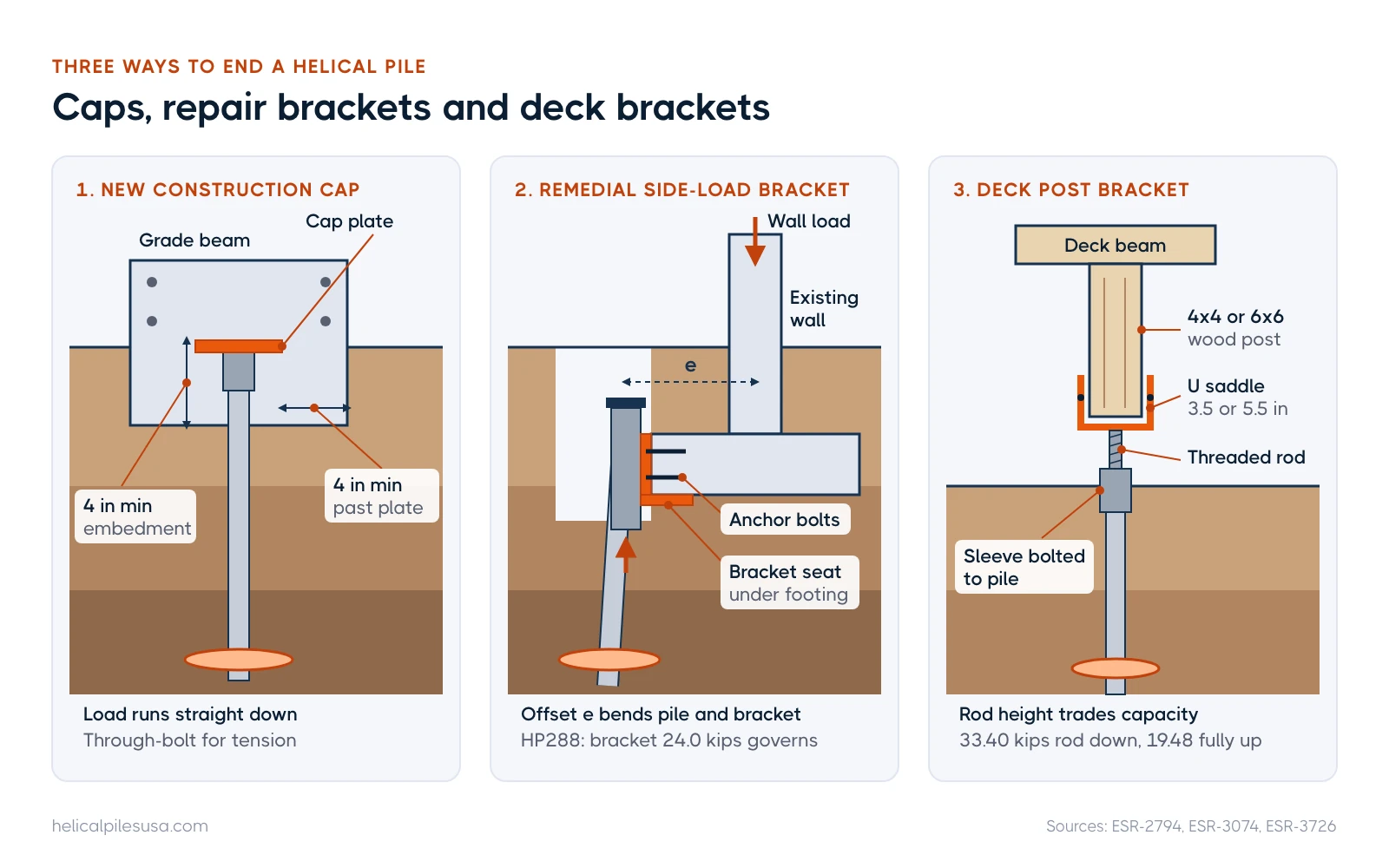
Plate caps
The plain plate cap is the most common detail. The Supportworks HP288NCB uses a 3/4 inch thick, 6 inch square plate on a 3-1/2 inch sleeve, held to the shaft with two 3/4 inch bolts. CHANCE caps in ESR-2794 range from 1/2 inch thick, 6 inch square plates on small square shafts up to 3/4 inch thick, 10 inch square plates for the 4-1/2 inch RS4500. Ram Jack's 4079.1 bracket in ESR-1854 has a 5/8 inch thick, 8 inch square plate.
Threaded and adjustable caps
Some caps sit on a threaded rod so the bearing height can be fine-tuned after the pile is cut. The trade-off is capacity. In ESR-3726, the GoliathTech GTBASE238-5X5-C flat plate on a 1 inch threaded rod is rated 33.40 kips in compression with no rod showing, 27.36 kips with 2 inches of rod exposed and 19.48 kips at full extension (about 6.5 inches). Its tension rating is 6.38 kips. Keep extensions as short as the detail allows.
Caps cast into a grade beam: embedment and cover
The concrete around the cap often limits capacity more than the steel does. The rules differ by report:
- CHANCE (ESR-2794): the top of the cap must be embedded at least 4 inches vertically and 4 inches beyond the edges of the cap plate. The shaft center must be at least 6 inches from the end or corner of the footing. Tension piles and fixed-head piles need at least 7.5 inches of shaft embedment into the footing, and piles must be plumb within plus or minus 1 degree.
- ECP (ESR-3559): code-minimum covers per IBC Section 1810.3.11 are 3 and 4 inches, a 4 inch edge distance and a 16 inch wide footing for the TAB-288-NC. That gives 10.72 kips in compression. To reach the full 58.6 kips, the footing grows to about 33.4 inches wide with 12.7 inches of edge distance.
- GoliathTech (ESR-3726): in 3,000 psi concrete, the GTBRST278-5X5 is rated 45.20 kips with 12 inches of embedment in a 28 inch footing, but only 8.80 kips with 4 inches of embedment in a 13 inch footing.
- Supportworks (ESR-3074): the HP288NCB is rated 33.1 kips at a 3 inch edge distance and 44.1 kips at 4 inches or more in 2,500 psi concrete. That figure covers concrete bearing only, so punching shear has to be checked separately.
- Ram Jack (ESR-1854): with 4 inches of bracket embedment, the 4075.1 is rated 18.2 kips in a 12 inch beam and the 4079.1 is rated 36.5 kips in a 14 inch beam.
The lesson is that a cap's rating is meaningless without the footing dimensions it was tested in. The engineer has to design the footing for punching shear, flexure and reinforcement, and every report says so.
Remedial and underpinning brackets
A remedial bracket (also called an underpinning or retrofit bracket) lifts and supports an existing foundation. The crew digs beside the footing, installs the pile at a slight batter next to it, then bolts a steel seat under the footing and transfers the load with a lift cylinder. CHANCE requires an exposed area at least 18 inches wide and 12 inches below the footing for its standard bracket. Supportworks describes a pit about 3 feet square dug 13 inches below the footing.
Eccentric loading
The pile sits beside the footing, not under its center, so the load reaches the pile off-axis. ESR-2794 splits this into bracket eccentricity, which the bracket, shaft and anchors resist and which the full-scale tests capture, and structural eccentricity, which twists the footing and must be checked by the engineer. The same report assumes the footing can provide lateral bracing equal to at least 0.4 percent of the pile's allowable load. A cracked, thin or unreinforced footing, or a loose stone wall, may not meet that assumption.
Why bracket capacity often governs
Side-load brackets are rated by full-scale load tests under AC358, typically with 5 feet of unbraced pile and one coupling. That test combines the bending from eccentricity with the bracket steel and the concrete bearing, so the result is usually lower than the shaft alone. Ram Jack also requires a 4 foot guide sleeve at the top of the shaft to reach its ratings.
Bracket styles
- Standard side-load: an angle seat bolted to the footing face with two to ten anchors. Examples include the CHANCE C1500121 (23.2 kips on RS2875.203 with the C2780001 T-pipe) and the Ram Jack 4021.1 (33.65 kips).
- Low-profile: a compact seat for shallow footings and tight access. The Supportworks FS288BL2 is listed as the HP288 Low Profile 2 Bracket (24.0 kips), and the Ram Jack 4039.1 low-profile bracket is rated 32.07 kips. Earth Contact Products released a low-profile bracket for its 2-7/8 inch TA-288 pile, rated by the maker at 20,000 lb working and 40,000 lb ultimate with up to 4 inches of lift (see our news item).
- Heavy-duty and direct-jack: larger seats for bigger shafts or loads. The CHANCE C1500840 direct-jack bracket is rated 48.3 kips on RS2875.203 in firm soil, and the Ram Jack 4021.55 on a 3-1/2 inch pile is rated 55.12 kips.
- Slab brackets: two steel channels that span a small hole cut through a floor slab. The Ram Jack 4093 slab bracket tops out at 11.7 kips, and the slab sets pile spacing. For a 4 inch, 2,500 psi slab at 40 psf live load, the report allows a maximum pile spacing of 4 feet 10 inches for 1 and 2 spans.
Deck post brackets for 4x4 and 6x6 posts
Deck brackets are small direct-load brackets with a U-shaped saddle that takes a wood post or beam. Nominal 4x and 6x lumber is 3-1/2 and 5-1/2 inches wide, and the saddles are sized to match.
- GoliathTech: ESR-3726 lists U-shape saddles on adjustable 1 inch threaded rods in several sizes, including the GTBU358 and GTBU558, whose 3.5 and 5.5 inch dimensions match 4x and 6x lumber. The galvanized versions are rated 33.40 kips in compression with the rod fully down, 6.38 kips in tension and 9.65 kips laterally, so the pile or the post usually governs, not the bracket.
- Techno Metal Post: ESR-3418 lists the PU4 (3-5/8 inch inside width) and PU5 (5-5/8 inch inside width) U brackets for wood members, fixed with four No. 14 wood screws 2 or 3 inches long. Their compression rating depends on the wood's crushing strength perpendicular to the grain: at 400 psi the PU4 is rated 4.54 kips and the PU5 7.13 kips, rising to 6.81 and 10.70 kips at 600 psi.
For layout, spacing and cost, see helical piles for decks.
Tension and anchor terminations
Uplift, overturning and retaining loads need a termination that can pull, not just push. Options in the reports include:
- Through-bolted caps: CHANCE and Supportworks caps carry tension only when bolted through the shaft. The CHANCE C1500797G cap on RS2875.203 is rated 43.5 kips allowable in tension, and the Supportworks HP288NCB is rated 24.3 to 34.0 kips depending on edge distance and concrete strength.
- Tension brackets with threaded bar: Magnum's MHC1080 Type D brackets connect to No. 10 threaded rebar cast into the structure, rated 38.2 kips on the MH325BG shaft and 67.3 kips on the MH325BRG in ESR-2997.
- Tieback plates: the Ram Jack 4550.2875.1 tieback assembly is rated 27.9 kips at 20 degrees and 27.6 kips at 30 degrees, and must bear on a concrete wall at least 6 inches thick.
Tension piles also need deeper helices. See helical wall anchors and helical ground anchors for those systems.
Materials and galvanizing
Bracket plates are typically ASTM A36 or A572 steel and sleeves are structural tube. Most brackets come plain or hot-dip galvanized. The reports cite ASTM A123 (zinc coating on fabricated steel products) or ASTM A153 (zinc coating on hardware): Supportworks brackets reference A123, and CHANCE brackets and bolts reference A153. A "G" suffix on a CHANCE or Supportworks part number means galvanized.
Ratings already include 50 years of corrosion loss. ESR-3726 applies AC358 losses of 0.036 inch for bare steel and 0.013 inch for galvanized steel, which is why galvanized parts rate higher. CHANCE bare repair brackets are rated at 90 percent of the galvanized value. ESR-2794 also says zinc-coated and bare parts must not be mixed in one system unless the bare-steel loss is assumed, and all helical parts must be isolated from rebar and other building steel. More on this in do helical piers rust.
Product examples and rated capacities
All values are ASD allowable compression from the documents linked, unless noted. Each rating applies only to the listed shaft, concrete and installation conditions.
| Maker and product | Type | Shaft | Rated capacity | Conditions and source |
|---|---|---|---|---|
| CHANCE C1500121 + C2780001 | Standard repair | RS2875.203 | 23.2 kips | 2,500 to 4,000 psi, ESR-2794 |
| CHANCE C1500840 | Direct-jack repair | RS2875.203 | 48.3 kips | Firm soil, ESR-2794 |
| CHANCE C1500781G | New-construction cap | RS2875.203 | 37.6 kips | 2,500 psi, firm soil, ESR-2794 |
| Supportworks FS288BL2 | Low-profile repair | HP288 | 24.0 kips (26.8 galvanized) | ESR-3074 |
| Supportworks HP288NCB | New-construction cap | HP288 | 33.1 to 44.1 kips | Edge distance 3 in or 4 in+, ESR-3074 |
| Ram Jack 4021.1 | Standard repair | 2-7/8 in | 33.65 kips | 2,500 psi, ESR-1854 |
| Ram Jack 4039.1 | Low-profile repair | 2-7/8 in | 32.07 kips | 2,500 psi, ESR-1854 |
| Ram Jack 4093 | Slab bracket | 2-7/8 in | 11.7 kips max | Limited by slab, ESR-1854 |
| Magnum MP1001-3G | Side-load repair | MH325BG/BRG | 39.3 kips | 5,000 psi, 10 anchors, ESR-2997 |
| Magnum MHC1300-3M6565BR2G | Direct-load cap | MH325BRG | 57.0 kips | 2,500 psi, ESR-2997 |
| ECP TAB-288-LUB | Repair | TA-288 | 22.6 kips | 2,850 psi, ESR-3559 |
| ECP low-profile bracket | Low-profile repair | TA-288 | 20,000 lb working, 40,000 lb ultimate | Manufacturer data |
| ECP TAB-288-NC | New-construction cap | TA-288 | 10.72 to 58.6 kips | Minimum vs full cover, ESR-3559 |
| GoliathTech GTUPHC278 | Heavy repair | 2-7/8 in | 21.92 kips | 2,500 psi, ESR-3726 |
| GoliathTech GTBU358 / GTBU558 | Deck U bracket, adjustable | 2-3/8 in | 33.40 kips (19.48 at full extension) | Galvanized, ESR-3726 |
| Techno Metal Post PU4 / PU5 | Wood U bracket | TMP shafts | 4.54 / 7.13 kips | Wood at 400 psi, ESR-3418 |
To see which report covers a given brand and when it expires, use our ICC-ES evaluation reports guide.
How to choose a bracket or cap
- Start with the job. Choose a cap for new footings, a side-load or low-profile bracket for an existing footing, a slab bracket for an interior floor, a U bracket for wood framing, and a through-bolted cap or tension bracket for uplift.
- Match the system. Ratings apply only to the bracket, sleeve and shaft combination tested. Do not mix brands.
- Check the load against the lowest of P1 to P4. On repair work, size the bracket first, since it usually controls.
- Check the concrete. Confirm footing strength, width and depth against the report. Two Magnum repair ratings need 5,000 psi concrete, and CHANCE needs an 8 inch minimum footing width with 6 inches of edge distance at the anchors.
- Pick the finish. Galvanized costs more but rates higher and suits wet or corrosive soil.
Our free helical pile tools help with quick capacity and spacing checks before you speak to an engineer.
Inspection points
Under the IBC, ESR-2794 and ESR-3074 call for special inspection under Section 1705.9 during installation. For brackets and caps, inspectors usually check:
- Part numbers and finish match the approved drawings and the evaluation report.
- Repair piles are at the specified batter, such as 2.5 plus or minus 1 degree for the HP288, and new-construction piles are plumb within 1 degree.
- The bracket seat bears fully on clean, flat concrete, and the anchors are the specified type, diameter and embedment.
- Cap plates bear on the cut shaft end, bolts are installed snug-tight, and the embedment, edge distance and cover are met before the pour.
- The lift is within the engineer's limits and the load transfer is logged for each pier.
- No bare and galvanized parts are mixed, and steel is isolated from rebar.
Find an installer
Bracket choice and footing details belong in a stamped design, but a good installer will know which brackets their system is rated for. You can find a helical pile installer in your state or province, compare products on the helical pile manufacturers page, and read our guide to helical piers for foundation repair before collecting quotes.
Frequently asked questions
What is a helical pile cap?
It is a steel plate welded to a sleeve that fits over the top of a helical pile and is cast into a new footing or grade beam. It carries load straight down the shaft and can be bolted through for tension.
How deep should a helical pile cap be embedded in concrete?
It depends on the report. CHANCE requires at least 4 inches of vertical embedment and 4 inches of concrete beyond the plate edges, and 7.5 inches of shaft embedment for tension piles. Deeper embedment and wider footings raise the rating on most caps.
Why is a repair bracket rated lower than the pile?
A side-load bracket holds the footing off-center from the pile, which bends the shaft and loads the anchors. The ratings come from full-scale tests that include that bending, so the bracket usually governs.
Can a helical pile bracket be used on a slab?
Yes, with a slab bracket or a low-profile bracket. Slab ratings are low, for example 11.7 kips maximum for the Ram Jack 4093, so piles are spaced closer under thin slabs.
Do deck post brackets need to be galvanized?
It is not always required, but GoliathTech and Techno Metal Post both offer galvanized versions, and galvanized brackets rate higher because their 50-year corrosion allowance is smaller. Pair them with fasteners rated for treated lumber.
Last reviewed October 2026 by the Helical Pile USA editorial team. Found an error? Tell us.
Subscribe to our weekly email newsletter
Industry news, featured projects, new products, and installer spotlights from across the helical pile industry, delivered to your inbox.


Latest articles

Get the Helical Pile Industry Brief
New installers, manufacturer news, cost updates, and fresh guides for the U.S. and Canadian helical pile industry. Short, occasional emails. Unsubscribe any time.
