

Helical Piles for Solar: Ground Mounts, Solar Farms and Cost
Helical piles for solar: how screw piles and ground screws handle uplift, rock and frost, compare to driven piles and ballast, and what they cost per watt.

Helical piles and ground screws hold solar arrays down by screwing steel shafts with helix plates or threads into the soil, so the array resists wind uplift and sideways load without concrete. They are used on residential ground mounts and on utility-scale solar farms, especially where frost, soft soil, slopes or rock make driven I-beam piles or concrete piers risky. On easy soils driven piles are usually cheaper per watt, but screw foundations often win once pile refusal, schedule delays or end-of-life removal are counted.
Key takeaways
- Uplift, not weight: A solar array is light, so the foundation's main job is resisting wind uplift and lateral push, which is where helix plates and screw threads perform well.
- Typical sizes: Residential solar piles commonly go 7 to 14 feet deep, and one manufacturer's dedicated solar pile uses a 4.5 inch shaft, 11 feet long, with a 12 inch helix.
- Cost per watt: One 2026 industry cost guide puts screw and helical foundations at $0.03 to $0.06 per watt, versus $0.02 to $0.05 for driven piles and $0.04 to $0.09 for concrete or ballast.
- Refusal flips the math: A pv magazine analysis found ground screws break even with driven piles at about a 29% pile refusal rate on a 10 MW site.
- Test before you build: Pull-out and lateral load tests on sacrificial piles confirm the design before production installation starts.
- Removable: Screw foundations can be backed out and reused or recycled when the array is decommissioned after 20 to 25 years.
Why helical piles and ground screws suit solar
A building foundation mostly carries weight pushing down. A solar racking foundation is different. The panels weigh little, but they act like a sail. Wind lifts the tilted modules, pushes them sideways and tries to rotate the posts, while frost heave in northern states can jack shallow posts out of the ground each winter. A helical pile resists these forces through bearing on its helix plates, which work in both compression and tension. CHANCE notes that because the helix plates do the work, helical piles do not need to be as long as driven piles to reach the same capacity, and they can be unscrewed at the end of a 20 to 25 year array life.
Ground screws are a close cousin. Instead of one or more flat helix plates on a smooth shaft (see what is a helical pile), a ground screw has a continuous thread along a tapered tube. Krinner, the German company that invented the ground screw, still sells a solar-specific series, and its screws were used in some of the early large solar parks in Germany. In practice, residential installers use both terms loosely, so ask the supplier for the load rating and ICC-ES evaluation rather than relying on the name.
Uplift and lateral loads
Wind is what governs most solar foundation designs. For a typical residential array tilted at 35 degrees in a 115 mph wind zone, one engineering guide lists uplift design pressures of 22 to 35 psf, and estimates that a single 400 watt panel at 30 psf sees about 630 lbs of upward force during a design wind event. Multiply that across a row and every post has to hold real tension.
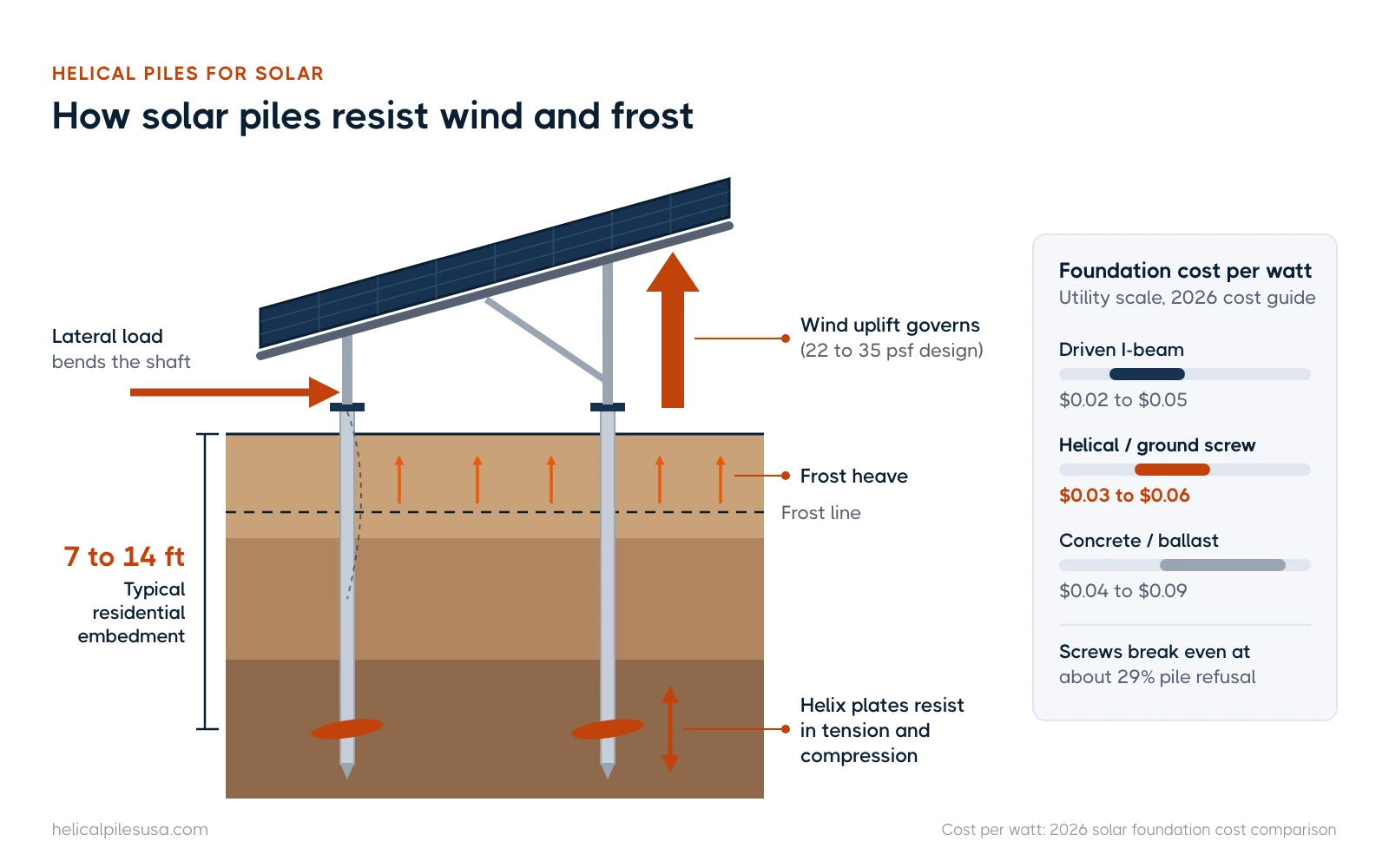
Lateral load is usually the limiting check, because the racking puts the load several feet above grade where it bends the shaft. The Magnum MHS425 solar pile shows how manufacturers rate this: a 4.5 inch shaft with 0.25 inch wall, a 12 inch helix, a maximum installation torque of 28,000 ft-lbs and a lateral capacity of 2,300 lbs applied 60 inches above the ground. For more on how torque translates into capacity, see our torque to capacity chart and how much weight a helical pile can hold.
Helical piles vs driven I-beams vs concrete and ballast
The right foundation depends almost entirely on the soil. The table below combines residential per-pile figures from one residential ground-mount design guide with utility-scale per-watt and install-rate figures from a 2026 solar foundation cost comparison.
| Foundation | Residential cost per pile | Residential install time | Utility cost per watt | Utility install rate | Best fit |
|---|---|---|---|---|---|
| Driven steel pile (I-beam or C-section) | $250 to $600 | 5 to 10 min | $0.02 to $0.05 | 150+ per day | Firm clay, dense sand, few obstructions |
| Helical pile | $400 to $900 | 15 to 25 min | $0.03 to $0.06 | 100+ per day | Soft clay, loose sand, high water table, frost |
| Ground screw | $300 to $700 | 10 to 15 min | $0.03 to $0.06 | 100+ per day | Mixed, rocky or frozen ground, tight access |
| Concrete pier | $350 to $800 | 1 to 2 days with cure | $0.04 to $0.09 | 30 to 50 per day (drilled caisson) | Most soils with adequate bearing |
| Concrete ballast block | $150 to $300 per block | No cure | $0.04 to $0.09 | Moderate | Landfills, contaminated or no-dig sites |
Ballast has a specific niche. An NREL study prepared with the EPA found that ballasted systems are the most common anchoring method on landfills because they do not penetrate the landfill cap, while helical piles fit landfills with deeper, known cap depths and side slopes. The trade-off is weight: the same residential guide notes ballast uses four to six times more concrete per kW than piers. For a wider comparison outside solar, read are helical piles better than concrete and helical piles vs drilled piers.
Rocky sites, refusal and installation rates
Driven piles are fast when they go down cleanly. The problem is refusal, when a pile hits rock, cobbles or a buried slab before reaching design depth. A pv magazine analysis of a 10 MW project modeled the trade-off in detail:
- Ground screw materials cost about 26% more than piles, and on soft sites piles held a $0.021 per watt advantage.
- About 40% more ground screws could be installed per day than piles, against a baseline of 50 piles per day.
- Remediating a refused pile by drill-and-drive added about $250 per foundation on top of a $68 install price.
- Cost broke even at roughly a 29% refusal rate. At 50% refusal, screws came out $0.016 per watt cheaper and piles needed a 24 day schedule extension, with delays costing up to $25,000 per week.
Screws also have a workaround for true bedrock. On utility projects, crews drill a pilot hole into the rock, fill it with aggregate and drive the screw into the hole, and one racking company reports a log of 12,000 ground screw tests from its installations. That article is clear that screws are not the cheapest choice on every project, only on difficult ones. See helical piles in rocky soil for more on what happens when a helix meets rock.
Corrosion and galvanizing
Solar piles are almost always hot-dip galvanized, and the coating is what sets service life. Field excavations by Chance Foundation Solutions engineers of galvanized foundations in service for decades, including one installed in 1983 and dug up in 2016, support a service life beyond 50 years in well-drained soils with resistivity above about 2,000 ohm-cm. Typical hot-dip zinc coatings run about 4 to 7 mils, and the measured loss at one site was about 0.19 mils per year. Wet, salty or acidic soils shorten that, so utility projects test soil resistivity, pH and chlorides during the geotechnical study. Our guide on whether helical piers rust covers the details.
Pull-out testing and pre-construction load tests
Because solar foundations are governed by uplift, the standard check is a pull-out test: a jack lifts a test pile while gauges record displacement. On utility projects, a pre-construction pile load test program installs sacrificial piles across the site, then tests them in tension, compression and lateral load to confirm or adjust embedment depth before thousands of production piles go in. Helical piles add a second check during installation, because installation torque correlates with capacity and is logged on every pile.
For homes, testing is smaller but still common. One residential guide budgets $800 to $1,800 for a pull test on production piles and $2,200 to $5,100 for a full testing package including hand auger probes and an SPT boring. It also lists skipped soil testing on fill sites as a cause of $4,000 to $9,000 in rework.
Residential ground mount cost and permitting
A typical home array needs a modest number of piles. GoliathTech says residential solar mounts usually need one to six piles set 7 to 14 feet deep, installed with compact equipment in days rather than weeks, year-round. Using the per-pile ranges above, the foundation for a small ground mount often lands in the low thousands of dollars. One guide estimates foundation cost at about $0.22 per watt for 10 to 20 kW systems on cooperative soil, or $2,200 for a 10 kW array and $4,400 for a 20 kW array. Rocky ground, deep frost or long equipment access raises that. For general pricing outside solar, see our helical pier cost guide.
Permits usually cover both the electrical system and the structure. Expect the building department to check:
- Setbacks: Often 5 to 15 feet from side and rear lot lines, though rules vary by state and county.
- Engineering: Many jurisdictions want stamped structural drawings, and a stamped soil report is standard above about 10 kW or a 1,000 sq ft footprint.
- Frost depth: Embedment below the local frost line, which ranges from almost nothing on the Gulf Coast to 60 inches or more in the northern Plains.
- Product evaluation: Helical products evaluated under ICC-ES AC358 make plan review simpler.
Our guide to helical pile permits and building codes explains how IBC Chapter 18 applies.
Finding a solar foundation installer
Many helical installers who build decks and repair foundations also set solar piles, and some specialize in utility-scale work. Ask for torque logs, pull test results and the manufacturer's evaluation report. You can find a helical pile installer in your state or province, compare solar-capable brands such as CHANCE, Magnum, GoliathTech, Krinner and MacLean on our manufacturers index, and read how to hire a helical pile contractor.
Frequently asked questions
Are ground screws the same as helical piles?
Not exactly. A helical pile has one or more flat helix plates on a shaft, while a ground screw has a continuous thread on a tapered tube. Both are screwed in with torque, carry uplift well and suit solar mounts.
How deep do helical piles go for a solar ground mount?
Residential solar piles are typically set 7 to 14 feet deep, and always below the local frost line. Utility projects set depth from geotechnical borings and pre-construction load tests. See how deep helical piles go.
Are helical piles cheaper than driven piles for solar farms?
Usually not on soft, rock-free soil, where driven piles cost less per watt. On sites with frequent pile refusal, screw foundations can be cheaper overall once remediation and schedule delays are included.
How many helical piles does a residential solar array need?
Small ground mounts often need one to six piles, and larger arrays need more depending on racking spans, wind exposure and snow load. The racking engineer sets the spacing.
Can helical piles be removed when the solar array is decommissioned?
Yes. They can be unscrewed and reused or recycled, which leaves no concrete in the ground and makes site restoration easier.
Subscribe to our weekly email newsletter
Industry news, featured projects, new products, and installer spotlights from across the helical pile industry, delivered to your inbox.


Latest articles

Get the Helical Pile Industry Brief
New installers, manufacturer news, cost updates, and fresh guides for the U.S. and Canadian helical pile industry. Short, occasional emails. Unsubscribe any time.
