

Helical Piles vs Drilled Piers: Cost, Capacity and Best Uses
Helical piles vs drilled piers and auger-cast piles: capacity, equipment, curing, groundwater, torque vs CSL verification, cost and best-fit projects.

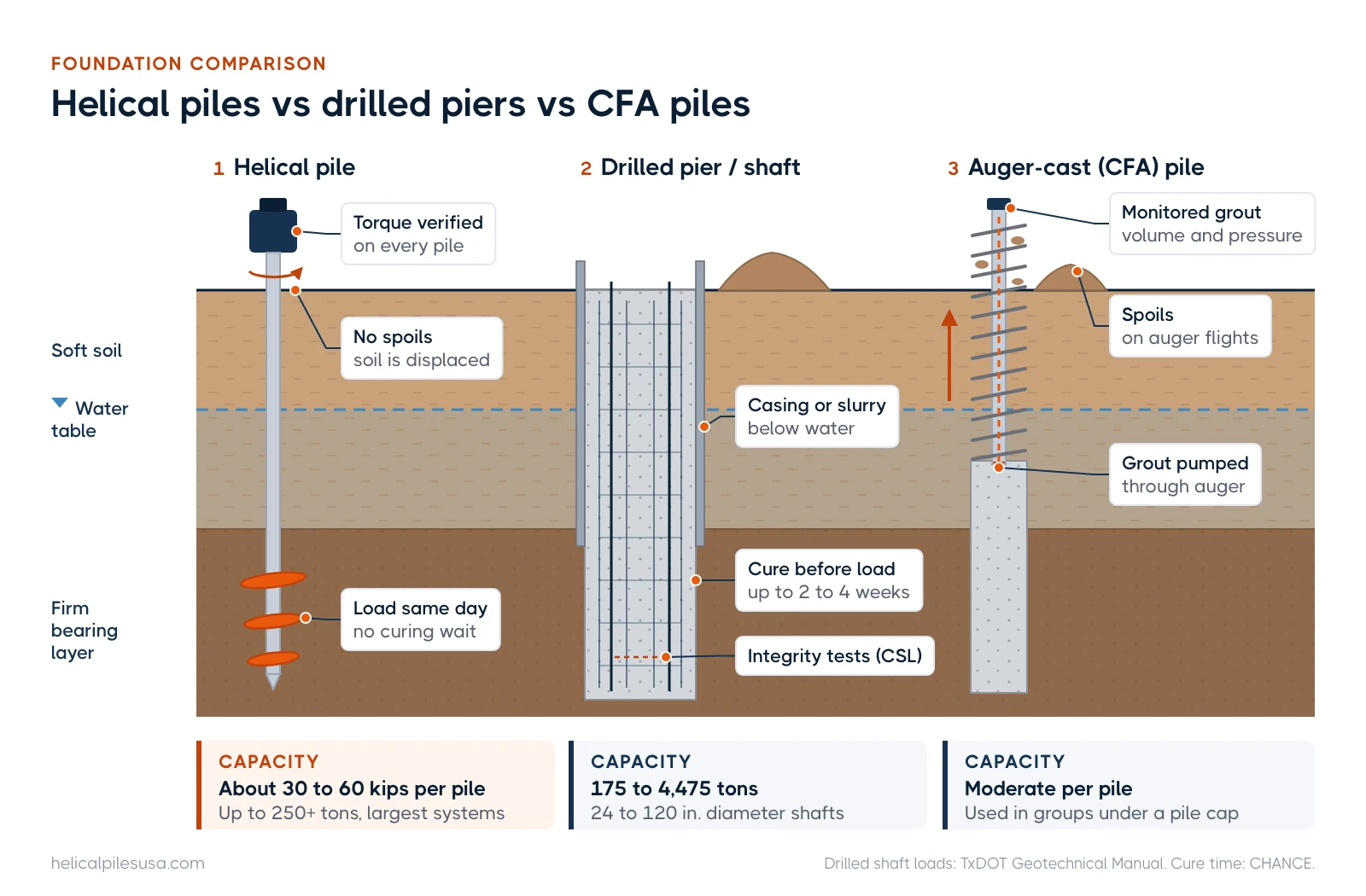
Helical piles are steel shafts screwed into the ground with light hydraulic equipment, verified by installation torque and ready for load the same day. Drilled piers (also called drilled shafts or caissons) and auger-cast piles are concrete elements cast in a drilled hole, and they need a drill rig, concrete delivery, curing time and inspection or integrity testing. For light to moderate loads, tight access, high groundwater or fast schedules, helical piles usually win. For very heavy column loads, large lateral or overturning demands, and rock sockets, drilled shafts are the standard choice.
Key takeaways
- Capacity: A single large drilled shaft can carry hundreds to thousands of tons, while most helical piles carry tens of tons each, with heavy-duty systems reaching 250 tons or more.
- Speed: Helical piles take load right after installation. Concrete shafts need curing time, which CHANCE puts at 2 to 4 weeks for full strength.
- Verification: Helical capacity is checked pile by pile with torque. Drilled shafts rely on inspection records, integrity tests such as crosshole sonic logging, and load tests.
- Site conditions: Groundwater and caving sand force drilled shafts into casing or slurry. Helical piles have no open hole, so neither issue applies, but cobbles and shallow rock can stop them.
- Auger-cast piles: They sit in the middle, built fast in groups of 12 to 24 inch piles on large commercial jobs, but they produce spoils and are hard to inspect directly.
How each foundation works
Helical piles
A helical pile is a steel shaft with one or more helix plates welded near the tip. A hydraulic drive head rotates it into the soil, and extensions are added until the required torque and depth are reached. Load transfers mainly through the helix plates bearing on the soil, plus some shaft friction on large diameter round shafts. New to the system? Read what a helical pile is.
Drilled piers, drilled shafts and caissons
These names describe the same basic element. A University of Massachusetts Lowell course on drilled deep foundations notes that "drilled shaft" is the common Texas and transportation term, "drilled caisson" or "drilled pier" is common in the Midwest, and "bored pile" is used outside the U.S. A rig drills an open hole, a reinforcing cage is lowered in, and concrete is placed. In stable clay or rock the hole stays open (the dry method). In caving or water-bearing soils, the contractor uses temporary steel casing or fills the hole with bentonite or polymer slurry and places concrete with a tremie. The Federal Highway Administration's design manual for this foundation type is Geotechnical Engineering Circular No. 10 (GEC 10).
Auger-cast piles (ACIP or CFA)
Auger-cast piles, also called continuous flight auger (CFA) or augered cast-in-place piles, are drilled with a hollow-stem auger. Concrete or grout is pumped through the stem under pressure as the auger is pulled out, and the rebar is pushed into the fresh concrete. The Deep Foundations Institute ACIP and drilled displacement committee maintains the industry manual and inspector's guide for this pile type, and FHWA covers it in GEC 8, Design and Construction of Continuous Flight Auger Piles.
Side-by-side comparison
Typical ranges from the sources cited in this guide. Treat them as starting points for your geotechnical engineer.
| Factor | Helical piles | Drilled piers / shafts | Auger-cast (CFA) piles |
|---|---|---|---|
| Typical size | About 2.875 in. to 18 in. shafts in the products cited here | 24 in. to 120 in. diameter on TxDOT bridge work | 12 to 36 in. diameter, usually 12 to 24 in. in U.S. practice |
| Typical length | Set by required torque and soil conditions | Set by load and bearing layer; at least 3 diameters when socketed into shallow rock (TxDOT) | Up to about 100 ft |
| Capacity per element | About 30 to 60 kips allowable for 2.875 to 3.5 in. shafts; 250+ tons for the largest systems | 175 tons (24 in.) to 4,475 tons (120 in.) maximum allowable on TxDOT bridges | Moderate; usually used in groups under a pile cap |
| Equipment | Mini-excavator, skid steer or excavator with drive head | Drill rig, crane for cage, concrete trucks, possibly casing or slurry plant | CFA rig, concrete or grout pump, cage handling |
| Spoils | None | Yes, plus slurry disposal when used | Yes (except drilled displacement variants) |
| Curing before load | None | Concrete must gain strength, up to 2 to 4 weeks | Concrete or grout must gain strength |
| Groundwater and caving soils | No open hole, so little effect on installation | Needs casing or slurry, adds cost and risk | Auger supports hole, but loose clean sand below water risks soil mining |
| Verification | Installation torque on every pile, plus load tests on larger jobs | Inspection records, integrity tests (CSL), load tests | Automated monitoring of grout volume and pressure, integrity tests |
| Rock | Cannot penetrate rock; can bear on it | Can be socketed into rock | Limited to soil or very weak rock |
Capacity and load range
This is the biggest difference between the systems. The Texas DOT geotechnical manual lists maximum allowable service loads of 175 tons for a 24 in. drilled shaft, 400 tons for 36 in., 700 tons for 48 in. and 4,475 tons for 120 in. A single large shaft can replace a whole group of smaller piles and the pile cap that ties them together. The UMass Lowell course material notes that, depending on local practice, 8 to 10 driven piles can be equivalent to one shaft.
Helical piles work at a smaller scale per element. In a Supportworks commercial design example, a 2.875 in. shaft has an ultimate torque-rated capacity of 71.1 kips and a 3.5 in. shaft has 122.5 kips ultimate and 60 kips allowable. At the top end, MAGNUM high-capacity helical piles come in 3 to 18 in. shaft sizes with capacities above 250 tons. For a deeper look at per-pile numbers, see how much weight a helical pile can hold and our helical pile shaft sizes chart.
Lateral load matters too. A slender helical shaft is far less stiff in bending than a large concrete shaft, so tall signs and bridge piers with big overturning moments usually point toward drilled shafts.
Equipment, access and installation speed
CHANCE (Hubbell) points out that helical piles install with common hydraulic machines such as backhoes, skid steers and mini-excavators, while a drilled shaft job needs a drill rig and concrete trucks that can weigh around 66,000 pounds. That matters for interior additions, basements, rear yards and sites with buried utilities. See how long it takes to install a helical pile for typical per-pile times.
Auger-cast piles are the speed leader among concrete options when many piles sit close together. According to FHWA GEC 8, private projects with 12 to 18 in. piles under 65 ft long typically reach 1,000 to 1,500 ft of pile per day, and cycle times of 15 minutes or less per pile are not uncommon. GEC 8 also notes that the high torque needed to turn a full-length auger keeps CFA piles smaller and shorter than drilled shafts.
Curing is the schedule item people forget. Helical piles take load at torque, while concrete must gain strength, and CHANCE notes that cold, heat, rain and snow affect concrete work.
Groundwater, caving soils and spoils
Drilled shafts are most sensitive to ground conditions. The UMass Lowell material explains that the hole can stay unsupported in cohesive soil or rock, but granular soils, boulders and water-bearing layers need slurry or casing. Slurry must be managed and disposed of, and concrete is placed by tremie from the bottom up.
Auger-cast piles avoid casing and slurry because the auger supports the hole, but FHWA GEC 8 warns that loose, clean sands below the water table are unfavorable because the auger can pull too much soil out (soil mining). Both concrete systems produce spoils, which GEC 8 notes can be a serious problem when soils are contaminated or the site has little room to stockpile and haul.
Helical piles displace soil instead of removing it, so there are no spoils and no open hole to cave or flood. Their weak point is hard ground: dense cobbles, boulders and shallow bedrock can stop a helix before it reaches design torque. If that describes your site, read our guide to helical piles in rocky soil. Steel in aggressive soil also needs a corrosion check (see do helical piers rust).
Verification: torque vs inspection and load tests
Helical piles carry a built-in quality check. Capacity is estimated from installation torque with the relationship Qu = Kt x T, where T is final torque and Kt is an empirical factor. ICC-ES AC358 publishes default Kt values, and Supportworks uses the AC358 defaults of 9 for a 2.875 in. shaft and 7 for a 3.5 in. shaft when no site-specific load test is available. Larger projects often run a site-specific load test to confirm Kt. Our helical pile torque to capacity chart walks through the math.
Drilled shafts are accepted on inspection records and testing after the concrete is placed. The New York State DOT drilled shaft inspector's guidelines state that acceptance usually rests on integrity tests and installation records, and NYSDOT specifies crosshole sonic logging (CSL) on every production shaft, with coring if a major defect shows up. Auger-cast piles rely on automated monitoring of auger depth, grout pressure and grout volume, since the hole cannot be seen. FHWA GEC 8 acknowledges that QA for CFA piles is less reliable than for driven piles.
Cost comparison
Cost depends on load, depth, soil, access and quantity, so per-unit prices only go so far. For residential work, Today's Homeowner lists concrete piers at $2,000 to $3,000 each and helical piers at $2,500 to $3,500 each. Our helical pier cost guide covers the details.
Commercial deep foundations are bid per linear foot plus mobilization. FHWA GEC 8 (published in 2007, so prices are dated) reported private-project CFA costs of about $12 to $20 per linear foot for 12 to 18 in. piles, rising to $60 to $80 per foot for 30 to 36 in. soundwall piles in Florida, and it stressed that mobilization and pile count drive unit price. Drilled shaft cost rises quickly when casing, slurry, rock sockets, CSL testing and spoil hauling are added. CHANCE cites a case study in which helical piles came in about 80% cheaper than caissons, but that is a manufacturer example, not a general rule. Compare total installed cost, including caps, testing and schedule.
Best-fit projects for each
- Choose helical piles for: additions, decks, light commercial buildings, equipment pads, boardwalks, solar arrays, underpinning and foundation repair, limited-access sites, high groundwater, contaminated soil where spoils are costly, winter work and tension or uplift loads.
- Choose drilled shafts for: bridge piers, high-rise and heavy industrial columns, large lateral or overturning loads, and sites where bedrock is reachable for a rock socket.
- Choose auger-cast piles for: large commercial buildings with many moderate-load piles close together, in clay or stable soil, where noise and vibration limits rule out driven piles.
For homeowner deck and sonotube questions, our guide are helical piles better than concrete is a better fit. Whatever you pick, check local requirements in our helical pile permits and building codes guide.
Find a helical pile contractor
If helical piles look like the right fit, get at least two bids from installers who can provide torque logs and engineering support. You can find a helical pile installer in your state or province, compare products in our helical pile manufacturers directory, and use our checklist on how to hire a helical pile contractor.
Frequently asked questions
Are drilled piers and caissons the same thing?
Yes, in most U.S. usage. Drilled pier, drilled caisson, drilled shaft and bored pile all describe a concrete element cast in a drilled hole, with the name varying by region and industry.
Can helical piles replace drilled shafts on a commercial project?
Often, when loads per column are moderate and a group of helical piles can share the load. Very heavy columns, large lateral loads and rock-socket designs usually still call for drilled shafts.
What is the difference between drilled piers and auger-cast piles?
A drilled pier is excavated as an open hole, then the cage and concrete are placed. An auger-cast pile is filled with concrete or grout through a hollow auger as it is withdrawn, so no casing or slurry is needed, but the hole is never visible for inspection.
Do helical piles work in high groundwater?
Yes. There is no open hole to flood or cave, so groundwater has little effect on installation, though the engineer should still check corrosion and soil strength.
How is drilled shaft capacity verified?
Through inspection of the excavation and concrete placement, integrity tests such as crosshole sonic logging, and static or other load tests on larger projects. Helical piles add a torque reading on every pile.
Subscribe to our weekly email newsletter
Industry news, featured projects, new products, and installer spotlights from across the helical pile industry, delivered to your inbox.


Latest articles

Get the Helical Pile Industry Brief
New installers, manufacturer news, cost updates, and fresh guides for the U.S. and Canadian helical pile industry. Short, occasional emails. Unsubscribe any time.
