

Helical Pile ICC-ES Reports: ESR and CCMC Numbers by Brand
Helical pile ICC-ES evaluation reports (AC358 ESRs), CCMC and IAPMO numbers for 20+ brands, what each covers, expiry dates and how to read capacity tables.

An ICC-ES evaluation report (ESR) is a third-party document showing that a specific helical pile system was tested and evaluated against ICC-ES acceptance criteria AC358 and found to comply with, or be a suitable alternative to, the International Building Code and International Residential Code. As of October 2026 the ICC-ES reports directory lists current helical pile ESRs for CHANCE, Magnum, Ram Jack, Supportworks, ECP, MacLean, IDEAL, PierTech, Postech, Techno Metal Post, GoliathTech, Grip-Tite and Cantsink, among others. In Canada the equivalent is a CCMC evaluation with a number ending in -R. The tables below list every report we verified.
Key takeaways
- AC358: The ICC-ES acceptance criteria for helical pile systems and devices. Push piers are evaluated under a separate document, AC517.
- What an ESR proves: The manufactured parts (shaft, couplings, helices, brackets) have published allowable capacities and a quality-control program with ICC-ES inspections.
- What it does not prove: Soil capacity at your site, the design of the concrete it connects to, or that the installer followed the report.
- Allowable load is the lowest of four values: bracket (P1), shaft (P2), helix plates (P3) and soil (P4).
- Reports expire: Each ESR is reissued on a cycle. Check the date on the live PDF before you submit it with a permit.
- Canada: CCMC lists 11 active auger-installed steel pile evaluations, and Almita and Mascore hold CCMC reports.
What AC358 is
ICC Evaluation Service (ICC-ES) is a subsidiary of the International Code Council. It writes acceptance criteria that spell out which tests, calculations and quality documents a product must submit before ICC-ES will issue a report on it. For helical piles that document is AC358, Helical Pile Systems and Devices, currently in its 2024 edition. Push piers, which are hydraulically driven rather than screwed in, have their own criteria, AC517, Push Pier Foundation Systems.
The criteria are sold, not posted free, but Section 6.0 of every ESR names the edition used. ESR-2794 cites AC358(24), published April 2025, while some older reports still cite the June 2020 edition and list older code editions. That matters if your jurisdiction is on the 2024 IBC.
AC358 reports describe a lead section with helix plates, extensions, couplings and a bracket. Brackets fall into two families:
- Type A side-load (retrofit) brackets: attach to the side of an existing footing for underpinning. Most reports limit them to compression.
- Type B direct-load (new construction) brackets: cast into a new pile cap, footing or grade beam. These usually carry compression and tension, and in many reports lateral load too.
Helical pile ICC-ES and CCMC reports by manufacturer (October 2026)
Every row was checked against the live listing on icc-es.org, the CCMC registry or the IAPMO UES list in October 2026, and each number links to its source. "Renewal" follows older-format reports ("subject to renewal"); "active through" follows newer ones, which stay under a continuous compliance program to the end of that month.
| Manufacturer | Product line | Report number | What it covers | Reissue / expiry |
|---|---|---|---|---|
| CHANCE (Hubbell Power Systems) | SS5, SS175, RS2875.203, RS2875.276, RS3500, RS4500, SS175/RS3500 combo | ESR-2794 | New construction caps (compression and tension); retrofit Type A brackets (compression only) | Reissued May 2026; renewal May 2027 |
| Magnum Piering | MH325BG and MH325BRG (3 in. round), MS150BG (square) | ESR-2997 | New construction, compression and tension; direct-load, tension-load and side-load brackets listed | Reissued May 2026; renewal May 2027 |
| Ram Jack (Gregory Enterprises) | 2-7/8, 3-1/2 and 4-1/2 in. pipe shafts | ESR-1854 | New or existing structures; compression, tension and lateral | Reissued Feb 2026; renewal Feb 2028 |
| Foundation Supportworks | HP288 and HP350 | ESR-3074 | Retrofit brackets and new construction brackets; compression and tension | Reissued Jul 2025; renewal Jul 2027 |
| Earth Contact Products (ECP) | TA-150, TA-175, TA-288, TA-350 | ESR-3559 | Retrofit Type A (compression only); new construction Type B (compression and tension) | Reissued Aug 2026; active through Aug 2028 |
| MacLean (MacLean Power) | MacLean-Dixie: 1-1/2 and 1-3/4 in. RCS bar; 2-7/8 and 3-1/2 in. pipe | ESR-3032 | Underpinning and new construction; compression, tension and lateral | Reissued Aug 2026; active through Aug 2028 |
| IDEAL Manufacturing | 2-7/8 and 3-1/2 in. round; 1-1/2 in. RCS | ESR-3750 | Repair brackets (compression); new construction (compression, tension, lateral) | Reissued Jun 2026; active through Jun 2028 |
| PierTech Systems | 2-1/4, 2-7/8 and 3-1/2 in. round | ESR-3969 | Side-load brackets (compression only); direct-load (compression, tension, lateral) | Reissued Jan 2026; renewal Jan 2027 |
| Postech Screw Piles | P312 (3-1/2 in.); CCMC lists P178, P238, P312 | ESR-4735 CCMC 13102-R | Underpinning and new construction; compression, tension and lateral | ESR reissued Oct 2026, active through Oct 2028; CCMC modified Oct 2025 |
| Techno Metal Post (Techno-Pieux) | 3-1/2 in. (HSS3.500); UES report adds P1, P2, P3 | ESR-3418 IAPMO UES ER-481 CCMC 13059-R | ESR: underpinning and new construction, compression, tension, lateral. ER-481: IRC decks, accessory and residential structures | ESR renewal Nov 2026; ER-481 valid through May 2027; CCMC modified Feb 2026 |
| GoliathTech | 2-3/8, 2-7/8 and 3-1/2 in. | ESR-3726 CCMC 13675-R | Underpinning (compression only); new construction (compression, tension, lateral) | ESR reissued Oct 2026, active through Oct 2027; CCMC modified Feb 2026 |
| Grip-Tite | RDS2875 (2-7/8 in.) | ESR-3533 | New or existing structures; compression, tension and lateral | Reissued May 2026; renewal May 2027 |
| Cantsink | 2-3/8 and 2-7/8 in. round | ESR-1559 | Repair brackets (compression); new construction brackets (compression and tension) | Reissued Dec 2024; renewal Dec 2026 |
| Almita Piling | SP238, SP278, SP312 | No ICC-ES report found (checked Oct 2026) CCMC 13691-R | CCMC: auger-installed steel pile, NBC 2015 | CCMC issued Feb 2015; modified Oct 2025 |
| US Helicals | n/a | No ICC-ES report found (checked Oct 2026) | No CCMC listing found | n/a |
| Torcsill | n/a | No ICC-ES report found (checked Oct 2026) | No CCMC listing found | n/a |
| Cyntech | n/a | No ICC-ES report found (checked Oct 2026) | No CCMC listing found | n/a |
| Heli-Pile | n/a | No ICC-ES report found (checked Oct 2026) | No CCMC listing found | n/a |
Hubbell's older CCMC report for CHANCE helical piles (CCMC 13193-R, which listed a re-evaluation due date of 2018-04-06) does not appear in the current CCMC registry. CCMC states that withdrawn assessments are removed from the registry, so treat it as inactive unless CCMC confirms otherwise. We also found no ICC-ES report under the names Krinner, Patriot Foundation Systems or Viking. Diamond Pier holds ESR-1895 (reissued December 2025, renewal December 2026), but that covers bearing pin piers, which are driven pins rather than helical piles.
Other current AC358 helical pile reports
The ICC-ES directory files helical piles under CSI section 31 63 00 (Bored Piles), where these holders also appear.
| Report holder | Report | What it covers | Reissue / expiry |
|---|---|---|---|
| Helical Anchors, Inc. | ESR-3982 | Repair brackets (compression only); new construction (compression, tension, lateral) | Reissued Sep 2025; active through Sep 2027 |
| Geotech Enterprises (3-1/2 in.) | ESR-3623 | Underpinning and new construction | Reissued Apr 2026; renewal Apr 2027 |
| Geotech Enterprises (2-7/8 in.) | ESR-3741 | New construction only | Reissued May 2026; renewal May 2027 |
| 2000 Helical Design and Manufacturing | ESR-4193 | Repair and new construction brackets | Reissued Feb 2026; renewal Feb 2027 |
| TMG Manufacturing | ESR-4621 | Underpinning and new construction, SDC A to C | Reissued May 2026; renewal May 2027 |
| Mascore (M1, M2, M3) | ESR-4892 and CCMC 14122-R | IRC only: decks, light-frame and accessory structures, compression, SDC A to C | ESR active through Jun 2027 |
| NSI (India) Ltd. | ESR-5473 | New or existing structures; compression, tension, lateral | Reissued Jul 2026; active through Jul 2028 |
| Vanterra (Rock Solid Class 278) | ESR-5587 | Retrofit (compression only) and new construction (compression and tension) | Reissued Aug 2026; active through Aug 2028 |
| Xtreme Post | ESR-5629 | Underpinning (compression only); new construction (compression, tension, lateral) | Reissued Oct 2026; active through Oct 2027 |
| Empire Piers | ESR-4050 | Repair brackets and new construction | Reissued Dec 2024; renewal Dec 2026 |
ESR-5049 (Precision Helical Piers) shows as suspended on icc-es.org and cannot support a permit.
Push pier reports (AC517)
Push piers carry separate reports. Do not submit a helical ESR for a push pier job, or the reverse.
| Manufacturer | Push pier report | Reissue / expiry |
|---|---|---|
| Magnum Piering | ESR-4317 | Reissued Sep 2026; active through Sep 2027 |
| Ram Jack | ESR-4331 | Reissued Feb 2026; renewal Feb 2028 |
| Earth Contact Products | ESR-4471 | Reissued May 2025; renewal May 2027 |
| Grip-Tite | ESR-4891 | Reissued Aug 2026; active through Aug 2027 |
| Stabil-Loc Systems | ESR-4121 | Reissued Apr 2026; renewal Apr 2027 |
| Supportworks (PP288, PP237) | IAPMO UES ER-289 | Revised Jul 2026; valid through Jan 2027 |
What an ESR proves, and what it does not
An ESR is evidence a code official may accept for a proprietary product. Its "Conditions of Use" section states that the system complies with, or is a suitable alternative to, the listed codes, subject to conditions. It establishes four things:
- Published structural capacities: tables of allowable (ASD) capacity for each shaft, helix and bracket combination.
- Material and dimension specs: steel grades, wall thicknesses, helix diameters and pitch, coupling bolts and coatings.
- Installation rules: torque limits, termination criteria and, in many reports, a requirement that installers be trained and certified by the manufacturer. ESR-3074 says Supportworks systems "must be installed by Supportworks trained and certified installers."
- A quality program: each report names the factory and states that it operates under a quality control program with inspections by ICC-ES. Parts must be labeled with the ESR number.
The limits are just as explicit. ESR-3074 says only concrete bearing was evaluated at the bracket, so punching shear, one-way shear and flexure of the foundation must be designed separately. Lateral capacity in most reports is left to the design professional. Soil capacity is never guaranteed: under the IBC a geotechnical report goes in with the permit, and capacity is confirmed in the field by torque, load tests or both. Every ESR also states it is not an endorsement or a recommendation.
How building officials use an ESR
Under the IBC, ESR-3074 and ESR-2794 set the same path: a registered design professional's calculations and drawings, conforming to IBC Section 1810, are approved by the code official for each project, with a geotechnical report in the submittal. The ESR supplies the component capacities, so the plan reviewer checks that applied loads stay under the published values.
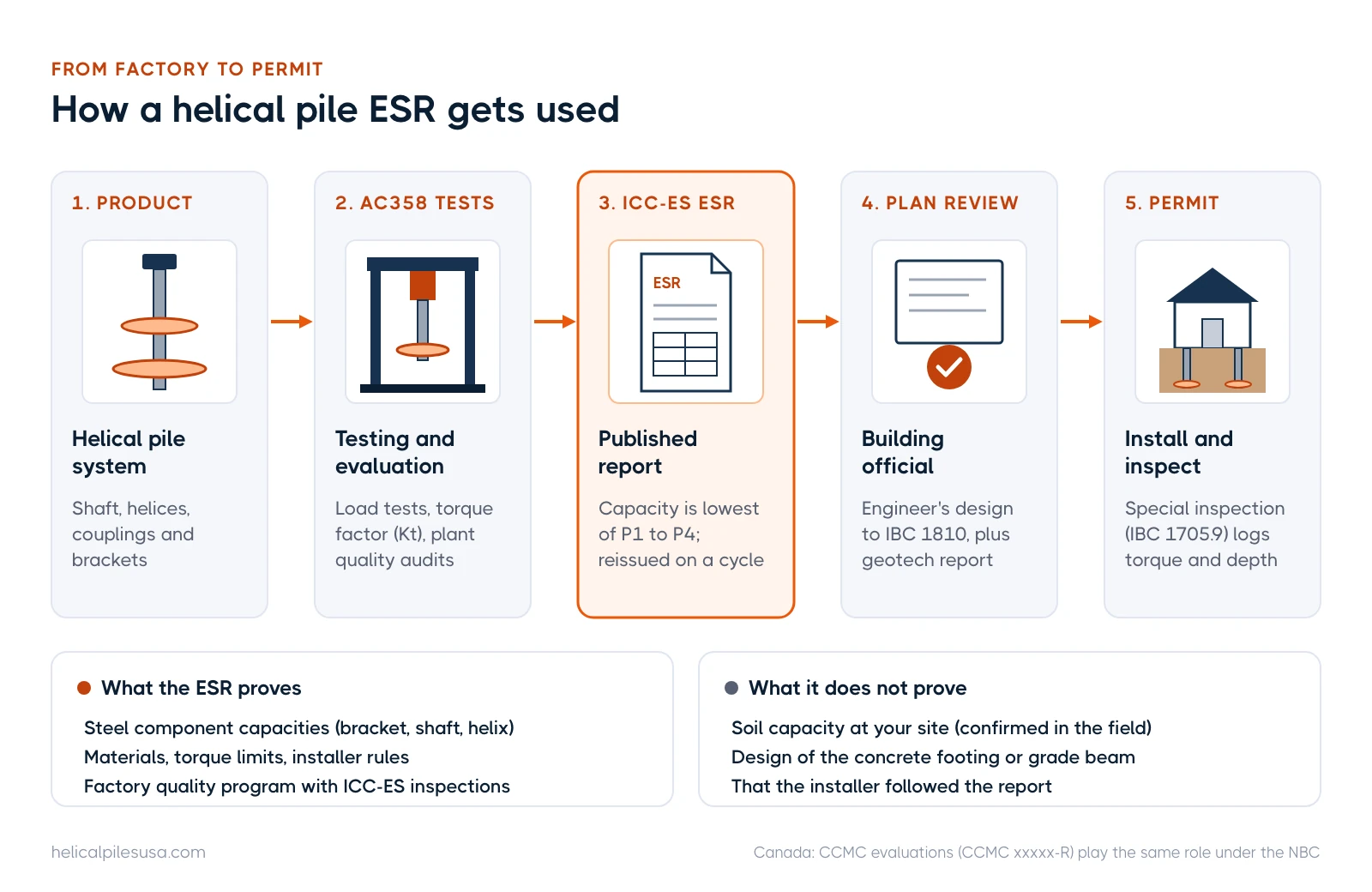
During construction, ESR-2794 requires continuous special inspection under IBC Section 1705.9. The inspector records the manufacturer and installer certification, product labels, torque, depth and compliance with the approved documents, and both minimum embedment and minimum torque must be met before installation stops.
Under the IRC, many reports allow helical piles as an alternate foundation for light-frame construction, decks, elevated walkways, stairways and accessory structures. ESR-3074 lets the installer skip a site-specific soil report for those IRC uses if soil capacity is set by the torque method with a factor of safety of 2.5 instead of 2.0. Some reports, such as ESR-4193, instead require an engineered design under IRC Section R301.1.3. Our guide to helical pile permits and building codes covers the wider permit process.
Some reports, including ESR-2794 and ESR-3726, carry City of Los Angeles, Florida or City of Chicago supplements with extra local conditions.
IAPMO UES reports: the other U.S. evaluation path
ICC-ES is not the only evaluation service. IAPMO Uniform Evaluation Service publishes evaluation reports numbered ER-xxx, and for helical piles it uses its own criteria, EC 027, written for helical foundations under the IRC. A keyword search of the IAPMO UES report list in October 2026 returned one helical pile report, ER-481 for Techno Metal Post, plus ER-289 for Supportworks push piers.
ER-481 (originally issued May 2018, revised May 2026, valid through May 31, 2027) recognizes Techno Metal Post helical foundations as alternatives to prescriptive footings for decks, residential accessory structures and new residential construction under the 2024, 2021, 2018 and 2015 IRC. It is limited mainly to Seismic Design Categories A, B and C, and lateral capacity is not evaluated. It does not replace an IBC-scope ESR on a commercial job. The manufacturer's certifications page lists ER-481, ESR-3418 and CCMC 13059-R side by side.
CCMC evaluations in Canada
In Canada, product evaluations against the National Building Code come from the Canadian Construction Materials Centre (CCMC), part of the National Research Council. Helical and screw piles are evaluated as "auger-installed steel piles" under CCMC technical guide CCMC-TG-316615.13. The CCMC registry lists 11 active reports in that category. CCMC reports do not carry an expiry date. Instead, an assessment is active for as long as it is published in the registry, and CCMC tells users to check the registry for status and the last modified date before relying on one.
| CCMC number | Holder | Code edition | Last modified |
|---|---|---|---|
| CCMC 13059-R | Techno Metal Post | NBC 2015 | Feb 2026 |
| CCMC 13102-R | Postech | NBC 2015 | Oct 2025 |
| CCMC 13675-R | GoliathTech | NBC 2015 | Feb 2026 |
| CCMC 13691-R | Almita | NBC 2015 | Oct 2025 |
| CCMC 14122-R | Mascore | NBC 2015 | Oct 2025 |
| CCMC 14027-R | Roterra Piling | NBC 2015 | Oct 2024 |
| CCMC 14098-R | Twist Developments | NBC 2015 | Oct 2025 |
| CCMC 13608-R | Pro Post Canada | NBC 2015 | Oct 2025 |
| CCMC 13353-R | Pieux Xtreme | NBC 2015 | Oct 2025 |
| CCMC 13268-R | Geopieux (Geopile) | NBC 2010 | Oct 2025 |
| CCMC 14791-R | Nortek Helical Piles | NBC 2015 and 2020 | Apr 2025 (new) |
A CCMC technical bulletin warns that report conditions are not always followed on Canadian sites. Every project needs a professional engineer who sets pile number and spacing and seals a certificate of conformity, a manufacturer-certified installer carrying a photo card, welds to CSA W59 and corrosion protection. Where corrosion has not been assessed before installation, the bulletin requires hot-dip galvanizing at a minimum of 610 g/m2. Each pile must be labeled with the phrase "CCMC XXXXX-R". For Canadian pricing, see our screw pile cost guide for Canada.
How to read the allowable-capacity tables
AC358 reports give the allowable axial capacity of a helical pile as the lowest of four separate limits. The reports label them consistently:
- P1, bracket capacity: what the retrofit bracket or new construction cap can carry.
- P2, shaft capacity: the steel shaft and couplings in compression and tension, assuming the shaft is braced by firm soil.
- P3, helix capacity: the structural strength of each helix plate. For multi-helix leads, the plate values are added.
- P4, soil capacity: the geotechnical capacity, set by the engineer from bearing calculations or load tests, and confirmed in the field by torque.
The table below uses real values from Table 5 of the Supportworks report ESR-3074 to show how this works.
| Value from ESR-3074 Table 5 | HP288 (2-7/8 in.) | HP350 (3-1/2 in.) |
|---|---|---|
| P2 shaft, compression | 63.6 kips | 105.0 kips |
| P2 shaft, tension | 34.1 kips | 62.7 kips |
| P3 helix, per plate | 40.0 kips | 40.0 kips |
| Kt (torque correlation factor) | 9 ft-1 | 7 ft-1 |
| Maximum installation torque | 7,898 ft-lb | 17,500 ft-lb |
| P4 torque-correlated soil capacity (compression) | 35.5 kips | 61.3 kips (two or more helices) |
The P4 figure comes from the torque correlation equation Qult = Kt x T. For the HP288, 9 ft-1 times the 7,898 ft-lb torque limit gives an ultimate capacity of about 71,000 lb. Dividing by the minimum factor of safety of 2.0 gives the 35.5 kip allowable shown. For a single-helix HP288 in compression, the controlling values are 63.6 kips (shaft), 40.0 kips (helix) and 35.5 kips (torque-correlated soil), so the allowable is 35.5 kips before the bracket is checked. That is the lowest-of-four rule in action.
Two notes when reading any ESR table:
- Kt is product specific. ESR-2794 uses 10 ft-1 for the 1.5 and 1.75 in. square shafts, 9 for the 2-7/8 in. RS2875 models, 7 for the RS3500 and 5.5 for the RS4500. Never borrow a Kt from another brand. Our torque to capacity chart explains the method.
- Shaft values assume bracing. Where a pile stands in air, water or fluid soil, ESR-3074 adds 5 ft (firm soil) or 10 ft (soft soil) to the unbraced length, and the shaft capacity must be recalculated by the engineer.
Related: the helical pile design guide, shaft sizes chart, load testing and brackets and caps.
Find an installer who works to the report
Because most ESRs require manufacturer-certified installers and continuous special inspection, ask any contractor which system they install, for its report number, and for a copy of their installer certification. Then confirm the report is current on icc-es.org or the CCMC registry. You can find a helical pile installer in your state or province, compare brands in the helical pile manufacturers directory, and use our checklist on how to hire a helical pile contractor.
Frequently asked questions
What is ICC-ES AC358?
AC358 is the ICC Evaluation Service acceptance criteria for helical pile systems and devices. It defines the tests, calculations and quality documentation a manufacturer must submit to receive an ICC-ES evaluation report (ESR). The current edition is AC358(24).
How do I check if a helical pile ESR is current?
Open the report from the ICC-ES reports directory, not a copy on a contractor's site, and read the reissue and renewal dates at the top of page 1. A suspended or withdrawn report cannot support a permit.
Does an ESR mean the pile will hold my house?
No. The ESR covers the steel components. Soil capacity depends on your site and must be set by an engineer and confirmed during installation by torque or load testing.
Is an IAPMO UES report as good as an ICC-ES report?
Building officials can accept either. Check the scope: ER-481 covers IRC residential uses only, while most helical ESRs cover the IBC and IRC.
Last reviewed October 2026 by the Helical Pile USA editorial team. Found an error? Tell us.
Subscribe to our weekly email newsletter
Industry news, featured projects, new products, and installer spotlights from across the helical pile industry, delivered to your inbox.


Latest articles

Get the Helical Pile Industry Brief
New installers, manufacturer news, cost updates, and fresh guides for the U.S. and Canadian helical pile industry. Short, occasional emails. Unsubscribe any time.
