

Screw Pile Cost in Canada (2026): Price per Pile by Province
Screw pile cost in Canada: CAD $185 to $500 per deck pile, more for additions, homes and underpinning, plus extensions, mobilization, HST/GST and permits.

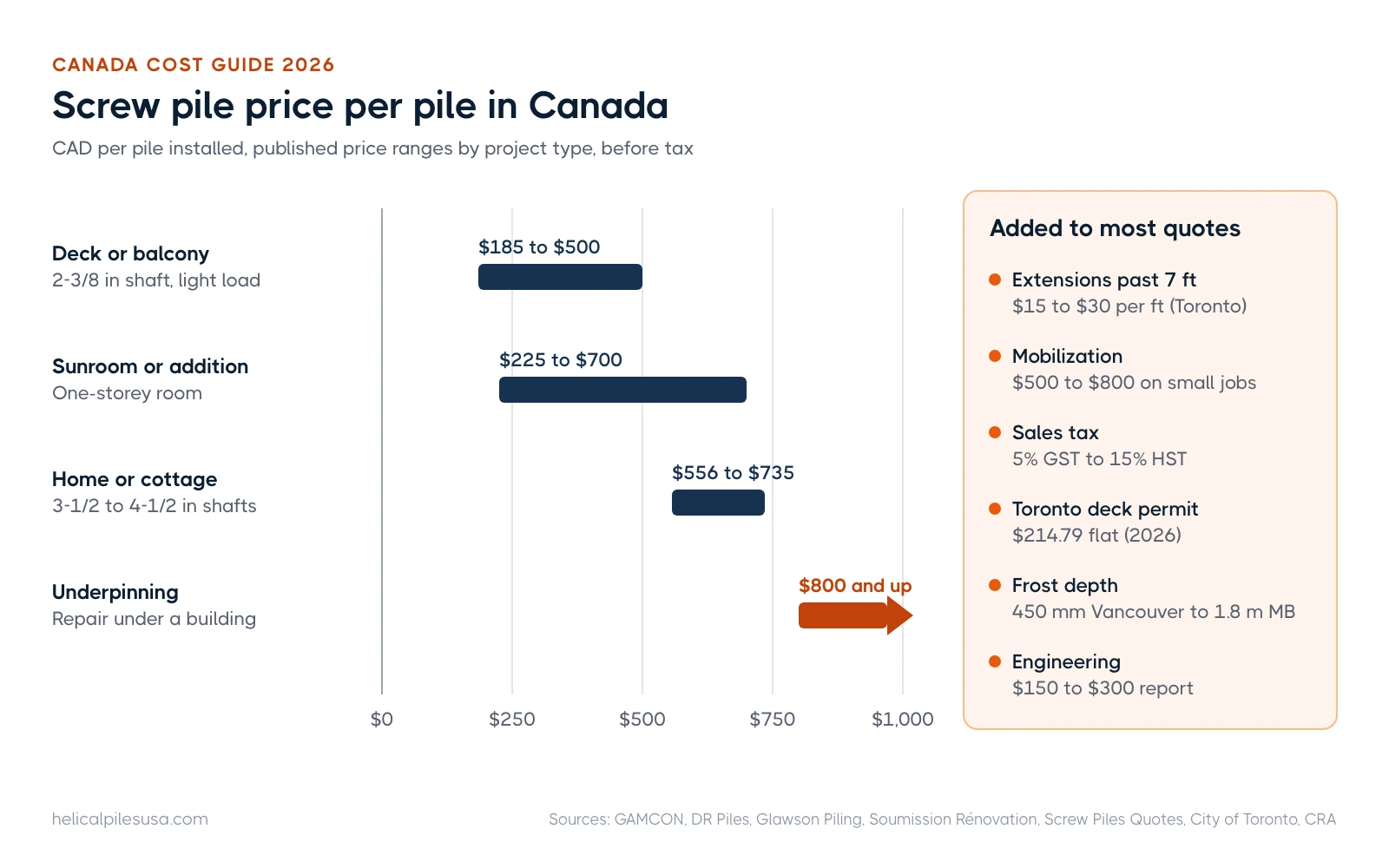
Screw piles in Canada cost about CAD $185 to $500 per pile installed for decks, $225 to $700 for sunrooms and additions, roughly $550 to $750 for the larger shafts used under homes, and $800 or more per pile for underpinning. A typical 6 to 10 pile deck comes to about $1,500 to $4,500 before tax, according to Postech. Mobilization, extensions past the standard length, engineering, permits and sales tax (5% to 15% depending on the province) are usually extra, so compare quotes line by line.
Key takeaways
- Deck piles: CAD $185 to $500 each in published Canadian prices, from Quebec balcony guides at the low end to Toronto contractors at the high end.
- Bigger loads cost more: one published price list climbs from $375 for a 2-3/8 in pile to $735 for a 4-1/2 in, 15 ft pile, supplied and installed.
- Depth is the swing factor: extensions add about $15 to $30 per foot in Toronto, or $120 to $362 per extension on a published list.
- Small jobs pay for the machine: Toronto mobilization runs $500 to $800, and some installers set a minimum pile count.
- Tax and permits: add 5% GST, 13% to 15% HST, or GST plus 9.975% QST in Quebec. Toronto's 2026 deck permit is a flat $214.79.
- Frost depth sets the minimum length: from 450 mm in Vancouver to 1.8 m in Manitoba, so the same deck needs longer piles on the Prairies than on the coast.
Screw pile cost by project type
The load on each pile decides the shaft diameter and helix size, and that drives most of the price. A deck pile carries a few thousand pounds; a pile under a house wall or an underpinning bracket carries far more and often needs excavation at the footing. Techno Metal Post puts a deck or addition pile in the range of a few hundred dollars, while a pile for a five-storey building can cost several thousand.
| Project type | Installed price per pile (CAD) | Typical pile count or project total |
|---|---|---|
| Deck, balcony or porch | $185 to $325 in Quebec (Soumission Rénovation); $300 to $500 in Toronto (GAMCON); $325 in Winnipeg (Glawson Piling) | 6 to 10 piles, $1,500 to $4,500 (Postech) |
| Sunroom or addition | $225 to $350 for a standard one-storey addition in Quebec (Soumission Rénovation); $400 to $700 in Toronto (GAMCON) | About 8 to 12 piles in Toronto (GAMCON); $9,000 to $15,000 per addition (Screw Piles Quotes) |
| Home or cottage foundation | $556 to $735 for 3-1/2 in and 4-1/2 in shafts, 10 to 15 ft (DR Piles) | $16,000 to $25,000 for a custom home (Screw Piles Quotes) |
| Underpinning or foundation repair | $800+ in Toronto (GAMCON) | 12 piles plus a TRCA permit: $10,000+ (GAMCON) |
The heavy end of the addition range shows how fast load adds up. Soumission Rénovation's addition guide prices a light pile for a three-season sunroom (2-3/8 to 3-1/2 in, 5,000 to 10,000 lb) at $150 to $225, a standard pile for a habitable one-storey room (10,000 to 25,000 lb) at $225 to $350, and a heavy pile for multi-storey work or deep clay at $350 to $500 or more. Its engineer's plans for the city add $800 to $1,500.
For underpinning, the work is closer to a foundation repair job than a deck install: crews dig to the footing, fit a bracket and transfer the load. Quebec renovation pricing for full stabilization with hydraulic piles runs $30,000 to $40,000, and partial stabilization $18,000 to $20,000 (Soumission Rénovation). For U.S. dollar figures, see our helical pier cost guide.
Screw pile prices by province
Few Canadian installers publish a rate card, so the provincial figures below mix national cost guides with the local price lists we could find. Use them to sanity-check a quote, not to replace one.
| Province | Published price per pile (CAD) | Sales tax |
|---|---|---|
| Ontario | $300 to $500 (Screw Piles Quotes); $300 to $700 typical in Toronto, $350 to $800 at GAMCON | 13% HST |
| Quebec | $300 to $500 (Screw Piles Quotes); $185 to $325 for balconies, with Techno Pieux about $250 to $325 and Pieux Goliath about $200 to $275 (Soumission Rénovation) | 5% GST plus 9.975% QST |
| Alberta | $400 to $600 (Screw Piles Quotes) | 5% GST |
| British Columbia | $400 to $600 (Screw Piles Quotes) | 5% GST |
| Manitoba | $325 for a 2-3/8 in deck pile with cap, Winnipeg, 3-pile minimum, taxes extra (Glawson Piling) | 5% GST |
| Saskatchewan | No published price found; get local quotes | 5% GST |
| New Brunswick | $350 to $550, grouped with Newfoundland and Labrador (Screw Piles Quotes) | 15% HST |
| Nova Scotia | No province-specific price found; Atlantic figure above is the closest guide | 14% HST (since April 1, 2025) |
Tax rates are from the Canada Revenue Agency GST/HST rate table; the QST rate is from Milesopedia's GST/QST calculator, which applies both taxes to the same pre-tax price for a combined 14.975%. The CRA table lists only GST and HST, so in provinces with a separate provincial sales tax, ask each installer whether the quote is tax-in or tax-out. Glawson, for example, states that its price excludes taxes.
Why the spread? Alberta and B.C. sit higher in the national guide, while Quebec's balcony market is busy and competitive at the low end. Within a province, local frost depth, soil and travel distance move the price more than the provincial average does.
Price by pile size: a published Canadian rate card
The clearest public price list we found is from DR Piles. Each price is a galvanized pile with an adjustable bracket, supplied and installed; extensions are galvanized, with hardware included. Mileage is extra.
| Shaft diameter | Pile (length, helix) | Price | Extension |
|---|---|---|---|
| 2-3/8 in | 7 ft, 12 in helix | $375 | 5 ft: $120 |
| 2-3/8 in | 10 ft, 12 in helix | $395 | |
| 2-7/8 in | 10 ft, 12 in helix | $410 | 5 ft: $140; 10 ft: $185 |
| 3-1/2 in | 10 ft, 16 in helix | $556 | 5 ft: $225 |
| 3-1/2 in | 15 ft, 16 in helix | $657 | 10 ft: $297 |
| 4-1/2 in | 10 ft, 16 in helix | $605 | 10 ft: $362 |
| 4-1/2 in | 15 ft, 16 in helix | $735 |
Most residential decks use the smallest shaft. Glawson's $325 Winnipeg pile, for example, is a 2-3/8 in shaft, 10 ft long, with a 12 in helix, rated up to 5,000 lb in typical Winnipeg soils. Our shaft sizes chart and capacity guide explain when a larger shaft is needed.
Extensions, mobilization and other line items
Most quotes are built from a per-pile price plus a handful of extras. These are the ones that change the total most:
| Line item | Published amount (CAD) | Source |
|---|---|---|
| Extensions past 7 ft | $15 to $30 per ft | GAMCON, Toronto |
| Extensions by length | $120 to $362 each (5 or 10 ft) | DR Piles |
| Mobilization | $500 to $800 on small jobs; about $800 minimum downtown | GAMCON, Toronto |
| Minimum order | 3 piles | Glawson Piling, Winnipeg |
| Adjustable head | $25 to $40 per pile | Soumission Rénovation, Quebec |
| Engineering report | $150 to $300 | GAMCON, Toronto |
| Engineer's plans for an addition | $800 to $1,500 | Soumission Rénovation, Quebec |
| TRCA permit (ravine or waterfront lots) | $240 to $535 | GAMCON, Toronto |
| Utility locates (Ontario One Call) | Free | GAMCON, Toronto |
Two points are easy to miss. First, Techno Metal Post notes that helical piles are priced per unit, not per linear foot, so a pile that reaches torque early costs the same as the quote, while soft soil means extensions on top. Second, Soumission Rénovation notes that the first pile tends to absorb the travel cost, so each added pile is cheaper. Folding a deck, steps and a shed pad into one visit spreads mobilization across more piles.
Frost depth by province and why it changes pile length
A screw pile's helix has to sit below the depth where the soil freezes, or frozen ground can grip the shaft and lift it each winter. The National Research Council's Canadian Building Digest 182 explains that frost heave needs three things at once: frost-susceptible soil, enough water, and freezing temperatures, with water drawn up to the freezing zone to form ice layers. Deeper frost means a longer pile, and once the design depth passes the standard lead section, extensions start to appear on the invoice.
| Location | Published frost or footing depth | Source |
|---|---|---|
| Vancouver, B.C. | Frost penetration no less than 450 mm | Vancouver Building By-law 2019, Div. B, 1.1.3.2 |
| Toronto, Ont. | Minimum pile depth 1.2 m | GAMCON |
| Alberta (deck guidance) | Foundation at least 1.2 m (4 ft) below grade | Alberta Municipal Affairs deck safety tips |
| Calgary, Alta. | Frost line 6 to 8 ft below grade, per one local installer | Downforce Piling |
| Manitoba (Red River district) | 1.8 m (6 ft) frost penetration for decks over 1,300 mm high or attached | Red River Planning District deck booklet |
| Quebec | Generally 1.2 to 1.8 m by region; often 4.5 to 5 ft in southern Quebec | Soumission Rénovation |
| Halifax, N.S. | Footings 1.2 m (4 ft) minimum for frost protection | Halifax deck permit guidance |
The effect on price is direct. A standard 7 ft lead easily clears Vancouver's 450 mm, so on the coast the bearing soil, not frost, usually sets the length. In Manitoba the 1.8 m frost line uses most of that 7 ft before the helix even reaches firm ground, so longer piles or extensions are common. The Red River booklet also allows "ground screws" only if the anchor reaches below frost depth and is approved by an engineer, and Halifax lists engineered screw piles among accepted deck footings. In Saskatoon, the city's deck project guide requires every screw pile to be designed by an engineer, which adds a fee to small jobs. Our guide to helical piles and frost heave covers the uplift check, and how deep helical piles go covers torque and depth.
Permits and the Toronto deck permit fee
The pile itself rarely needs its own permit, but the deck, sunroom or addition it supports usually does. The City of Toronto's building permit fee schedule sets a flat $214.79 for residential decks, porches and carports, effective January 1, 2026, which is also the city's minimum fee for any work. That is up from the $206.53 2025 fee quoted on GAMCON's cost page. Toronto's deck and porch guide asks for footing size, spacing, depth and frost protection details on the drawings, and notes that some detached decks may not need a permit.
Other cities set their own triggers. Saskatoon requires a permit for any deck higher than 200 mm above ground, among other conditions, and the Red River district in Manitoba requires one for nearly any deck. Many manufacturers can supply load documentation for the application; Techno Metal Post offers permit documentation for a small fee. See helical pile permits and building codes for the code side.
Winter installation
Screw piles are one of the few foundations that go in through a Canadian winter without a price jump for heating or curing. Postech says installation is not weather-dependent and can be done year-round, because the piles are driven below the frost line and surface frost does not stop the work. Soumission Rénovation notes that hydraulic machines can break through the frozen surface layer, and PierTech says there is no need to heat the ground except for very light structures. Concrete footings, by contrast, need to cure, and poured concrete in cold weather needs protection.
None of the Canadian price lists we reviewed shows a winter surcharge, but snow clearing and access to the site can add labour, so ask. Winter can also help on price and timing: spring and summer are peak season, and both Soumission Rénovation and RenoQuotes suggest late fall or early spring for better availability.
Worked examples (CAD)
12 x 16 ft deck in Toronto
GAMCON estimates 5 to 6 piles for a 12 x 16 ft deck. Using 6 piles at $300 to $500 ($1,800 to $3,000) plus $500 to $800 mobilization gives $2,300 to $3,800. Adding 13% HST brings that to $2,599 to $4,294, and the $214.79 permit makes the total about $2,814 to $4,509. GAMCON's own example for a small downtown deck with 6 piles is $2,100 to $3,000.
8-pile deck in Winnipeg
At Glawson's $325 per pile, 8 piles cost $2,600. With 5% GST the total is $2,730, before any permit, travel outside the city or extensions for soft clay.
One-storey addition in Quebec
Soumission Rénovation estimates 6 to 8 structural piles for a 12 x 16 ft addition. At $225 to $350 per pile that is $1,350 to $2,800, plus $800 to $1,500 for the engineer's plans, or $2,150 to $4,300. With 5% GST and 9.975% QST the total is about $2,472 to $4,944.
To run your own numbers, try the helical pile cost calculator or the other free planning tools.
How to get accurate screw pile quotes
- Ask for the pile spec: shaft diameter, helix size, lead length and target torque, so quotes compare like for like (see our screw piles guide).
- Get the extras in writing: the extension rate per foot or per section, mobilization, mileage, minimum pile count, engineering and permits.
- Ask for installation records: RenoQuotes recommends asking for torque reports, certificates or capacity documents for each pile.
- Check credentials: confirm the installer's licence and insurance for your province; in Quebec, foundation and pile work requires an RBQ licence (Soumission Rénovation).
- Confirm tax: ask whether the price includes GST, HST or QST.
- Bundle or share the visit: RenoQuotes suggests coordinating with a neighbour to split mobilization.
Start with installers near you: find a screw pile installer in your province, then use our checklist on how to hire a helical pile contractor. For deck layouts and pile counts, see helical piles for decks.
Frequently asked questions
How much does a screw pile cost in Canada?
Most published prices fall between CAD $185 and $500 per pile installed for decks and $225 to $700 for additions. Larger shafts for homes run about $550 to $750, and underpinning piles start around $800.
How much do screw piles for a deck cost?
Postech puts a standard deck of 6 to 10 piles at $1,500 to $4,500 installed. Small jobs may also carry a mobilization fee of $500 to $800 in Toronto.
Are screw piles cheaper than concrete footings?
For a small deck, the sticker price can be close. Soumission Rénovation compares about $650 plus two days of work for four DIY concrete supports with about $900 for four installed screw piles, which need no digging or curing.
Do screw pile prices include HST or GST?
Often not. Glawson states its price excludes taxes, and GAMCON lists 13% HST as a separate line in Ontario, so confirm before you compare.
Can screw piles be installed in winter?
Yes. Postech says installation can be done year-round through surface frost, and the Canadian price lists we reviewed show no winter surcharge.
How deep do screw piles go in Canada?
At least below the local frost depth, which ranges from 450 mm in Vancouver to 1.8 m in Manitoba, and deeper until the pile reaches its design torque in firm soil.
Last reviewed October 2026 by the Helical Pile USA editorial team. Found an error? Tell us.
Subscribe to our weekly email newsletter
Industry news, featured projects, new products, and installer spotlights from across the helical pile industry, delivered to your inbox.


Latest articles


Get the Helical Pile Industry Brief
New installers, manufacturer news, cost updates, and fresh guides for the U.S. and Canadian helical pile industry. Short, occasional emails. Unsubscribe any time.
