

Pylex Helical Piles: Specs, Prices, Ratings and Limits
Pylex helical piles explained: specs, Lowe's and Home Depot prices, load ratings, install steps, permit acceptance and when to use an engineered pile.

Pylex helical piles are short, hand-installed steel screw piles for decks, porches and sheds that replace a dug and poured concrete footing. The best-known model, the 50 in. Adjustable Pylex, has a 1-1/4 in. tube and a 6 in. helix, sits about 42 in. below grade, and is rated by its maker for up to 5,000 lb in sandy soil and 3,500 lb in clay. It costs under $50 at Lowe's. These retail screw piles work well for light, low structures, but they are not engineered helical piles, and the published ratings are not a substitute for a torque-verified, code-evaluated foundation.
Key takeaways
- What it is: A 32 in. or 50 in. steel screw pile with a 6 in. helix and an adjustable U-shaped saddle for a 4x4 post, made by Pylex of Shawinigan, Quebec.
- Published rating: Up to 5,000 lb in sandy soil and 3,500 lb in clay, for vertical load only, according to the manufacturer.
- Price: $48.33 for the 50 in. model and $44.41 for the 32 in. model at Lowe's (checked October 1, 2026).
- Installation: Turned in by hand with a 2x4 lever or with an optional impact-wrench adapter, with soil firmness checked by sledgehammer rather than by measured torque.
- Permits: We could not find an ICC-ES evaluation report or a CCMC evaluation for Pylex piles, so ask your building department before you buy for a permitted deck.
- When to step up: Attached or raised decks, roofed structures, additions, poor soil and any job that needs an engineer's sign-off call for an engineered helical pile from a trained installer.
What Pylex screw piles are
Pylex is a Quebec company that started making its "foundation screw" in 1997 and now sells a wider range of deck and backyard hardware. Its adjustable helical pile is a black, powder-coated steel tube with a single welded helix at the bottom and a U-shaped saddle at the top that holds a 4x4 post. A threaded rod under the saddle gives about 3 in. of height adjustment for leveling. The product comes in two lengths, and the same model numbers are sold at Lowe's and Home Depot.
Published specifications
The figures below come from the Pylex product page, the 50 in. technical data sheet and the Commercial Pylex 66 page.
| Model | Item # | Shaft | Helix | Post | Rated capacity (maker) |
|---|---|---|---|---|---|
| Adjustable Pylex 50 in. | 10555 | 1-1/4 in. tube, about 1/8 in. wall | 6 in. | 4x4 | 5,000 lb sand, 3,500 lb clay |
| Adjustable Pylex 32 in. | 10565 | 1-1/4 in. tube | 6 in. | 4x4 | 5,000 lb sand, 3,500 lb clay |
| Commercial Pylex 66 | 10730 | 1-1/4 in. tube, about 1/8 in. wall | 6 in. | 6x6 | 5,000 lb; 4,781 lb uplift; 1,641 lb side thrust |
Accessories include a 24 in. extension (item 10571) for reaching firmer soil, a lateral stabilizer (item 10575) for decks that move sideways, and installation adapters in 1/2, 3/4 and 1 in. drive sizes. A 6x6 post can sit on the standard pile with a separate Pylex adjustable patio support.
Prices at Lowe's, Home Depot and from Pylex
Retail screw piles are cheap compared with installed foundations. On October 1, 2026, a Lowe's search for "helical pile" returned three Pylex items: the 50 in. pile at $48.33, the 32 in. pile at $44.41 and the 1 in. socket installation adapter at $104.98. On its own Canadian store, Pylex lists the 50 in. pile at CAD $51.99, the 32 in. at CAD $44.99, and the extension and stabilizer at CAD $19.99 each. The heavier Commercial Pylex 66 lists at CAD $106.99. Retail prices change often, so check the shelf price before you plan a budget.
Home Depot carries the same Pylex model numbers in the U.S. and Canada. Home Depot Canada also sells a heavier option from Groundhog Anchor and Support System: its Model #812 is 8 ft long with a 12 in. helix and a stated safe load of 5,000 lb, which the listing defines as one-third of the failure load in medium to stiff soil. It is turned in with a manual wrench, and the listing says professional installation can be arranged through the store.
For context, HomeGuide puts DIY helical posts at $45 to $50 or more each, professionally installed helical piers for a new deck at $300 to $500 each, and foundation repair piers at $2,000 to $4,000 each.
How Pylex piles are installed
The Pylex installation guide describes a manual process that one or two people can do without digging:
- Remove the adjustable head, push the tip into the ground with a sharp blow and turn it by hand until the helix is buried. A 1/2 in. rebar rod can be driven first to find rocks and act as a pilot.
- Slide an 8 ft 2x4 through the U-shaped bracket and walk it around in a circle to screw the pile down.
- When the bracket is about 12 in. above grade, strike it 3 or 4 times with a sledgehammer. If the pile does not sink easily, the soil is firm. Keep turning until the bracket is 4 in. (sandy soil) to 6 in. (clay) above grade and test again.
- Thread the leveling nut back on, set the post in the saddle, fasten it with wood screws and adjust the height. Leave at least 3 in. of threaded rod inside the tube.
If the pile sinks too easily, the guide recommends the 24 in. extension, and it suggests stabilizers to control sideways movement on a patio. With the optional adapter and a high-torque impact wrench, Pylex says a pile goes in in under 2 minutes.
What the ratings mean, and their limits
The 5,000 lb and 3,500 lb figures are the manufacturer's own ratings, and the guide says capacity depends on soil composition. Read the fine print before you design around them:
- Vertical load: The adjustable pile is listed for vertical load. Pylex states it should not be used for fences, which put sideways and pull-out forces on a post.
- Spacing: The guide recommends no more than 8 ft center to center. The product page tightens that to one pile every 4 ft under load-bearing walls with a roof.
- No measured capacity: The sledgehammer test tells you the soil is firm, not how much a given pile will carry. There is no torque reading, so there is no record to show an inspector.
- Corrosion: The finish is baked powder coat, not hot-dip galvanizing. The guide warns that de-icing salt or a saltwater pool system nearby can greatly shorten the life of the steel.
- Soil: Rock, cobbles, loose fill and soft clay can stop a hand-turned pile short or leave it in weak soil. Our guide to how deep helical piles go explains why depth matters.
Permits and code acceptance
This is where retail screw piles and engineered helical piles differ the most. The Pylex catalog says the product meets Canadian and American building code specifications, and the installation guide tells buyers to comply with local building codes. We searched for an ICC-ES evaluation report and a CCMC evaluation covering Pylex piles and did not find one. That does not mean a building department will reject them, but it does mean the inspector has no third-party report to rely on.
Engineered piles are usually accepted through those reports. In the U.S., ICC-ES evaluates helical systems under acceptance criteria AC358, which requires a factor of safety of at least 2 when capacity is estimated from installation torque. In Canada, the CCMC technical bulletin on auger-installed steel piles describes evaluated piles that carry a "CCMC XXXXX-R" label, installers certified by the manufacturer, and a signed and sealed engineer's certificate for the installation and allowable loads. For a freestanding, ground-level deck or a shed, some jurisdictions do not require a permit at all. For an attached or raised deck, call the building department first and ask what documentation it wants. Our guide to helical pile permits and building codes covers the usual requirements.
Retail screw pile vs engineered helical pile
Engineered helical piles are installed with a hydraulic drive head, and capacity is checked as they go in. Foundation Supportworks explains the torque correlation method: ultimate capacity equals a factor (Kt) times final installation torque, with AC358 default Kt values of 10 ft-1 for 1.5 to 1.75 in. square shafts and 9 ft-1 for 2.875 in. round shafts. A 2.875 in. pile that finishes at 4,000 ft-lb therefore has an ultimate capacity of about 36,000 lb, or about 18,000 lb allowable with a factor of safety of 2. Torque is read from pressure gauges or an electronic transducer and logged for each pile.
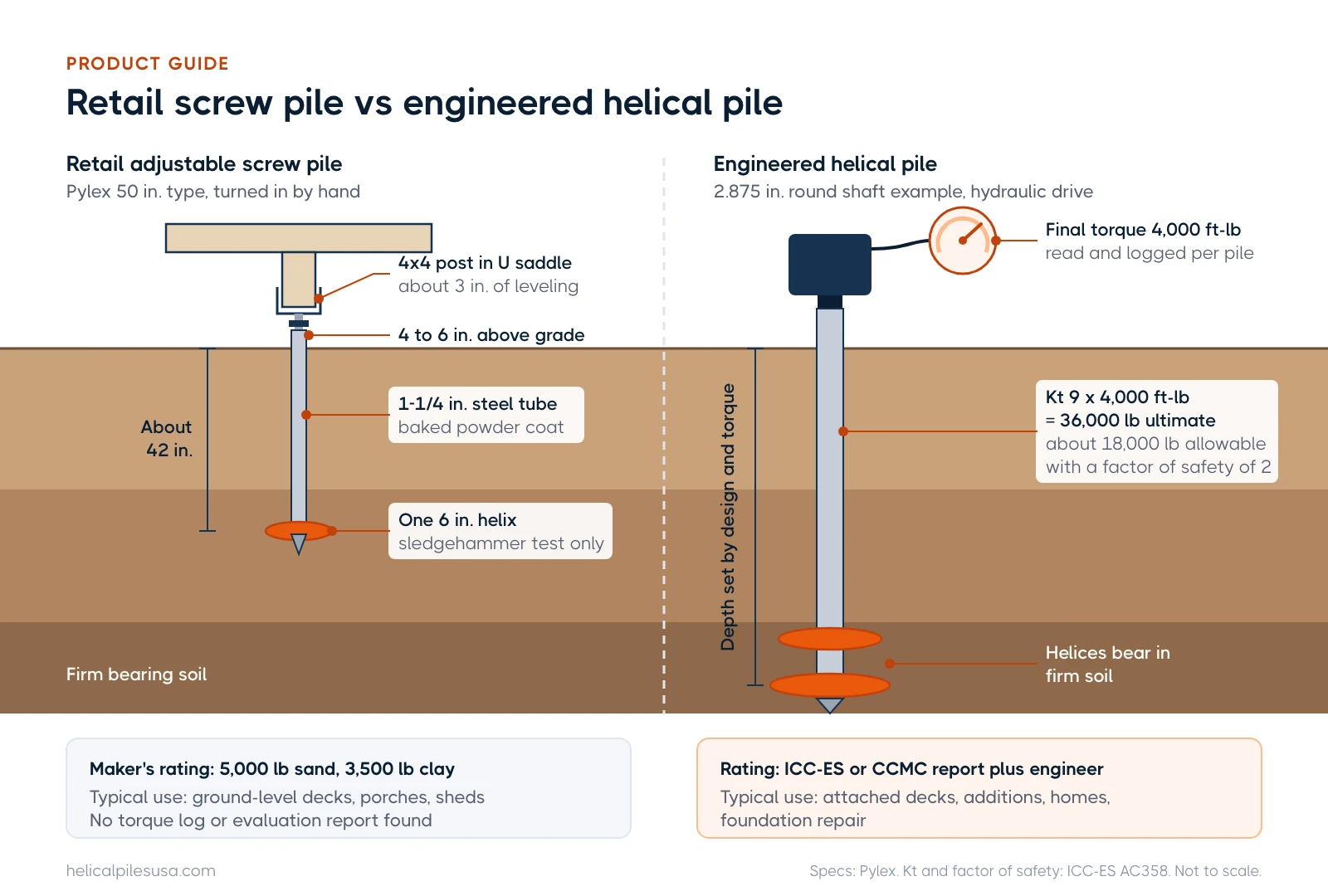
| Factor | Retail screw pile (Pylex type) | Engineered helical pile |
|---|---|---|
| Typical use | Ground-level decks, porches, sheds, light patio structures | Attached and raised decks, additions, homes, foundation repair, commercial work |
| Shaft and helix | 1-1/4 in. tube, one 6 in. helix | Shaft and helix sizes chosen by the designer, often 1.5 in. square or 2.875 in. round and up |
| Depth | About 42 in. below grade, or 24 in. more with an extension | Driven until the required torque is reached, with depth set by the design |
| Installation | By hand with a 2x4 lever or an impact wrench adapter | Hydraulic drive head on an excavator, skid steer or portable unit |
| Capacity check | Sledgehammer test for firm soil | Torque logged per pile and converted to capacity with Kt |
| Rating source | Manufacturer's published figure | ICC-ES or CCMC evaluation plus the engineer of record |
| Corrosion protection | Baked powder coat | Often hot-dip galvanized (required under the CCMC bulletin when soil corrosivity is not assessed) |
| Cost | About $44 to $49 per pile at Lowe's, plus your labor | About $300 to $500 per pile installed for a new deck (HomeGuide) |
When to step up to an engineered helical pile
A retail screw pile can be a sensible choice for a small, low, freestanding deck or a garden shed where a little settlement would be an annoyance, not a hazard. Choose an engineered pile and a trained installer when:
- The deck is attached to the house, raised well above grade, or carries a hot tub, roof or snow load.
- The building department wants stamped drawings, an evaluation report or an installation log.
- The soil is soft clay, loose fill, wet or full of rock.
- The structure needs uplift or lateral resistance, for example on a slope or in a high-wind area.
- You are supporting part of a house or repairing a settled foundation.
Our guides to DIY helical piles, helical piles for decks and helical piers for sale go deeper on each path. For pricing on professional work, see the helical pier cost guide.
Find an installer
If your project needs a documented foundation, find a helical pile installer in your state or province. Ask each contractor which product they install, for its ICC-ES or CCMC report number, and whether they provide a torque log for every pile. Our checklist on how to hire a helical pile contractor lists more questions to ask.
Frequently asked questions
How much weight can a Pylex helical pile hold?
Pylex rates its adjustable piles for up to 5,000 lb in sandy soil and 3,500 lb in clay, for vertical load. Actual capacity depends on the soil, and the rating is the maker's figure rather than a third-party evaluation.
Are Pylex screw piles approved by building code?
Pylex says the product meets Canadian and American building code specifications, but we could not find an ICC-ES or CCMC evaluation report for it. Acceptance is up to your local building department, so ask before you buy for a permitted project.
Can I use Pylex piles for a fence?
No. Pylex states that its adjustable helical pile should not be used for fencing.
How much do helical piles cost at Home Depot or Lowe's?
Lowe's listed the Pylex 50 in. pile at $48.33 and the 32 in. pile at $44.41 on October 1, 2026, and Home Depot carries the same models. Professionally installed deck piles cost about $300 to $500 each according to HomeGuide.
Do I need special tools to install a Pylex pile?
No. The installation guide uses an 8 ft 2x4 as a lever and a sledgehammer to check soil firmness. An optional adapter lets you drive it with a high-torque impact wrench.
Can a Pylex pile support a house addition or foundation repair?
Pylex markets the adjustable pile for decks, porches and sheds. Additions and foundation repair need engineered helical piles sized by a design professional and installed with torque monitoring.
Subscribe to our weekly email newsletter
Industry news, featured projects, new products, and installer spotlights from across the helical pile industry, delivered to your inbox.


Latest articles

Get the Helical Pile Industry Brief
New installers, manufacturer news, cost updates, and fresh guides for the U.S. and Canadian helical pile industry. Short, occasional emails. Unsubscribe any time.
