

Helical Piles and Frost Heave: Frost Depth, Adfreeze and Winter
How helical piles resist frost heave and adfreeze uplift: sourced frost depths by region, embedment below the frost line, winter installs and permafrost.
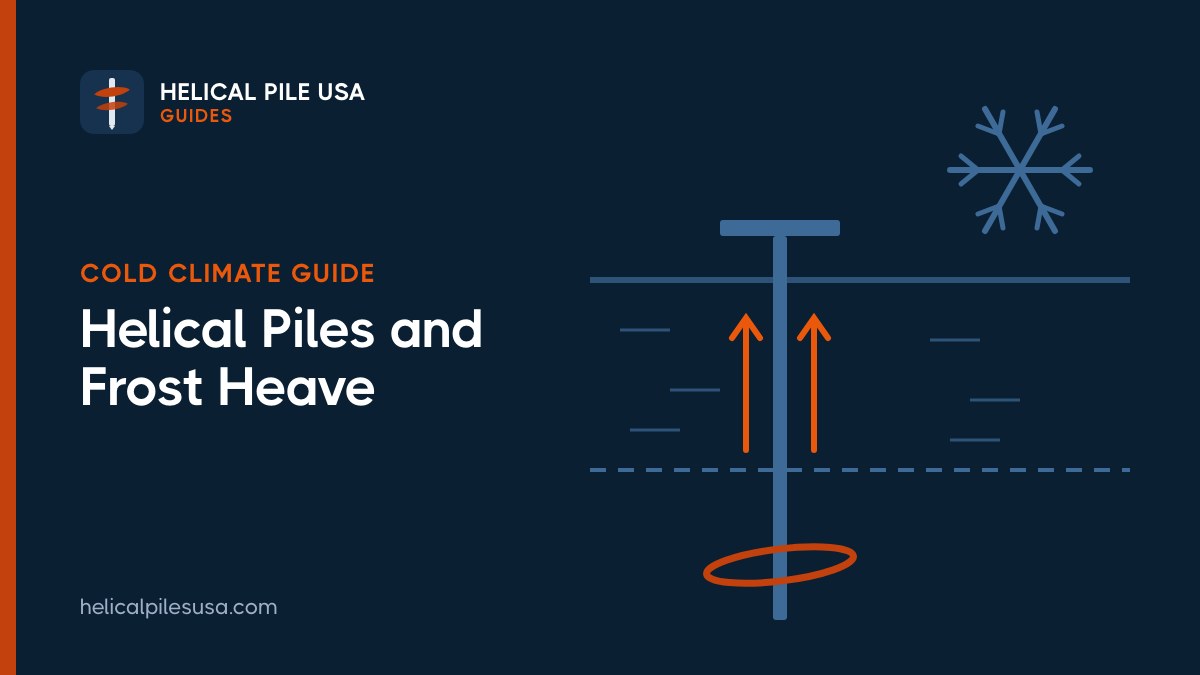

Helical piles resist frost heave because their helix plates sit in unfrozen soil below the frost line, where they act as anchors against the upward pull of freezing ground on the shaft. That pull, called adfreeze uplift, can reach several thousand pounds on a single small-diameter pile, so the helix must be placed below the maximum frost depth plus at least one helix diameter and checked against the uplift. Get the depth and the uplift check right and a helical pile will stay put through winters that jack concrete footings out of the ground.
Key takeaways
- The mechanism: freezing soil bonds to the pile shaft (adfreeze) and lifts it as ice lenses grow. Lightly loaded structures such as decks, fences, signs and solar racking are the most exposed.
- The rule: put the helices below maximum frost penetration plus at least one helix diameter, according to frost-heave guidance from CHANCE by Alan Lutenegger.
- Frost depth is local: codes set it by state, county or city. Minnesota uses 5 ft or 3.5 ft by county, Wisconsin uses at least 48 in, and Winnipeg uses 1.8 m for taller decks.
- Uplift is real: measured adfreeze on steel piles ranges from about 1,000 to 8,200 psf, and the Canadian Foundation Manual design value cited for steel in fine-grained soil is 2,100 psf.
- Winter installs work: there is no concrete to cure, and crews in Alaska installed helical piles through a frozen surface layer and permafrost after Typhoon Halong.
- Permafrost is different: the goal there is to keep the ground frozen, use adjustable connections and get an engineered design.
How frost heave and adfreeze uplift act on piles
Frost heave is not mainly water expanding as it freezes. The National Research Council of Canada's Canadian Building Digest 182 identifies ice segregation as the basic mechanism: water is drawn up to the freezing front and builds layers of ice (ice lenses) that push the soil apart. Three conditions must all be present: frost-susceptible soil (silts, clays and very fine sands), enough water, and freezing temperatures. Remove any one and heave stops. It reports heaving pressures as high as 19 tons per square foot (1,820 kPa).
A pile meets this force in two ways. Anything wide inside the frozen zone (a mushroomed concrete top or a helix plate) is pushed up directly. And through adfreeze, the frozen soil bonds to the shaft and drags it upward as the layer lifts. NRC's Canadian Building Digest 128 gives the simple estimate used ever since: uplift equals frost depth times the shaft perimeter times the adfreeze strength.
The numbers are larger than most people expect. In the NRC tests, 3.5 in steel posts in clay developed a maximum heave force of about 6,000 lb with 3.5 ft of frost penetration, which works out to an average adfreeze strength of about 12.5 psi. The digest suggested 18 psi as a conservative design value. CHANCE reports measured adfreeze on steel pipe piles from about 1,000 to 8,200 psf (48 to 390 kPa), and it notes that heave often accumulates over several seasons, with each winter lifting the pile a little further.
Why a helix below the frost line resists uplift
A helical pile handles frost the way a tension anchor handles a pull. Once the helix sits in soil that never freezes, the adfreeze force on the upper shaft has to lift the helix and the block of unfrozen soil above it, plus overcome side friction along the shaft below the frost line. The CHANCE frost-heave article by Dr. Alan Lutenegger, P.E., sets out the design check: the factor of safety against heave is the uplift resistance below the frost zone divided by the adfreeze force inside it, and it should be at least 1.0 with no help from the structure's dead load.

That article is useful because it shows the check failing. Its worked example is a single-helix pile with a 2.875 in shaft and a 12 in helix, installed 14 ft into soft Ottawa clay, with 5 ft of frost and an adfreeze stress of 2,100 psf. The adfreeze force on the shaft comes to 7,903 lb. The resistance is 3,251 lb of shaft friction plus 3,998 lb from the helix, or 7,250 lb. The factor of safety is 0.92, so the pile would creep upward. The fixes are a larger helix, a second helix below the frost depth or more embedment.
Field results: helical pile vs drilled pier
In one winter of field testing at Hadley, Massachusetts, with an estimated frost depth of about 3 ft, a larger helical pile heaved about 0.2 in (5 mm) while a drilled concrete pier heaved about 1.4 in (36 mm), according to the same CHANCE article. At 5 ft of embedment, the helical pile also performed somewhat better than a plain steel pipe pile, because the helix added anchorage the smooth pipe lacked.
Frost-related design factors
| Factor | Why it matters | Sourced reference value |
|---|---|---|
| Design frost depth | Sets the length of shaft gripped by frozen soil and the minimum helix depth | Local code value; frost can reach about 6 ft in northern latitudes (CHANCE) |
| Adfreeze strength | Uplift per square foot of shaft surface in the frozen zone | 2,100 psf (100 kPa) for steel in fine-grained and silty soils, cited from the Canadian Foundation Manual; measured range about 1,000 to 8,200 psf (CHANCE) |
| Shaft perimeter | Uplift grows directly with the surface area in contact with frozen soil | Uplift = frost depth x perimeter x adfreeze strength (NRC CBD 128) |
| Helix depth below frost | A helix in frozen soil is lifted, not anchored | Below maximum frost penetration plus at least one helix diameter (CHANCE) |
| Soil frost susceptibility | Silts, clays and very fine sands grow ice lenses; clean sands and gravels generally do not | Three conditions: susceptible soil, water, freezing (NRC CBD 182) |
| Downward load on the pile | Dead load works against uplift, but decks and fences carry very little | CHANCE checks the factor of safety ignoring dead load, so the anchor alone must hold |
| Freezing severity | Colder, longer winters drive frost deeper | Frost depth estimate DF = 4.8 x square root of freezing degree-days, DF in cm (Soliman et al., cited by CHANCE) |
Frost depth: typical design values by region
There is no single national frost depth. The International Residential Code's frost protection section (R403.1.4.1) points to the frost line depth in Table R301.2(1), and each jurisdiction fills in that table with its own number; Anchorage, for example, amends R403.1.4.1 to point to its own local table instead (AMC 23.85). The values below come from the code documents linked in each row. Confirm the number your building department enforces today.
| Jurisdiction | Design frost or minimum footing depth | Notes |
|---|---|---|
| Minnesota, Zone I (34 counties, including St. Louis and Otter Tail) | 5 ft | Applies unless an engineer competent in soil mechanics shows a lesser depth works (Minn. R. 1303.1600) |
| Minnesota, Zone II (53 counties) | 3.5 ft | Includes Hennepin, Ramsey and Olmsted counties (Minn. R. 1303.1600) |
| Wisconsin (one- and two-family dwellings) | 48 in or the frost penetration level, whichever is deeper | Footings may not be placed on frozen material (Wis. Admin. Code SPS 321.16) |
| Fairbanks, Alaska | 42 in to the bottom of the footing | Unless a stamped engineer's design is submitted (City of Fairbanks) |
| Anchorage, Alaska | 42 in for warm (heated) foundations; 60 in for cold perimeter footings; 120 in for cold cast-in-place piers | Cold piers in non-frost-susceptible material may be 60 in (AMC 23.85 Table R403.1) |
| Winnipeg, Manitoba (decks over 1,300 mm high) | 1.8 m (6 ft) | Screw piles allowed if they extend below frost penetration and are properly tested (City of Winnipeg deck guide) |
Note the Anchorage split: an unheated (cold) foundation gets no warmth from a basement, so its required depth is greater. Deck and porch piles are cold foundations.
How to look up your frost depth
- Call or check the website of your city or county building department and ask for the frost line depth in its adopted Table R301.2(1), or the local equivalent in Canada. That number governs your permit.
- Check for state or provincial amendments like Minnesota's county zones or Wisconsin's 48 in floor, which can override a local value.
- For design work beyond the code minimum, engineers estimate frost depth from freezing severity. NOAA's National Centers for Environmental Information publishes Air-Freezing Index maps and data for this purpose, and CHANCE recommends designing for the worst frost depth expected over the structure's life, not an average winter.
- Note site conditions that push frost deeper: snow-cleared driveways and paths, north-facing slopes, and wet, silty soil.
See how deep helical piles go for other depth drivers and our permits and building codes guide for how inspectors accept helical piles.
Minimum embedment below the frost depth
Two rules of thumb circulate, and they are not equal. The first, from the CHANCE frost-heave article, is that the helix plates must sit below the maximum frost penetration plus at least one helix diameter. For a 12 in helix and a 5 ft frost depth, that puts the top helix at 6 ft or deeper.
The second is the older rule that the pile should extend below the frost zone by a distance equal to the thickness of the frozen zone, for example 5 ft of frost and 5 ft more below it. Lutenegger points out that this only works if the side resistance in the unfrozen soil is at least as high as the adfreeze stress in the frozen soil. In soft clay it often is not, which is exactly why the Ottawa example above failed at 14 ft of embedment. Treat the helix-diameter rule as the minimum for placement and the uplift calculation as the real test.
Torque still matters, because a pile that stops in weak soil may lack anchorage. Installers log final torque to confirm capacity (see our torque to capacity chart guide), and engineers can confirm uplift with a tension test, covered in helical pile load testing.
Winter installation: frozen ground and no concrete to cure
Helical piles are one of the few foundations that can be installed and loaded in midwinter. Concrete needs unfrozen ground and protected curing time; a steel helical pile can take load once it reaches torque. Manufacturer PierTech says helical piles can be installed through frozen ground with no wait for concrete to cure, and that the ground generally does not need to be heated.
The clearest recent example is western Alaska. After Typhoon Halong struck in October 2025, more than 40 villages reported damage and storm surge displaced miles of boardwalk, which in these communities serves as the main route for people, ATVs and emergency transport. According to CHANCE's account of the Alaska DOT boardwalk rebuild:
- About 12,000 helical piles from three manufacturers were used, and Alaska DOT already had boardwalk specifications covering helical piling.
- Crews worked through blizzards and freezing rain, installing through a frozen surface layer into deeper permafrost.
- Piles were installed with mini excavators and torque was checked against the engineer's depth and torque requirements.
- Parts were light enough to fly in: one lead section with 8 in and 10 in helices weighs 57 lb (26 kg).
- Piles could be loaded at once, with no curing time.
On a winter job, ask how the crew will get through the frozen crust (some pre-drill a pilot hole) and confirm torque is still logged for every pile. Capacity should never depend on frozen soil, since that strength is lost at thaw. Our installation process guide walks through a normal install day.
Helical piles in permafrost
Permafrost is ground that stays frozen for two or more years. The layer above it that freezes and thaws each year is the active layer. The State of Alaska's Foundations for Building on Permafrost guide sets out the two goals for any foundation there: keep the permafrost frozen, and avoid exceeding the soil's bearing capacity.
Here the deep frozen ground is an asset, and the active layer above it is what heaves. The Alaska guide recommends:
- An open air gap under the building so cold winter air circulates and keeps the ground frozen.
- Adjustable jacks or brackets on top of piles so differential movement can be corrected.
- Diverting runoff away from the foundation, since water drives thaw and heave.
- Avoiding ice wedges, or lengthening the pile where one cannot be avoided.
- Installing adfreeze piles at ground temperatures below 25 F, with an engineer designing the pile.
Permafrost projects need a geotechnical engineer with northern experience. No prescriptive rule of thumb covers them.
Decks and porches in cold climates
Decks heave because they are light: a deck post carries little dead load, so almost nothing holds the footing down when adfreeze grabs it. A helical pile gives a deck the anchorage its own weight cannot.
- Treat deck piles as cold foundations. No heated basement warms the soil beside them, so use the full local frost depth for an unheated footing.
- Use a slender shaft through the frost zone. Uplift scales with shaft perimeter, so a 2.875 in shaft attracts far less adfreeze than a wide concrete pier, a point NRC also makes about slender columns.
- Keep the helix out of the frozen zone. A helix that sits in frozen soil is pushed up by it.
Layout, spacing and cost for decks are in our helical piles for decks guide. Ground-mounted solar has the same light-load problem, covered in helical piles for solar.
Signs of a heaved pile and how it is fixed
Frost-jacked piles usually show up in late winter or spring:
- A deck, porch or stair that is higher at one post than the others, or out of level in spring and closer to level by late summer.
- Gaps between a post and its bracket, or a beam lifted off its post.
- Movement that gets worse each year.
The fix depends on why the pile moved. The usual causes are a helix that sits within the frozen zone, too little anchorage below it, or a cap and bracket set directly on frost-susceptible soil. A contractor will check the installation record (depth and final torque) and, if it is missing, assume the pile is short. Typical repairs:
- Extend and re-drive: unbolt the cap, add an extension and advance the pile until the helix is well below frost depth and reaches its target torque.
- Add anchorage: install a replacement pile with a larger or second helix below the frost line, the remedies the Lutenegger example points to.
- Relevel: lower or shim the post through an adjustable bracket once the pile is stable.
- Deal with water: regrade so water drains away from the piles. NRC CBD 128 also describes free-draining granular backfill and insulation as frost-control options, though CHANCE considers sleeves, bond breakers and gravel backfill around piles not cost-effective and sometimes counterproductive. Depth and anchorage are the dependable fix.
If a structure is heaving and you are not sure why, a local installer can read the torque logs and check embedment. Find a helical pile installer in your state or province, and use our contractor hiring checklist to ask how they size piles for frost.
Frequently asked questions
Do helical piles prevent frost heave?
They do not stop the ground from heaving, but a correctly designed pile resists being lifted. The helix sits in unfrozen soil below the frost line and anchors the pile against the adfreeze pull on its shaft.
How far below the frost line should a helical pile go?
The helix should sit below the maximum frost depth plus at least one helix diameter, according to CHANCE. The pile then needs enough uplift capacity below the frost zone to exceed the adfreeze force, which an engineer can check.
Can helical piles be installed in winter?
Yes. There is no concrete to cure, piles can carry load as soon as they reach torque, and crews in Alaska installed them through frozen ground and into permafrost after Typhoon Halong.
Are screw piles good for permafrost?
Yes, as the Alaska boardwalk rebuild shows, but permafrost needs an engineered design that keeps the ground frozen and allows adjustment.
What is the frost depth where I live?
Ask your local building department for the frost line depth in its adopted code. Published values range from 3.5 ft in Minnesota's Zone II to 1.8 m in Winnipeg and 120 in for cold piers in Anchorage.
Last reviewed October 2026 by the Helical Pile USA editorial team. Found an error? Tell us.
Subscribe to our weekly email newsletter
Industry news, featured projects, new products, and installer spotlights from across the helical pile industry, delivered to your inbox.


Latest articles


Get the Helical Pile Industry Brief
New installers, manufacturer news, cost updates, and fresh guides for the U.S. and Canadian helical pile industry. Short, occasional emails. Unsubscribe any time.
